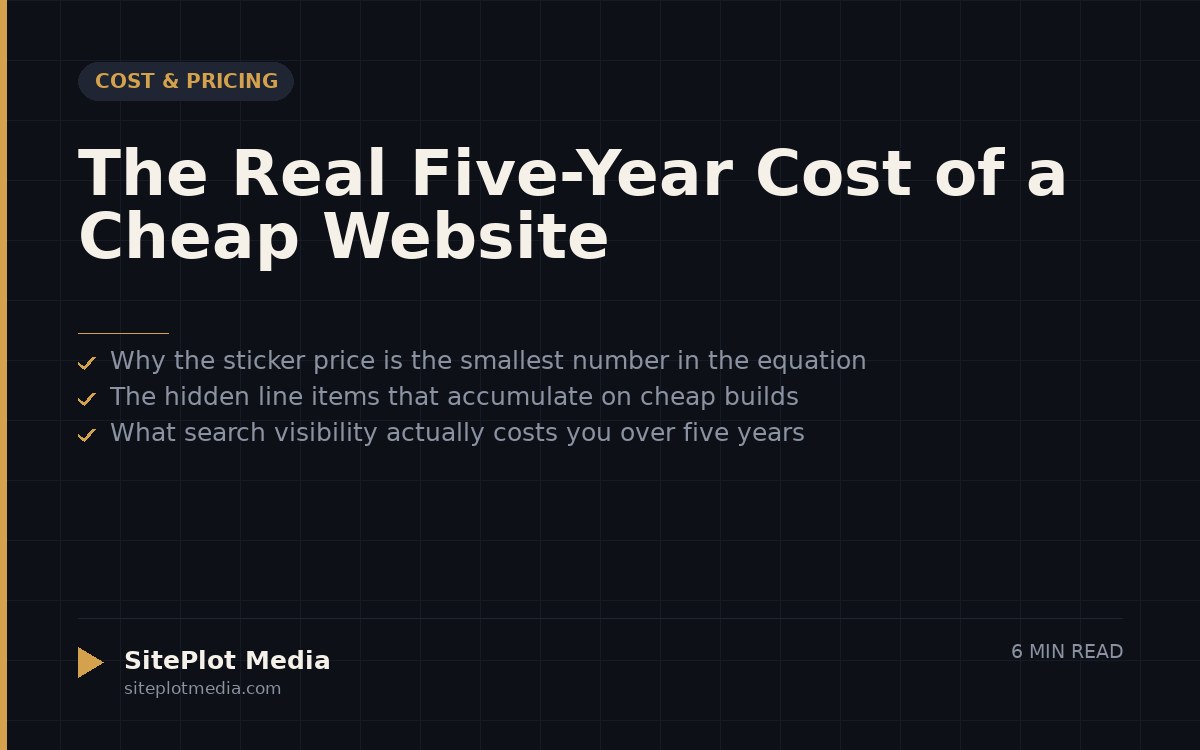
The real five-year cost of a cheap website is almost always higher than the cost of a well-built one, once you add up recurring fees, developer patches, lost search visibility, and the opportunity cost of a site that quietly fails to convert visitors into customers. A $500 website or a $29/month drag-and-drop plan can look affordable on day one, but the compounding costs of platform lock-in, slow load times, and poor structure tend to surface within the first 12 to 18 months. Whether that trade-off is worth it depends entirely on how much your website is expected to do for your business.
Why the sticker price is the smallest number in the equation
When a business owner compares a $500 freelance build to a $5,000 professional project, the math looks obvious. It is not. The upfront price is a one-time event. Everything else — hosting, plugins, security certificates, speed fixes, content updates, and redesigns — recurs year after year. Over five years, those recurring costs routinely exceed the original build cost on budget sites.
The more important question is: what does the site cost you when it does not work? A slow homepage, a broken contact form, a checkout that frustrates mobile users — none of these show up on an invoice, but every one of them has a dollar value. That value is the revenue that walked out the door without anyone noticing.
The hidden line items that accumulate on cheap builds
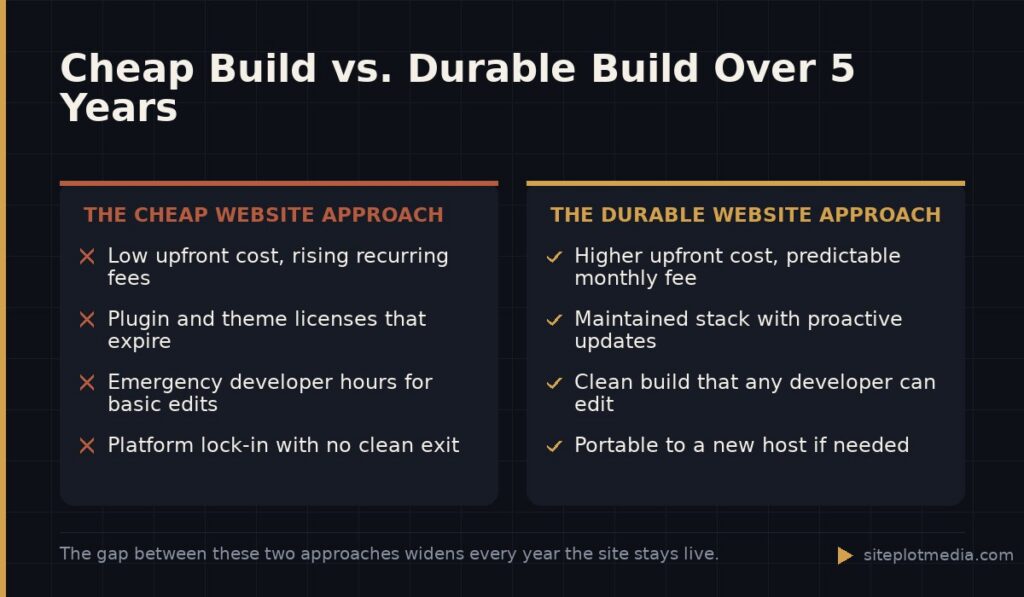
Budget websites tend to arrive with a specific set of structural choices that feel fine at launch and become expensive later. Here are the costs that catch business owners off guard:
- Platform fees that increase over time. Many hosted website builders start at a low monthly rate and raise prices as your business grows or as they restructure their tiers. You often cannot move your site to a different host without rebuilding it entirely.
- Plugin and theme renewals. A typical WordPress site built on a cheap theme and a stack of free or budget plugins requires annual license renewals. When those licenses lapse, features break. When the theme developer abandons the product, you are on your own.
- Emergency developer hours. Budget sites are frequently built in ways that make routine changes difficult. When you need to update your services page or add a landing campaign, a developer unfamiliar with someone else’s shortcuts may charge several hours just to understand the structure before touching it.
- Performance debt. Page builders like Elementor and Divi produce sites with significant CSS and JavaScript overhead. That extra code weight does not cost money directly, but it slows load times, which hurts both user experience and how search engines rank the site — a cost that compounds quietly over years.
- Security incidents. Outdated plugins and themes are the most common entry point for WordPress malware. A single cleanup event from a reputable security service can cost several hundred dollars. If customer data is involved, the exposure is far greater.
None of these costs are hypothetical. They are the normal lifespan of a site that was optimized for low upfront cost rather than long-term function.
This is the kind of thing we handle day to day — you can see how our build process works or browse recent work.
What search visibility actually costs you over five years
Search engine optimization is not magic, and no honest agency will promise you rankings. But the structure of your website — how fast it loads, how clearly it communicates its topic to search engines, how well it handles mobile users — directly affects whether your site has any chance of appearing when a potential customer is looking for what you sell.
Cheap websites are frequently built without any thought given to structure. Pages have duplicate titles, images are not compressed, heading tags are used for styling rather than meaning, and there is no coherent internal linking. These are not SEO tricks. They are basic quality signals. A site with poor structure starts at a disadvantage and stays there, while a competitor with a well-built site quietly accumulates visibility over those same five years.
The cost here is not a line item. It is the difference between being found and not being found by people who are actively looking for your services. For most small businesses, that gap is worth far more than the money saved on a cheap build.
When a cheap website is actually the right call
Honesty requires acknowledging this: for some businesses, a simple inexpensive website is completely appropriate. If you are testing a new business idea before committing to it, if your customers find you entirely through referrals and your website is effectively a digital business card, or if you are in an early stage where cash flow genuinely constrains your options — a budget site can be a reasonable temporary choice.
The mistake is treating a temporary choice as a permanent infrastructure decision. A site built to test an idea in year one should be evaluated and replaced in year two or three if the business proves out. The businesses that pay the highest five-year cost are not the ones that started cheap — they are the ones that never graduated from cheap when their situation changed.
How to think about the five-year total before you decide
Before choosing a website approach, work through a simple five-year estimate for each option you are considering. Add the upfront cost, then estimate annual hosting, plugin renewals, expected maintenance hours at a realistic developer rate, and one redesign cycle. Do not forget to include your own time spent managing workarounds or waiting on support queues.
As a reference point: Siteplot Media builds sites at $5,000 one-time with a 90-day included support period, then $500 per month after that for hosting, maintenance, and ongoing development support. That is a known, stable number. When you compare it honestly to a $29/month platform that requires a rebuild every three years plus developer patches in between, the five-year totals are often closer than they first appear — and the quality difference is not close at all.
The right answer depends on your scope, your growth stage, and how much revenue your website is expected to influence. Run the actual numbers for your situation rather than comparing sticker prices in isolation.
What to look for in a website that holds its value
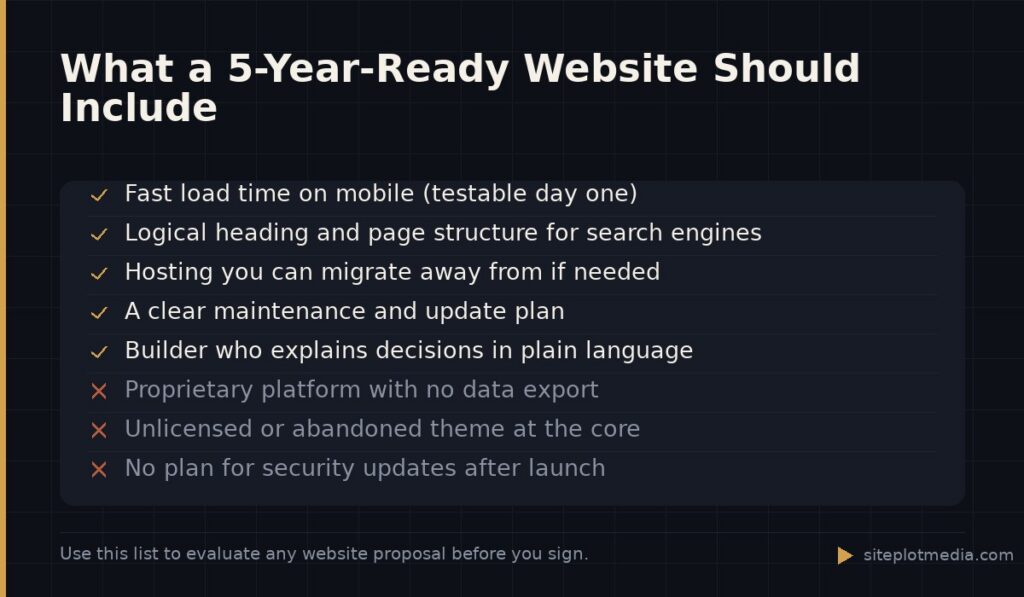
A website that stays useful and functional over five years without constant emergency intervention tends to share a few qualities. It is built on a platform you can migrate away from if you need to. It loads quickly on mobile without special optimization heroics. Its content structure makes sense to both humans and search engines. And the people who built it can explain the decisions they made in plain language.
You do not need the most expensive option on the market to get these qualities. You need a builder who treats the site as infrastructure rather than a deliverable to be shipped and forgotten. Ask any prospective developer how they handle plugin updates, what happens if you need to change hosts, and what their sites look like on a 4G mobile connection. The answers will tell you a great deal about the five-year cost you are actually signing up for.
Frequently asked questions
What does a cheap website actually cost over five years?
The five-year cost of a cheap website typically includes the original build fee plus recurring platform or hosting fees, annual plugin or theme license renewals, developer hours for fixes and updates, at least one partial or full redesign, and the harder-to-measure cost of lost conversions or search visibility. For many small businesses, these combined costs exceed what a well-built site would have cost from the start.
Is it ever okay to start with a cheap website?
Yes — if you are testing a new business concept, working with genuine cash flow constraints, or your website plays a minimal role in how customers find or evaluate you, a low-cost site can be a reasonable starting point. The key is treating it as a temporary decision and revisiting it as your business grows.
Why do cheap websites hurt SEO?
Cheap websites are often built without the structural basics that search engines use to evaluate quality — things like fast load times, logical heading structure, compressed images, and clear page organization. These are not advanced SEO tactics; they are table stakes, and skipping them puts a site at a persistent disadvantage over time.
What is a realistic budget for a small business website?
A professionally built small business website typically ranges from $3,000 to $15,000 depending on scope, with ongoing maintenance and hosting running $200 to $600 per month — though both figures depend heavily on the complexity of the project and the market you are in. The more important question is what the site is expected to do for your revenue, since that sets the ceiling on what investment makes sense.
How do I know if my current website is costing me money?
Check your site's mobile load time using a free tool like Google PageSpeed Insights, then look at your analytics to see what percentage of visitors leave without taking any action. If your site loads slowly, looks broken on a phone, or sends most visitors away without a click or a form submission, it is likely costing you more in lost business than a rebuild would cost.