A $5,000 website project should include custom design, a professionally built and mobile-responsive site, basic on-page SEO setup, and a clear plan for ongoing support — not just a finished file handed over and forgotten. What separates a legitimate $5,000 engagement from a cheap template dressed up is the strategy, communication, and post-launch care built into the price. If a proposal at this budget can’t explain exactly what is included in a website project from discovery to delivery, that’s a warning sign worth taking seriously.
Why $5,000 Is a Real Threshold — and What It Actually Buys
At the $5,000 price point, you’re crossing from DIY-adjacent territory into professional services with real scope. Below this, most agencies are selling templated builds with minimal customization and little strategic input. Above it, you’re typically paying for more complex functionality — e-commerce, membership portals, custom integrations — that most small businesses don’t need yet.
At this level, you should expect a human being (or a small team) who learns your business, designs something purposeful, and builds it properly from the start. What you should not expect: a fully custom web application, extensive content writing, or a paid advertising strategy. Those are separate services, and any agency bundling them into $5,000 is cutting corners somewhere.
The Core Deliverables That Should Always Be Included
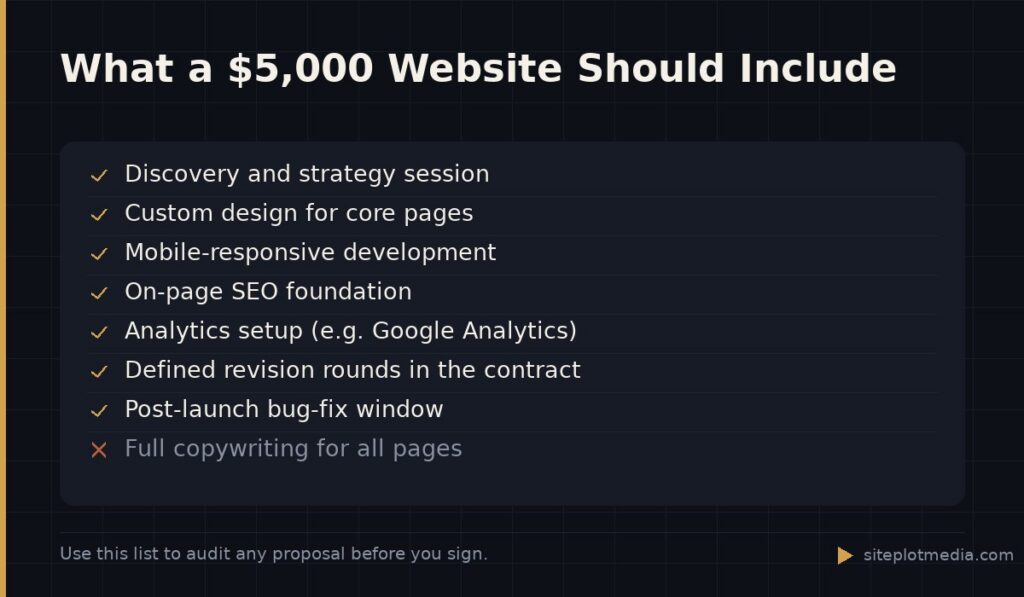
A well-scoped $5,000 project typically covers the following. If a proposal you’re reviewing is missing several of these, ask why before signing anything.
- Discovery and strategy session — A structured conversation about your goals, audience, and competitors. This is where a good agency earns its fee before a single pixel is designed.
- Custom design — Not a theme dropped into place, but a layout built around your brand, your content hierarchy, and the actions you want visitors to take. Usually 5–10 core pages.
- Mobile-responsive development — The site must work correctly on phones and tablets. This is non-negotiable in 2025, not a premium add-on.
- On-page SEO foundation — Proper page titles, meta descriptions, heading structure, image alt text, and a clean URL structure. This does not mean rankings are guaranteed; it means the technical groundwork is done correctly.
- Basic analytics setup — Google Analytics (or an equivalent) connected so you can see who visits, from where, and what they do.
- A defined revision process — Usually one or two rounds of revisions built into the contract. Open-ended revision policies lead to scope creep that hurts both sides.
- Launch support and a short post-launch window — At minimum, 30 days of bug fixes after the site goes live. Some agencies include a longer maintenance period.
A quick note on scope honesty: a five-page brochure site and a fifteen-page site with a blog, contact forms, and multiple service areas are both called “websites,” but they are not the same project. Make sure the page count and functionality are spelled out in writing.
This is the kind of thing we handle day to day — you can see how our build process works or browse recent work.
What Is Usually Not Included — and Why That's Fair
Being clear about exclusions protects you just as much as knowing the inclusions. At $5,000, you should not assume the following are covered unless they are explicitly listed in your contract.
- Copywriting — Writing polished, conversion-focused page content is a skill that takes real time. Most $5,000 builds assume you supply the copy, or they use a basic content brief. Full copywriting usually adds $1,000–$3,000 depending on page count.
- Custom photography or video — Stock imagery is typically used unless you provide your own photos. A professional shoot is a separate line item.
- Ongoing SEO campaigns — The on-page foundation described above is not the same as a monthly SEO engagement. Building authority, acquiring links, and producing optimized content over time is ongoing work billed separately.
- E-commerce functionality — Even a modest WooCommerce or Shopify build adds significant complexity. A small product catalog might fit into a $5,000 budget; a real storefront usually won’t.
- Third-party software or licensing fees — Premium plugins, fonts, or SaaS tools may carry annual costs that fall outside the project fee.
The honest truth: some of these exclusions matter a lot for your business, and some don’t. A local service business with five pages and a contact form doesn’t need copywriting support the way a multi-location company does. Know your situation before comparing proposals.
The Ongoing Cost Question: What Happens After Launch?
This is where many small business owners get caught off guard. A website is not a one-time expense in the way a printed brochure is. It runs on servers, uses software that needs updates, and exists in a security environment that changes constantly. Any agency that doesn’t discuss post-launch costs in their proposal is either omitting something or assuming you’ll figure it out yourself.
Typical recurring costs for a professionally maintained site in this tier include hosting, software and security updates, plugin or theme licensing, and some form of support retainer for edits and troubleshooting. These costs range widely — from a few hundred dollars a year on the low end to several hundred dollars per month for a full-service maintenance plan. For reference, Siteplot Media’s model is a $5,000 one-time build followed by a $500/month retainer that begins after a 90-day included period, covering hosting, updates, support, and ongoing SEO work. That structure is one way to budget for it; there are others. The important thing is that you know the number before you sign.
Be skeptical of agencies that sell you a site and disappear. WordPress and similar platforms require regular updates to stay secure, and a site left unmaintained for six months can become a liability rather than an asset.
How to Evaluate a Proposal Before You Sign
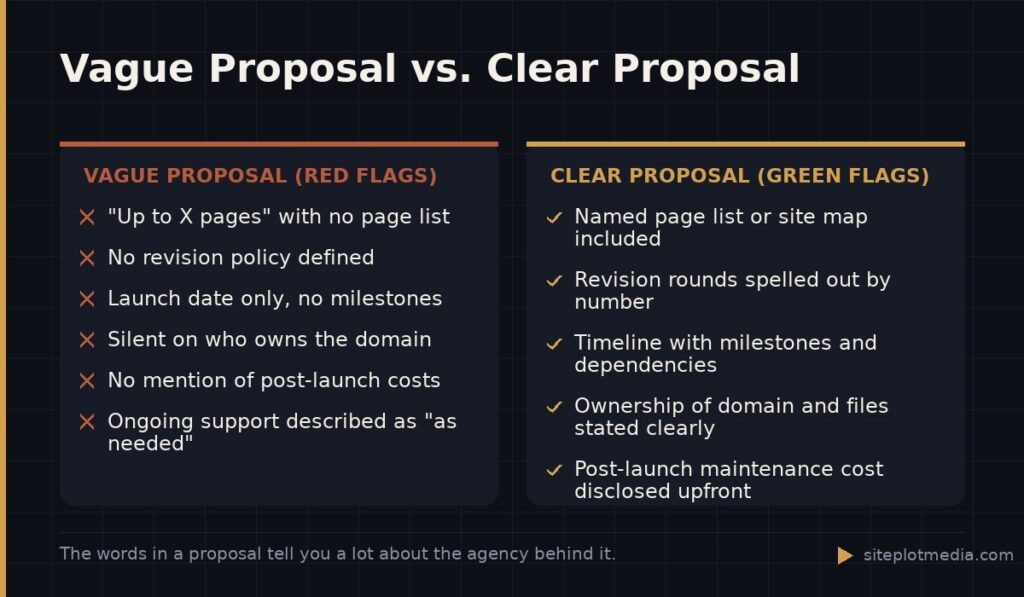
A good proposal answers five questions without you having to ask: What exactly will be built? When will it be done? What do you need to provide, and by when? What happens if the scope changes? And what does ongoing support look like after launch? If a proposal is vague on any of these, the ambiguity will cost you later — usually in the form of extra invoices or a project that stalls because the agency is waiting on something they never told you they needed.
A few practical things to look for:
- A clear page list or site map, not just “up to X pages”
- A defined timeline with milestones, not just a launch date
- A revision policy with specific rounds spelled out
- Explicit ownership terms — who owns the domain, the files, the content after launch?
- References or a portfolio with work similar to your industry or scale
On ownership: you should always own your domain name. Register it yourself, in an account you control, and never let an agency hold it on your behalf. The same applies to your Google Analytics property and your hosting account credentials. These are your business assets, not theirs.
Frequently asked questions
What is included in a website project at the $5,000 price point?
A $5,000 website project should include custom design, mobile-responsive development, on-page SEO setup, analytics installation, and a defined post-launch support window. Copywriting, photography, and ongoing SEO campaigns are typically separate services not bundled at this price.
Is $5,000 enough for a small business website?
Yes, $5,000 is a reasonable budget for a professionally built small business website with five to fifteen pages and standard functionality. If you need e-commerce, custom integrations, or extensive content development, the budget will likely need to be higher.
What ongoing costs should I expect after a website launch?
Expect recurring costs for hosting, software updates, and some form of maintenance or support — these typically range from a few hundred dollars a year on a self-managed plan to several hundred dollars per month for a full-service retainer. Your agency should give you a clear number before the project begins.
How long does a $5,000 website project take to complete?
Most professionally scoped projects at this budget take six to twelve weeks from kickoff to launch. Timeline depends heavily on how quickly the client provides content, feedback, and approvals — delays on the client side are the most common reason projects run long.
Should I own my domain and hosting, or let my agency manage them?
You should always own your domain name in an account registered in your name. Letting an agency hold your domain creates real risk if the relationship ends — transferring ownership can be slow and, in worst cases, contested.