
For most small and mid-sized businesses, a professional website takes between 6 and 16 weeks to build from kickoff to launch, depending on the size and complexity of the project. A simple five-to-ten page site with a clear scope can often launch in six to eight weeks, while a larger site with custom features, e-commerce, or multiple rounds of revision will take longer. The biggest variable is rarely the developer — it’s how quickly the client can supply content, feedback, and decisions.
The honest timeline breakdown by project type
There’s no universal answer, but there are useful benchmarks. A small brochure site — think homepage, about, services, contact — built on a solid template can be designed, built, and launched in four to eight weeks when both sides stay responsive. A mid-sized site with ten to twenty pages, a blog, a contact form, and some customization typically runs eight to twelve weeks. A larger build with e-commerce, custom integrations, or a content management system configured for a non-technical team can run twelve to twenty weeks or more.
These ranges assume a professional doing the work. DIY website builders like Squarespace or Wix can get a basic site live faster — sometimes in a weekend — but the trade-off is that you’re doing the work yourself, and the result is usually harder to optimize for search and harder to hand off later if your needs grow. That’s not a reason to avoid them if you genuinely just need a simple online presence. It is a reason to think carefully about where you’re headed before you commit.
What actually determines the timeline (it's not what most people think)
Most business owners assume the developer sets the pace. In practice, the client side drives the majority of delays. The two most common causes of a project running long are content and decisions. Content means the words, photos, and brand assets that go on the site. Decisions means things like: Which services do we feature first? Do we want a pricing page? What’s the call to action on the homepage? These questions sound simple but they often surface deeper strategic conversations that take time to work through.
A professional web team will typically set a kickoff call, gather a detailed brief, and then provide a content checklist. If those materials come back quickly and feedback rounds are focused, the project moves quickly. If content trickles in over weeks, or if stakeholders disagree internally, the timeline stretches — through no fault of the developer. This is worth knowing before you sign a contract, because a longer project usually costs more, either directly or in the form of delayed revenue from not having your site live.
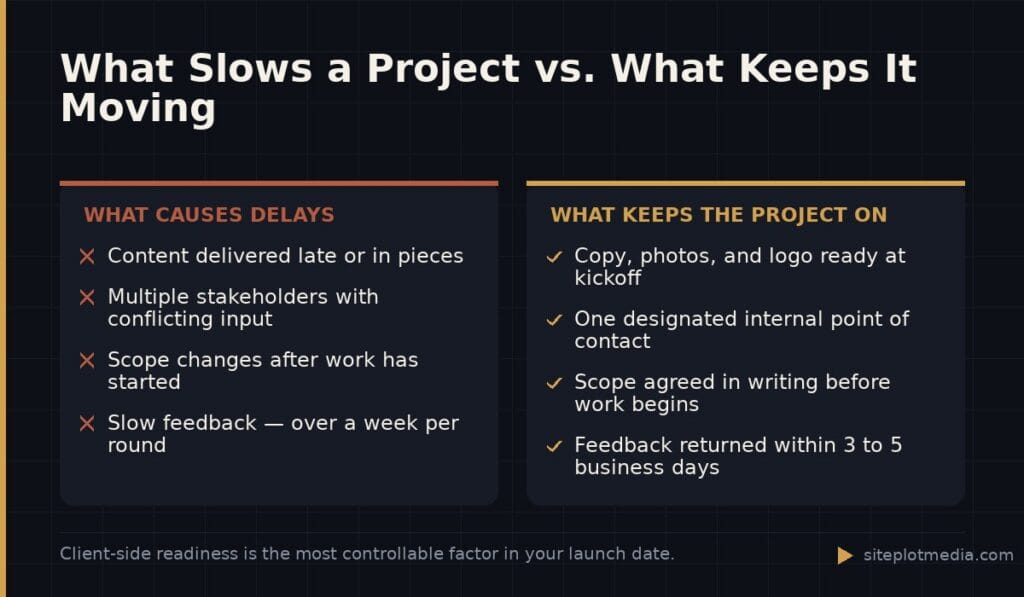
- Content (copy, photos, logo files) delivered late is the single most common delay
- Unclear decision-making — too many internal approvers — adds weeks
- Scope changes mid-project almost always push the launch date
- Slow feedback rounds (taking more than a week to review a draft) compound quickly
This is the kind of thing we handle day to day — you can see how our build process works or browse recent work.
The phases of a web project and how long each one takes
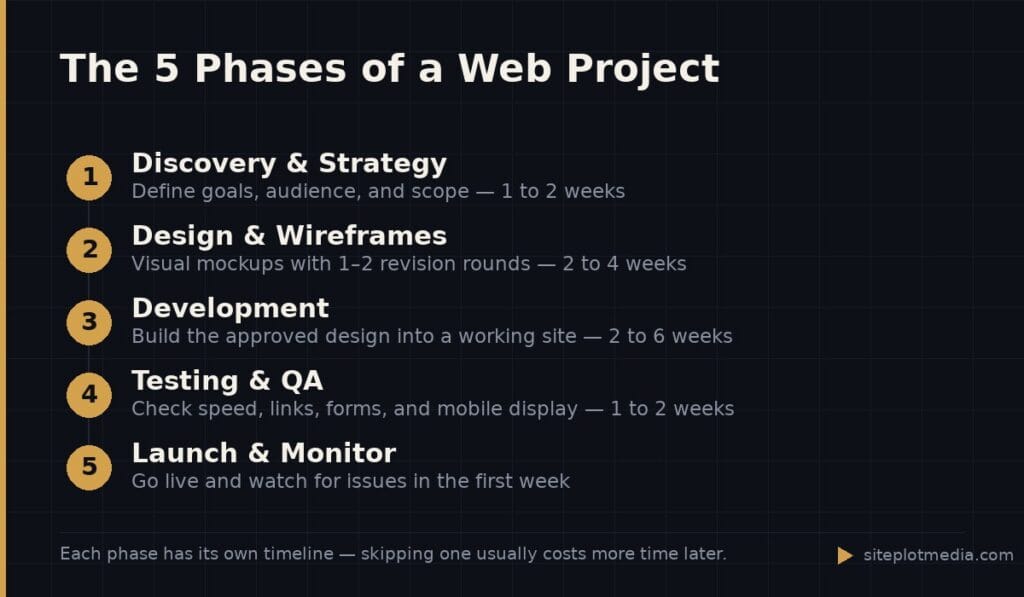
A professional website build doesn’t go straight from contract to code. It moves through distinct phases, and each one has a realistic time cost. Understanding this helps you plan your own schedule and set honest expectations with your team.
Discovery and strategy typically takes one to two weeks. This is where the developer or agency asks about your goals, your audience, your competitors, and your existing brand. Design — wireframes and visual mockups — usually takes two to four weeks and often involves one to two rounds of revision. Development, where the approved design gets built into a working site, takes two to six weeks depending on complexity. Then there’s a testing and quality-assurance phase, usually one to two weeks, followed by launch and a short period of monitoring. Add these up and the math is clear: even a well-scoped project with a responsive client is a multi-week commitment.
When faster is fine — and when it costs you later
Speed has a real cost, and it’s worth naming honestly. Some agencies offer a “website in a week” or similar compressed timelines. That’s sometimes legitimate — particularly for very small sites built from a proven template with content the client supplies upfront. But more often, compressed timelines mean skipped steps: no real discovery, minimal testing, templated copy that doesn’t reflect how your customers actually talk about your problem. The site goes live fast and looks fine. The SEO foundation is weak, the messaging is generic, and six months later you’re paying to redo it.
On the other end, there’s no virtue in a slow project either. A site that takes nine months and dozens of revisions to launch is a site that wasn’t scoped or managed well. The goal is an appropriate timeline for the actual scope — not faster to sell you urgency, not slower to bill more hours. If a vendor can’t give you a clear phase-by-phase schedule at the start of a project, that’s a warning sign worth taking seriously.
How to set your project up to stay on schedule
The most effective thing you can do before a web project starts is assemble your content. That means final (or near-final) copy for each page, professional photography or a clear direction on stock imagery, your logo in a vector format, and a short document describing what makes your business different and who your best customers are. Arriving at kickoff with this material in hand can cut weeks off the timeline.
It also helps to designate a single point of contact on your side — one person who can give feedback and make decisions without needing to run every detail past three other stakeholders. That doesn’t mean ignoring your team; it means agreeing internally before feedback goes to the developer, so the developer receives consolidated, actionable notes rather than conflicting opinions. For what it’s worth, this is exactly how Siteplot Media structures its onboarding: a detailed brief upfront, a content checklist before design begins, and clearly scoped revision rounds so neither side is surprised.
- Prepare your copy, photos, and logo before the project starts
- Name one internal decision-maker for the project
- Agree on scope in writing before work begins — changes cost time
- Respond to drafts within the agreed review window, usually three to five business days
- Ask your developer for a phase-by-phase schedule at kickoff
What to ask a web developer before you hire them
Timeline is one of the most revealing questions you can ask a prospective web developer or agency. A confident, experienced team will give you a phased estimate with clear assumptions. A vague answer — “it depends” with no further detail — is worth probing. Ask them to walk you through the last three projects they launched: how long were they scoped for, and how long did they actually take? The gap between those two numbers tells you a lot about how that team manages projects.
Also ask who owns the site when it’s done. Some agencies build on proprietary platforms or retain control of your hosting in ways that make it difficult and expensive to leave. You want to walk away with a site you control: your domain, your hosting account, your content management login. These aren’t unreasonable requests — any reputable professional will find them completely normal.
Frequently asked questions
How long does it take to build a small business website?
A small business website typically takes six to twelve weeks to build professionally, assuming the client provides content and feedback on schedule. Very simple sites built from a template can sometimes launch faster, but skipping discovery and testing phases usually creates problems later.
Can a website be built in a week?
A basic website can be launched in a week, but only if the scope is very small, all content is ready upfront, and meaningful testing is acceptable to skip. For most businesses, a week-long build means shortcuts that show up later as SEO gaps, performance issues, or messaging that doesn't convert.
What causes website projects to go over schedule?
The most common cause is late or incomplete content from the client — missing copy, photos, or logo files. Other frequent delays include mid-project scope changes, slow feedback turnaround, and too many internal stakeholders with conflicting input.
Is it faster to build a website yourself with a website builder?
Yes, DIY website builders like Squarespace or Wix can get a simple site live much faster because you skip the design and development queue. The trade-off is that you're doing all the work yourself, and the result is often harder to optimize for search engines or scale as your business grows.
How long does the design phase of a website take?
The design phase — wireframes and visual mockups — typically takes two to four weeks for a standard business website. That window includes at least one to two rounds of client feedback and revision before moving into development.