To evaluate a web design portfolio, look beyond visual style and check whether the sites actually work: do they load fast, function well on mobile, and appear to serve the client’s business goals? A portfolio that looks beautiful but hides slow load times, broken links, or templated designs with swapped logos tells you more about a designer’s weaknesses than their strengths.
Start by clicking through the live sites, not the screenshots
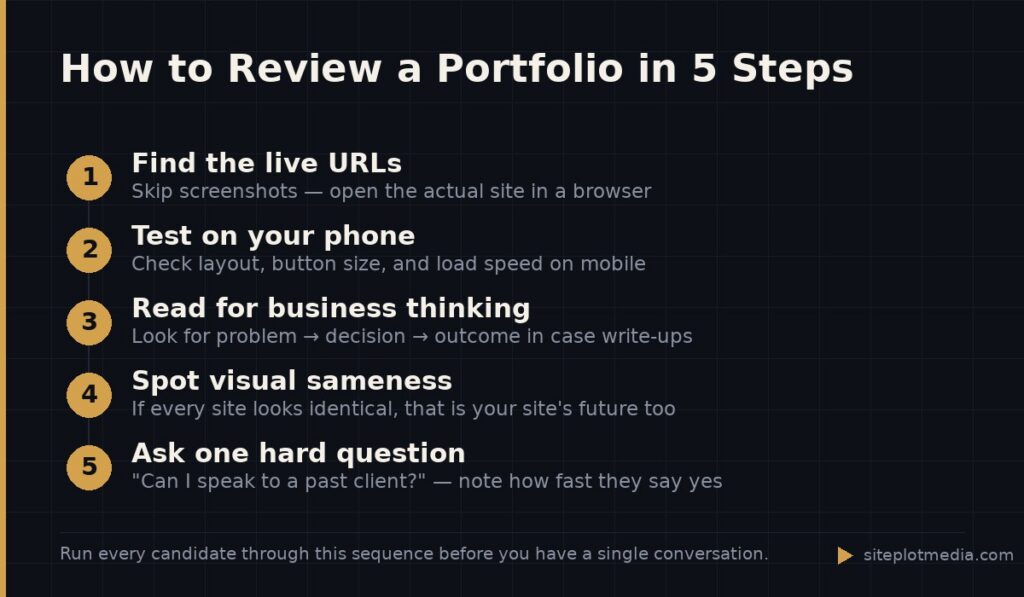
Screenshots lie. A portfolio page can show you a gorgeous homepage mockup while the live site behind it loads in six seconds, breaks on a phone, or hasn’t been updated since the designer handed it off. Always find the actual URL — most designers link to live work — and open it on both a desktop browser and your phone.
When you land on a live site, pay attention to how quickly it loads. You don’t need testing software to notice a site that feels sluggish. If the images pop in late, the page jumps around as it loads, or you’re waiting more than a couple of seconds to see real content, that’s meaningful information. Speed is not a finishing touch — it’s baked into how a site is built from the start.
Also check whether the work in the portfolio still exists and still looks the way the designer claims. Sites get redesigned by new vendors. If half a designer’s “case studies” return a 404 error or now look completely different, that’s worth noting.
Look for evidence that the work solved a real business problem
Good designers talk about outcomes. Great portfolios explain what problem the client had, what choices the designer made to address it, and — where possible — what happened afterward. If every portfolio entry reads as “here’s a pretty site we made,” you’re looking at a studio that thinks of web design as decoration rather than a business tool.
You don’t need to see detailed analytics reports. Even a simple explanation like “this flooring company was losing leads because their quote form was buried on a third page, so we restructured the navigation and moved the call-to-action above the fold” tells you the designer understands the purpose of a website. Contrast that with a portfolio entry that says only “modern, clean design for a local contractor” — that tells you almost nothing.
Ask the designer directly: what was the goal for this project, and how did you know you’d hit it? Their answer reveals whether they think strategically or just aesthetically.
This is the kind of thing we handle day to day — you can see how our build process works or browse recent work.
Red flags to watch for in any portfolio
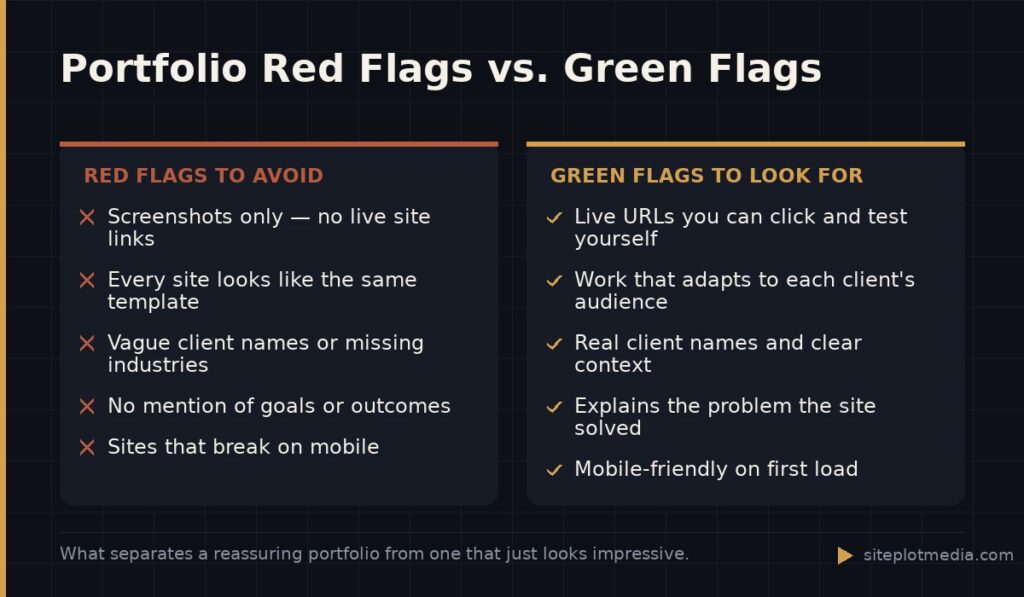
Some warning signs are subtle; others are obvious once you know what to look for. Here are the most common ones:
- Every site looks identical. If you can tell the designer has one template they reskin for every client, your brand will get the same treatment. Some use of frameworks is normal, but the work should adapt meaningfully to each client’s audience and goals.
- No real client names or industries. Vague placeholders like “a marketing client” or “a retail brand” may mean the designer has very little real client experience, or the work didn’t go well enough to feature publicly.
- Sites that aren’t mobile-friendly. Resize the browser window or pull up the site on your phone. If the layout breaks, text runs off-screen, or buttons are impossible to tap, the designer is not building to current standards.
- Overly flashy animations with no clear purpose. Motion can serve real UX goals, but heavy animations that make you wait to read the page are often a signal that style is being prioritized over usability — and they can hurt performance.
- No mention of SEO, accessibility, or performance. A web designer who never mentions how the site performs in search, loads for users on slower connections, or works for people with disabilities is working in a silo that will cost you later.
Match the portfolio to your actual industry and goals
A portfolio full of restaurant websites doesn’t automatically qualify someone to build a B2B software company’s lead generation site, and vice versa. Industry experience matters — not because designers can’t learn, but because a designer who has worked with businesses like yours already understands the customer journey, the typical objections, and what a conversion looks like in your context.
That said, don’t be too rigid. A skilled designer with strong process and good judgment can often do better work for an unfamiliar industry than a mediocre designer who has built the same site fifty times. What you’re really looking for is evidence that they research and think before they design, not that they already have ten clients in your niche.
Ask yourself honestly: does any of this work make you feel something? Does it seem like it would actually attract and persuade the kind of customer you’re trying to reach? Your gut reaction to portfolio work is data, not vanity — you’re trying to represent your business, not win a design award.
Ask these specific questions before you hire
A portfolio review is only the first filter. Before you sign anything, the conversation you have with a potential designer matters just as much as the work you’ve seen. These questions tend to reveal a lot quickly:
- “Who actually built this — you, or a subcontractor?” Agencies sometimes show work produced by people who no longer work there, or by freelancers they hired for a single project. Know who you’re actually getting.
- “What platform did you build this on, and why?” There’s no single right answer, but a designer who can’t explain their platform choices in plain terms probably doesn’t have strong technical reasoning behind their decisions.
- “What happens if I need changes after launch?” Some designers hand off a finished site and disappear. Others charge per-change with no ceiling. Understand the ongoing relationship before you commit.
- “Can I talk to one of your past clients?” A confident designer with happy clients will say yes quickly. Hesitation here is itself a signal.
Pricing varies widely depending on scope, platform, number of pages, and the complexity of any custom functionality — expect a wide range from a few thousand dollars to well above $20,000 for sophisticated builds. What matters is whether the deliverables are clearly defined and whether you understand what you’re paying for.
The difference between a portfolio that impresses and one that reassures
There’s a distinction worth making: some portfolios are built to impress other designers. They feature bold typography, complex layouts, and creative risk-taking. Others are built to reassure business owners — they show clear thinking, measurable intent, and evidence that clients got what they paid for. You want to hire for the second category.
The most honest signal in any portfolio is whether the designer seems proud of what their work accomplished, not just what it looked like. When a designer says “we helped this law firm reduce their bounce rate significantly by simplifying the intake process” rather than “we gave this firm a premium, modern feel,” they are telling you something important about how they prioritize your interests over their portfolio piece.
If a designer’s work passes the live-site test, reflects genuine business thinking, and holds up under a few direct questions, that’s a strong foundation. No portfolio review is a guarantee — but a careful evaluation gets you far closer to making a hire you won’t regret.
Frequently asked questions
How many portfolio pieces should a web designer have before I consider hiring them?
Quality matters far more than quantity — three or four well-documented, live projects tell you more than twenty screenshots with no context. If the work is strong, thoughtful, and verifiable, a smaller portfolio is not a disqualifier, especially for newer designers charging accordingly.
Should I hire a web designer whose style I love but whose industry experience doesn't match mine?
Yes, if they demonstrate strong process and ask smart questions about your business before pitching a direction. Industry experience shortens the learning curve but doesn't replace judgment — and a great generalist often outperforms a niche specialist who has stopped thinking critically about the work.
Is it a red flag if a designer's portfolio only shows template-based work?
It depends on your needs — templates built well on solid platforms can deliver excellent results for many small businesses, and there's no shame in that approach. The red flag is when every site looks nearly identical regardless of the client's industry, audience, or goals, which suggests the designer isn't adapting their thinking to each project.
How do I check if a portfolio site actually performs well technically?
Open the live URL in Google's free PageSpeed Insights tool (pagespeed.web.dev) and enter the address — it will give you a plain-language performance score and explain any major problems. You don't need to understand every detail; a consistently low score across multiple portfolio sites is a clear pattern worth raising with the designer.
What should a web design proposal include after I've reviewed the portfolio?
A solid proposal should clearly define the number of pages, the platform, what's included at launch, revision rounds, timeline, and what happens after the site goes live — including who handles maintenance and at what cost. Vague proposals that describe deliverables in adjectives rather than specifics are a common source of disputes and disappointment.