

A solid web development contract should spell out the full scope of work, who owns the finished site, what happens if deadlines slip, and exactly how disputes get resolved. Without these web development contract essentials in writing, you have almost no recourse if the project goes sideways. Reviewing these clauses before you sign is one of the highest-leverage things you can do to protect your business.
Scope of work: the clause that prevents the most arguments
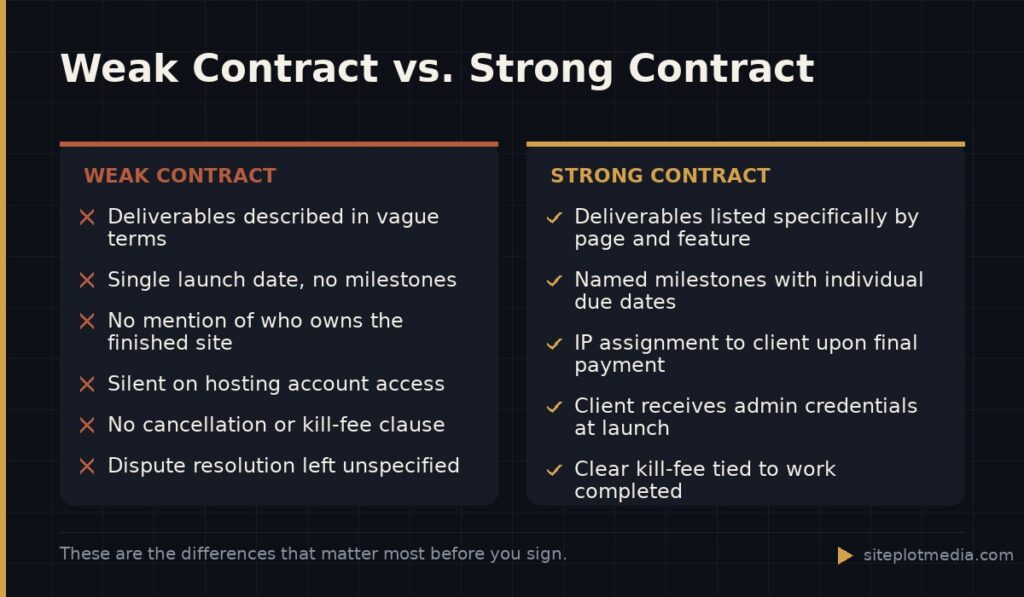
The scope of work section is where the entire project gets defined in plain language. It should list every deliverable — number of pages, specific features (contact forms, e-commerce checkout, blog, booking system), which platform the site will be built on, and what is explicitly excluded. “A professional website” is not a scope. “A ten-page WordPress site with a WooCommerce store, a contact form, and one round of revisions” is a scope.
Vague scopes are the single most common cause of cost overruns and broken client-agency relationships. If a contractor hands you a contract that describes deliverables in broad strokes, ask them to rewrite it with specifics before you sign. Any contractor who resists that request is telling you something important.
The scope section should also define what counts as a revision versus a new request. Typically, a revision corrects something that did not match the agreed spec; a new request adds something that was never in scope. That distinction, in writing, saves a great deal of friction later.
Timeline, milestones, and what happens when deadlines slip
A good contract includes a project timeline with named milestones — not just a vague launch date. Common milestones include design mockup approval, development handoff, content population, testing, and go-live. Each milestone should have a due date attached to it and, ideally, a note about whose responsibility it is to hit that date.
Equally important is what the contract says when a deadline is missed. Some contracts place all responsibility on the developer regardless of cause. Better contracts distinguish between delays caused by the developer and delays caused by the client — for example, if you are two weeks late delivering your logo files or copy. Without that distinction, a developer can be penalized for a delay that was entirely your fault, which makes the contract unenforceable in practice and poisons the relationship.
Look for a clause that pauses the timeline clock when the project is waiting on client-provided materials. That is fair to both sides and reflects how projects actually work.
This is the kind of thing we handle day to day — you can see how our build process works or browse recent work.
Ownership and intellectual property: you need to own your own site
This clause matters more than most business owners realize. When a developer builds your site, the copyright in that work belongs to them by default under U.S. law — unless the contract transfers it to you. Without an explicit intellectual property assignment, you may not legally own the design, the custom code, or even the content the developer wrote on your behalf.
Your contract should state clearly that upon final payment, full ownership of all deliverables transfers to you. This includes custom design files, any code written specifically for your project, and any written content the contractor produced. Stock photos and licensed third-party plugins operate under their own licenses and cannot be assigned — a good contractor will note which assets those are and confirm you have proper licenses for them.
Also check whether the contract grants the developer the right to display your site in their portfolio. That is a reasonable request and typically fine to allow — just make sure it is limited to portfolio use and does not give them broader rights to your brand or content.
Payment terms: structure matters as much as the total price
Web development projects are almost always paid in installments, and that structure should be explicit in the contract. A typical arrangement is a deposit up front (commonly 25–50% of the project total), one or more progress payments tied to milestones, and a final payment on or just before launch. Never pay 100% up front. Never agree to pay nothing until launch — that removes all financial accountability from both sides.
The contract should also define what happens if you cancel the project midway through. A fair kill-fee clause compensates the developer for work already completed and returns any unused portion of your deposit. Without a cancellation clause, a dispute over a half-finished project is entirely he-said-she-said.
Pricing for web development varies widely depending on scope, platform, and who you hire. A simple brochure site from a freelancer might run a few thousand dollars; a custom-built site from a full-service studio is typically higher. What matters is that the contract makes clear exactly what that price covers — and what it does not.
Hosting, maintenance, and what happens after launch
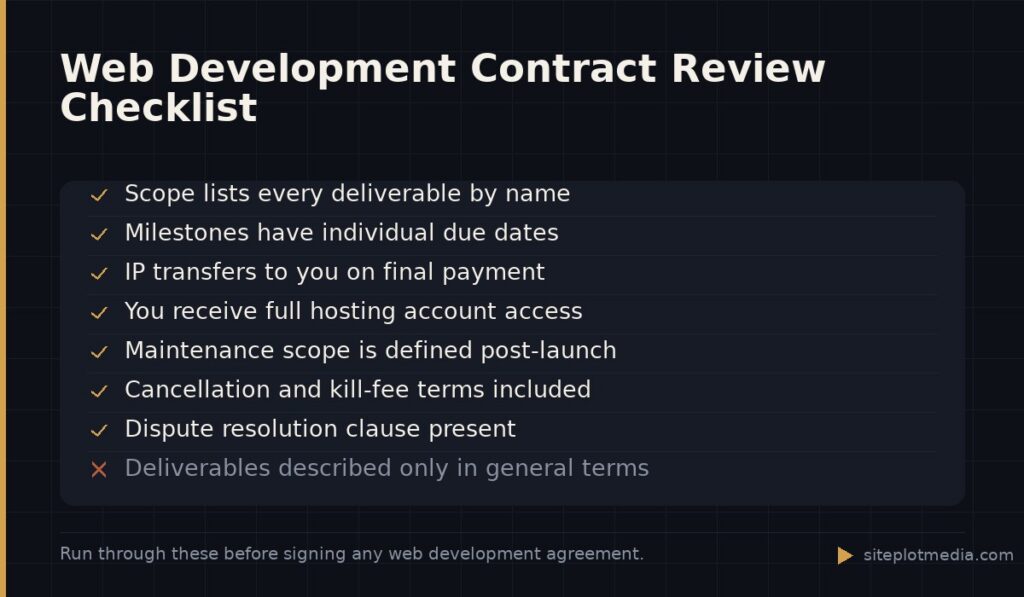
Many business owners sign a contract focused entirely on the build and never think about what happens on day 91. Who is responsible for keeping WordPress updated? Who handles security patches? Where is the site hosted, and who controls that account? These questions need answers in writing before you sign — not after something breaks.
Some developers retain control of your hosting account as a way to lock you into their maintenance services. That is a legitimate business model, but you should know going in whether you own the hosting account credentials or whether you are dependent on the developer to access your own site. A contract that is silent on this is usually not in your favor.
If ongoing maintenance is part of the engagement, the contract should define what that maintenance includes — software updates, uptime monitoring, security scanning, backups — and what it does not include, such as new feature development or content changes. For reference, Siteplot Media structures this as a one-time build followed by a clear monthly retainer after a 90-day included period, so clients know exactly what they are paying for and when.
- Confirm you receive admin-level access to the site and hosting account at launch
- Confirm backups are included and where they are stored
- Get the maintenance scope in writing, including response time expectations
- Understand what triggers additional charges beyond the monthly fee
Dispute resolution and governing law: the clauses everyone skips
No one signs a contract expecting a dispute, which is exactly why these clauses get ignored — and exactly why they matter. A dispute resolution clause specifies what happens if you and the developer cannot agree: does the contract require mediation first, then arbitration, or does it go straight to court? Each path has different costs and timelines, and you should understand which one you are agreeing to.
The governing law clause specifies which state’s laws apply and where any legal action would take place. If you are a business owner in Texas hiring a developer in another state, this clause determines whether you would have to file a claim in their jurisdiction or yours. For small projects, the practical answer is often that neither party would ever litigate — but for larger engagements, this clause is worth reading carefully.
A limitation of liability clause is also common and reasonable. It typically caps the developer’s financial exposure at the amount you paid them, rather than leaving open-ended liability for consequential damages. That is fair and standard — but if the cap is set extremely low relative to the project size, it is worth negotiating.
Frequently asked questions
What is the most important thing to look for in a web development contract?
The scope of work is the most important clause — it defines exactly what you are paying for and prevents scope creep disputes. If the deliverables are described vaguely, ask the contractor to rewrite that section before you sign.
Should I hire a lawyer to review a web development contract?
For projects over a few thousand dollars, a brief legal review is worth the cost. For smaller projects, focus on reading the ownership, payment, and scope clauses yourself — those are where most disputes originate.
Who owns a website after a developer builds it?
Under U.S. copyright law, the developer owns the work by default unless the contract explicitly transfers ownership to you. Always confirm the contract includes an intellectual property assignment clause that takes effect upon final payment.
Is it a red flag if a web developer does not use a contract?
Yes — a developer who works without a written contract is a significant red flag, regardless of how experienced they seem. A contract protects both parties, and any professional should expect and welcome one.
What should a web development contract say about hosting?
The contract should specify who controls the hosting account and confirm that you receive full admin credentials at launch. If the developer retains hosting control, understand what that means for your ability to switch providers or access your site independently.