For most small businesses with a straightforward website need and a budget under $5,000, a skilled freelancer is often the smarter choice — you get direct access to one person and lower overhead costs. If your project involves multiple moving parts, ongoing strategy, or you need a team that can handle design, development, and SEO under one roof, an agency is worth the higher price tag. The honest answer is that neither option is universally better; the right fit depends on your project’s complexity, your budget, and how much hand-holding you want after launch.
What you actually pay: the real cost difference
A freelance WordPress developer typically charges anywhere from $1,500 to $8,000 for a small-to-mid-sized business site, depending on scope. Hourly rates vary widely — from $40 an hour for an overseas contractor to $150 or more for a seasoned U.S.-based specialist. That range is wide because “freelancer” covers everyone from a moonlighting college student to a 15-year veteran who just prefers working independently.
Agencies tend to start around $5,000 and can run into the tens of thousands for larger projects. That premium exists for a reason: you’re paying for a team — usually a project manager, a designer, and a developer at minimum — plus the agency’s infrastructure, processes, and accountability layer. Whether that’s worth it depends entirely on whether your project actually needs all of those roles.
One thing to watch with both options: the build cost is not the total cost. Hosting, security monitoring, plugin licenses, and ongoing maintenance are real expenses that come after launch. Ask any candidate — freelancer or agency — what happens after the site goes live and what that support will cost you.
What a freelancer does well (and where they fall short)
Freelancers shine on focused, well-scoped projects. If you need a clean five-to-ten-page WordPress site with a contact form, solid on-page SEO basics, and a design based on an established theme, a good freelancer can deliver that efficiently and affordably. You’ll usually work directly with the person building the site, which means faster decisions and less communication overhead.
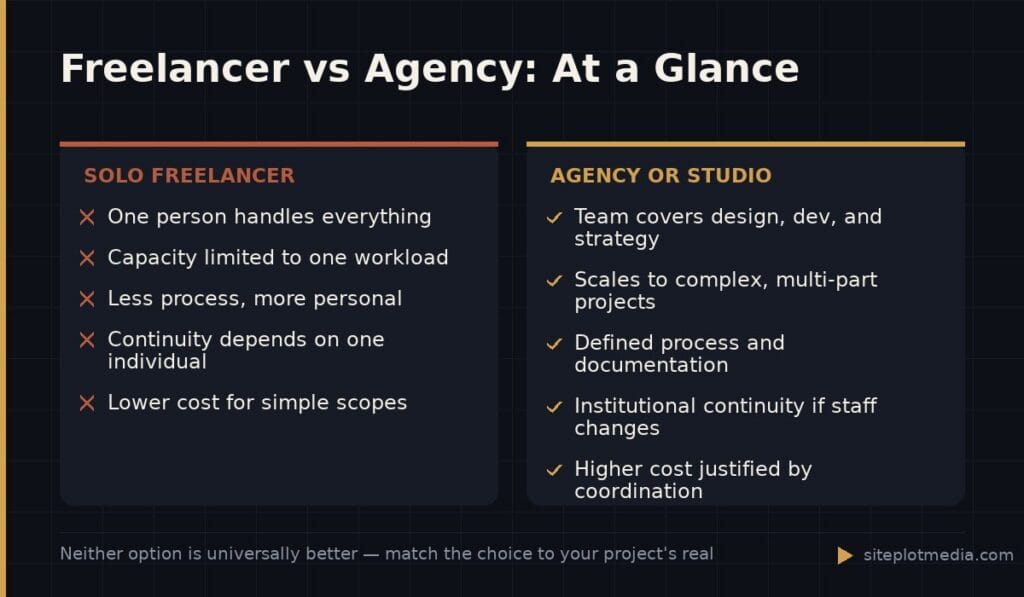
The risk with freelancers is capacity and continuity. One person can only handle so much at once, and if your site needs help two years from now, you need that same person to still be in business, still be responsive, and still remember your project. Some freelancers are extraordinarily reliable. Others disappear. Vetting matters more here than with an agency because there’s no institutional backstop.
Freelancers also tend to be specialists rather than generalists. A developer who’s excellent at building clean WordPress code may have limited design chops. A designer who knows WordPress may not have deep SEO knowledge. If your project needs all three disciplines, you may end up managing multiple freelancers yourself — which is its own job.
This is the kind of thing we handle day to day — you can see how our build process works or browse recent work.
What an agency does well (and where the cost isn't justified)
Agencies make the most sense when your project is genuinely multi-disciplinary. A rebrand plus new website plus SEO foundation plus ongoing content strategy is a project that benefits from a coordinated team. You’re not just buying deliverables — you’re buying a process that keeps the pieces from conflicting with each other.
Accountability is the other real advantage. Agencies have reputations to protect at an organizational level. They have contracts, defined scopes of work, and (ideally) documented handoff procedures if the person you’ve been working with leaves the company. That institutional continuity has real value for businesses that plan to grow into their website over time.
That said, an agency is overkill for a simple brochure site. If you need five pages, a blog, and a way for customers to contact you, paying agency rates for that scope means you’re subsidizing overhead that doesn’t benefit your project. Be honest with yourself about what you actually need — not what sounds impressive.
The questions that actually determine the right fit
Before you contact anyone, answer these questions. They’ll tell you more than any comparison article can.
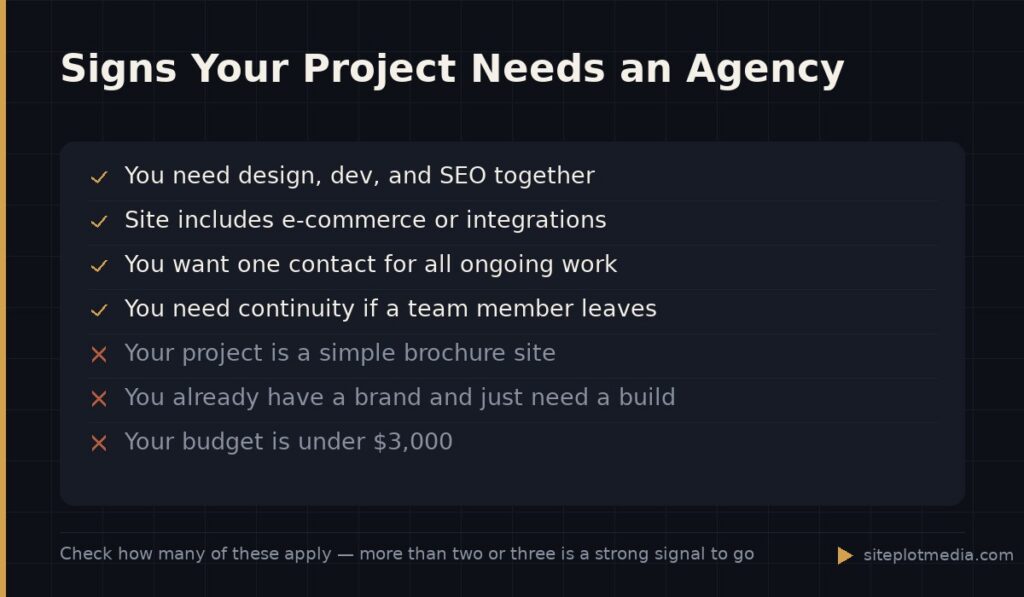
- How complex is the project? A portfolio site or local service site is simple. A site with e-commerce, membership areas, booking systems, or third-party integrations is complex. Complex projects benefit from team depth.
- Do you need design, development, and strategy, or just one of them? If you already have a brand and just need someone to build a site, a focused freelancer may be ideal. If you need the whole package, an agency’s coordination is worth more.
- What’s your tolerance for project management? Working with multiple freelancers means you’re the PM. An agency handles that internally.
- What does “after launch” look like for you? If you want one point of contact for security updates, edits, and SEO work indefinitely, an agency retainer or a studio with a defined ongoing plan is a safer bet than hoping a freelancer stays available.
- What’s your honest budget? Not the budget you wish you had — the one you actually have. If it’s under $3,000, a strong freelancer is likely your realistic path. If it’s $7,000 or more, you have real agency options.
A third option worth knowing about: the boutique studio
There’s a category that sits between the solo freelancer and the full-service agency: the small boutique studio. These are typically two-to-five-person operations that specialize in a narrow set of services — often WordPress design, development, and foundational SEO — and work with a limited number of clients at a time. They offer more consistency and process than a solo freelancer, but without the overhead (and price tag) of a larger agency.
This is the model we follow at Siteplot Media. Our build engagements start at $5,000 one-time, which includes a 90-day support window, followed by a $500/month ongoing plan covering maintenance, security, and SEO work. That structure is designed to be transparent: you know exactly what you’re getting and what it costs after launch. It’s not the right fit for every business, but if you want coordinated work without paying for a 20-person agency’s overhead, it’s worth understanding this middle tier exists.
When evaluating any studio or agency, ask to see their process documentation, their communication approach, and what specifically is included in any ongoing retainer. Vague answers to those questions are a red flag regardless of company size.
How to vet whoever you hire
The most important thing you can do — with a freelancer or an agency — is look at real work and talk to real clients. A portfolio shows aesthetic taste and technical range. A reference call tells you whether the person or team is actually pleasant to work with, meets deadlines, and communicates clearly under pressure.
Ask for two or three references and actually call them. Ask specifically: Did the project come in on time? On budget? What happened when something went wrong? You’ll learn more in ten minutes of conversation than in hours of reading proposals.
Also ask to see the back end of a WordPress site they’ve built, if possible. A site that looks good on the front can be a maintenance nightmare on the back end — bloated with unnecessary plugins, built on an abandoned theme, or structured in a way that makes future edits difficult. Clean, sustainable builds are a skill, not a given.
Frequently asked questions
Is it cheaper to hire a freelancer or an agency for a WordPress website?
Freelancers are almost always cheaper upfront, with small business WordPress sites typically ranging from $1,500 to $8,000 depending on scope — compared to agency projects that often start at $5,000 and go up from there. However, total cost over time depends on what ongoing support you need, so compare full-lifecycle pricing, not just the build quote.
What are the risks of hiring a freelance WordPress developer?
The biggest risks are availability and continuity — a freelancer may become unavailable, raise rates, or change focus, leaving your site without reliable support. Vetting references carefully and getting clear documentation of your site's setup at handoff significantly reduces that risk.
Can a freelancer handle SEO as well as a WordPress agency?
Some freelancers are exceptional at SEO, but it depends entirely on that individual's skill set — it's not guaranteed the way it often is with an agency that has a dedicated SEO role. Ask any candidate specifically what SEO work is included and what their process looks like, rather than assuming it's covered.
How do I know if my WordPress project is too complex for a freelancer?
If your project requires e-commerce, custom integrations, a membership system, or coordinated design and development from scratch, it's likely complex enough to benefit from a team. A single freelancer managing all of that simultaneously carries meaningful execution risk.
What should I ask before hiring anyone to build a WordPress site?
Ask for references you can actually call, ask to review the back end of a site they've built, and ask explicitly what happens after launch — who handles updates, security, and edits, and what that costs. Clear, specific answers to those three questions tell you most of what you need to know.