Answer engine optimization (AEO) is the practice of structuring your content so that AI-powered tools like ChatGPT, Google’s AI Overviews, and Perplexity pull from it when generating a direct answer to a user’s question. It differs from traditional SEO in one key way: SEO earns you a ranked link that someone clicks, while AEO earns you the actual answer that gets surfaced — sometimes without a click at all. Both matter, and for most small businesses right now, they are more complementary than they are in conflict.
What "answer engine" actually means
For most of the internet’s history, search worked one way: you typed a query, got a list of blue links, and clicked through to find your answer. Google, Bing, and others were essentially librarians pointing you to books. You still had to do the reading yourself.
An answer engine skips that step. Tools like ChatGPT, Perplexity, Google’s AI Overviews (the AI-generated summaries now appearing at the top of many Google results), and even voice assistants like Siri read the sources for you and synthesize a direct response. The user may never visit any website at all — or they may visit only the one or two sources the AI chose to cite.
That shift changes what it means to “rank.” Visibility now includes being the source an AI chooses to quote, paraphrase, or link — not just appearing on page one of a list.
How AEO is different from traditional SEO
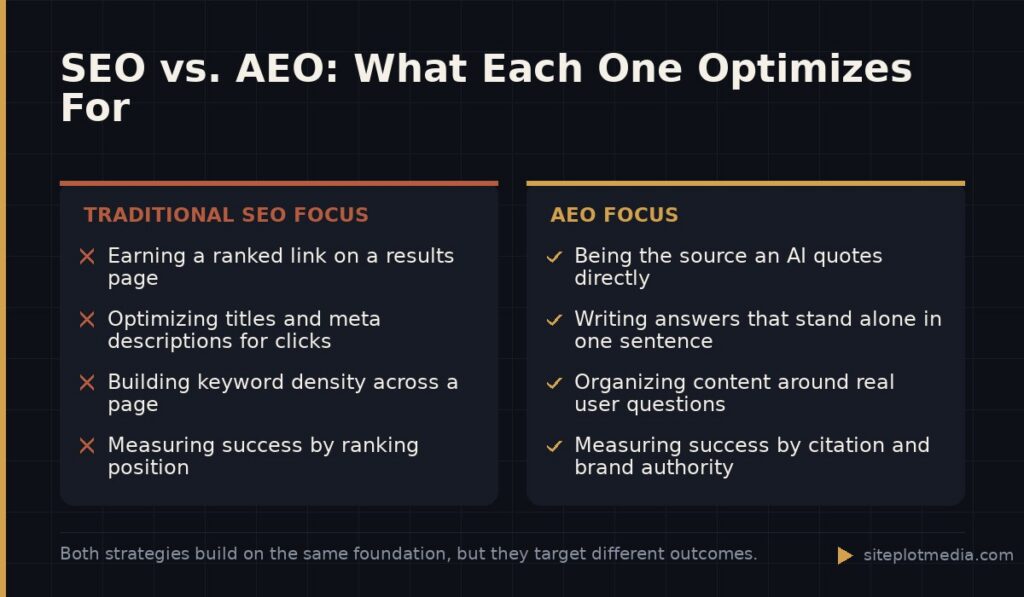
Traditional SEO is built around signals like backlinks, keyword density, page speed, and technical site health. The goal is to convince a search algorithm that your page is relevant and trustworthy enough to rank highly for a given query. It works at the level of the whole page and the whole site.
AEO operates at the level of the individual answer. It asks: if someone asks a specific question, is your content written in a way that a language model can extract a clear, accurate, citable response from it? That means writing in plain language, structuring content with real questions as headings, answering directly before elaborating, and earning genuine authority in your subject area.
Here is where they overlap and where they diverge:
- Both reward expertise and trustworthiness. Google’s E-E-A-T guidelines (Experience, Expertise, Authoritativeness, Trustworthiness) matter for both. An AI is more likely to cite a source a search engine already considers authoritative.
- SEO still cares about click-through. Meta titles, descriptions, and ranking position all influence whether someone visits your page. AEO cares much less about click-through and much more about whether your content is extractable.
- AEO rewards question-and-answer structure. Content organized around real user questions — with direct answers at the top — performs better in AI summaries than content organized around keyword density or marketing messaging.
- AEO does not replace SEO. AI tools still use search indexes and backlink authority as part of how they decide what sources to trust. A site with strong SEO fundamentals is better positioned for AEO, not worse.
This is the kind of thing we handle day to day — you can see how our build process works or browse recent work.
Why this matters for small and mid-sized businesses right now
If you run a small or mid-sized business, the honest answer about AEO urgency is: it depends on what your customers are searching for and how they search. If your customers are asking research questions before making a purchase — “what should I look for in a commercial HVAC contractor” or “how does a retaining wall get priced” — those are exactly the kinds of queries AI tools are now answering directly. If your brand is not in those answers, a competitor’s might be.
On the other hand, if most of your business comes from local intent searches — “plumber near me” or “Athens Georgia florist” — the click-based local SEO model still dominates those results for now. AI Overviews are less common for hyper-local queries, and Google Maps results remain largely unchanged. You do not need to abandon what is working.
The practical risk is this: businesses that have invested in thin, keyword-stuffed content are losing ground on both fronts simultaneously. AI tools are good at detecting when a page says a lot without actually answering anything. That kind of content will underperform in traditional rankings and get skipped entirely by answer engines.
What good AEO content actually looks like
AEO is not a technical trick you bolt onto existing content. It is a writing discipline. The core idea is that your content should answer the question first, then support and expand the answer. This is sometimes called the “inverted pyramid” structure — journalists have used it for over a century, and it turns out AI tools appreciate it too.
Practically, that means:
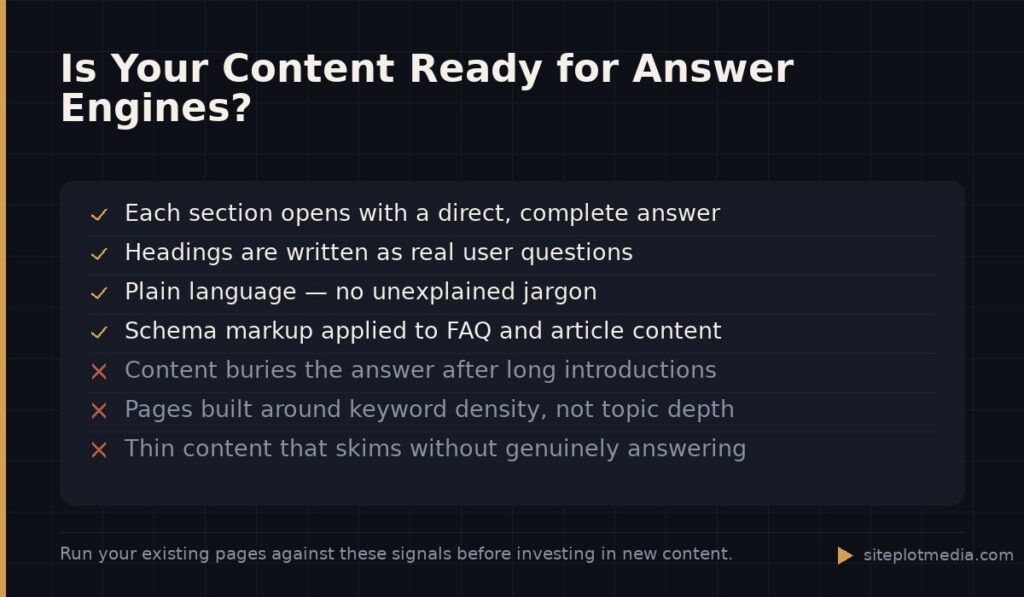
- Use the actual question as a heading, written the way a person would ask it.
- Open the first paragraph of each section with a complete, standalone answer to that question.
- Avoid burying the useful information inside long introductions or marketing copy.
- Use plain language. AI tools parse content written at a conversational level more reliably than dense industry jargon.
- Cover the topic genuinely well. Thin content that skims the surface is easy for both humans and AI to recognize as low-value.
Schema markup — a type of structured data you add to your site’s code — can also help signal to search engines and AI tools that a piece of content is a formal FAQ, article, or how-to guide. It is worth doing, but it is not a shortcut. Schema on shallow content does not help much. Schema on genuinely useful content amplifies what is already there.
Should you hire someone to do this, or handle it yourself?
Some of this work you can do yourself, especially if you are willing to rethink how you write. Auditing your existing pages, rewriting introductions to lead with answers, and reformatting blog posts around real questions are tasks a thoughtful business owner or in-house marketing person can tackle without a large budget.
Where professional help pays off is in the technical layer — structured data implementation, site architecture, page speed, and making sure your content is being indexed correctly — combined with a content strategy that maps your real expertise to the questions your customers are actually asking. That combination is harder to DIY consistently.
If you are evaluating outside help, be realistic about scope. A one-time content audit and rewrite can cost anywhere from a few hundred to several thousand dollars depending on how many pages are involved. Ongoing content and optimization work typically runs $500 to $2,000 per month at the small-business scale, though it varies considerably by provider and deliverables. Siteplot Media’s SEO foundation package, for reference, is a $5,000 one-time build that includes 90 days of support, then $500 per month — structured specifically for small businesses that want a solid technical and content base without committing to a large retainer before they have seen results.
What you should be cautious of: anyone who promises specific rankings or guarantees that your content will appear in AI answers. No one can make that promise honestly. The goal is to make your content a credible, well-structured candidate — and then let the algorithms do what they do.
Frequently asked questions
What is answer engine optimization in simple terms?
Answer engine optimization (AEO) is the practice of writing and structuring your content so that AI tools like ChatGPT or Google's AI Overviews cite it when answering a user's question. Instead of optimizing to rank on a list of links, you are optimizing to be the source an AI quotes directly.
Do I need AEO if I already do SEO?
You do not need to choose — AEO and SEO overlap significantly, and strong SEO fundamentals actually support AEO. The main adjustment is shifting some of your content writing toward clearer, question-and-answer formatting rather than treating them as separate strategies.
Will AEO hurt my website traffic if AI answers the question without a click?
It can reduce clicks for purely informational queries, and that is a real trade-off worth acknowledging. However, being cited in an AI answer still builds brand awareness and authority, and many commercial or local queries still drive traditional click traffic.
How does Google's AI Overview relate to AEO?
Google's AI Overview is one of the most visible places AEO plays out — it is the AI-generated summary box that now appears above traditional results for many searches. Content that is well-structured, authoritative, and answers questions directly is more likely to be sourced in those summaries.
Is AEO only relevant for large companies with big content teams?
No — in fact, small businesses with real subject-matter expertise and a willingness to write plainly often outperform larger competitors in AI-cited results. What matters is genuine depth and clear structure, not content volume or budget size.