Yes, most WordPress sites still benefit from an SEO plugin like Yoast or Rank Math in 2026, because they handle technical housekeeping — sitemaps, meta tags, structured data — that WordPress does not do on its own. Neither plugin will rank your site for you, but skipping both entirely means leaving routine technical tasks to chance. For most small business owners, Rank Math’s free tier covers everything Yoast charges for, making the choice less about which is better and more about which fits how you work.
What these plugins actually do (and what they don't)
Yoast SEO and Rank Math are both WordPress plugins that help you manage the behind-the-scenes signals search engines read when they crawl your site. Think of them as a checklist manager and a control panel rolled into one. They let you set a page title and meta description (the text that appears in search results), generate an XML sitemap automatically, and add structured data — a kind of machine-readable label that helps Google understand whether a page is a recipe, a product, a local business, or an FAQ.
What they cannot do is create demand for your business, write content that earns links, or override the fundamental quality signals Google cares about most: expertise, relevance, and trust. The little color-coded readability scores inside both plugins are training wheels, not ranking signals. Google has never confirmed it reads Yoast’s green dots. If you have been chasing a 100% score thinking it moves rankings, you can stop — focus on writing for your reader instead.
Yoast vs Rank Math: the honest side-by-side
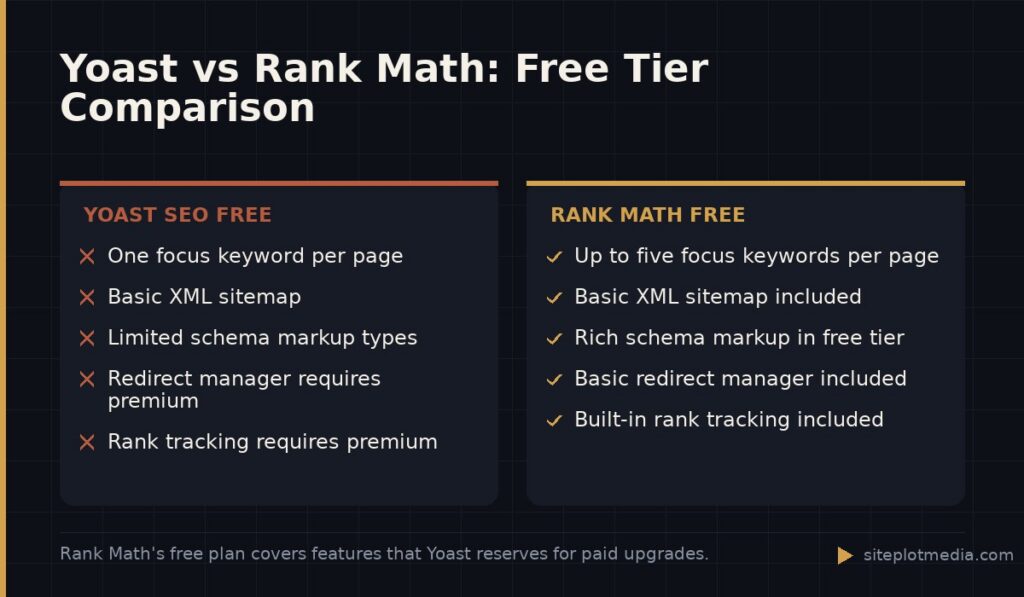
Yoast SEO has been around since 2010 and built its reputation on simplicity and reliability. The free version covers the basics well, and the premium tier adds features like internal linking suggestions and redirect management. Its interface is approachable if you are new to SEO, though some users find it opinionated — it nudges you toward its own style of optimization whether or not that style fits your content.
Rank Math launched in 2018 and immediately gave away a generous free tier that includes schema markup, rank tracking, and multi-keyword focus — features Yoast reserves for paid plans. The tradeoff is a more complex dashboard that can feel overwhelming at first. Rank Math Pro runs considerably cheaper than Yoast Premium for comparable features, though both are priced in a range most small businesses can absorb without much deliberation.
The practical difference for most business owners is small. If your site is already on Yoast and running well, switching to Rank Math is not worth the migration friction unless you have a specific need Rank Math handles better. If you are building a new site and starting fresh, Rank Math’s free plan is the stronger starting point today.
This is the kind of thing we handle day to day — you can see how our build process works or browse recent work.
When you genuinely need one of these plugins
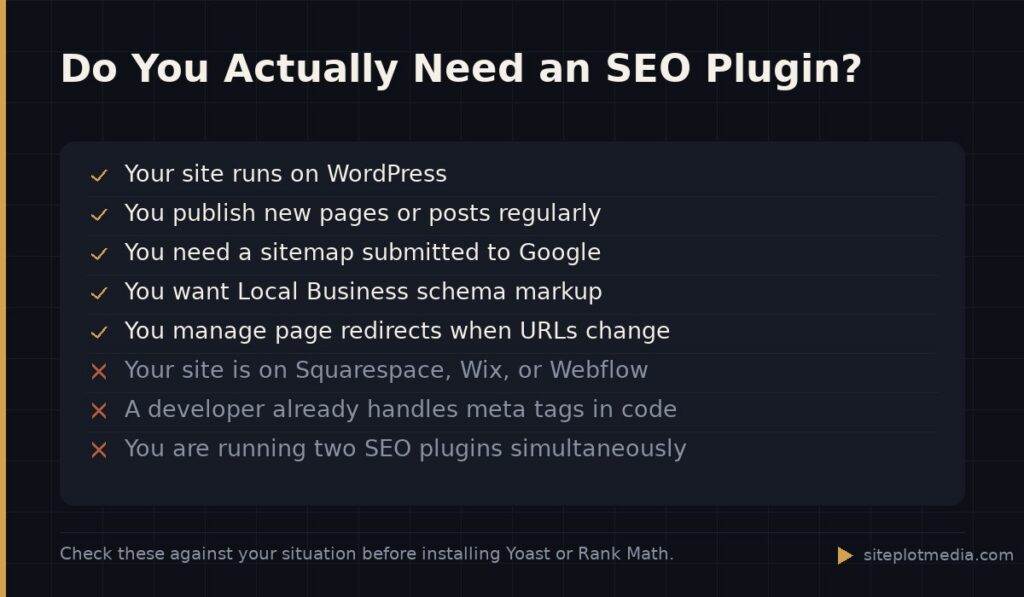
You should use an SEO plugin if your site runs on WordPress and you are not managing meta tags, sitemaps, and structured data through custom code or another dedicated tool. That covers the vast majority of small and mid-sized business sites. The plugin handles these tasks reliably in the background so you do not have to think about them every time you publish a page.
Specific situations where the plugin earns its keep:
- You publish blog posts or service pages regularly and need a consistent way to set unique titles and descriptions for each one.
- Your site has local business information — hours, address, service area — that benefits from Local Business schema markup.
- You want Google to find your pages faster through an up-to-date XML sitemap submitted to Google Search Console.
- You manage redirects when you rename or move pages, so old links do not lead to dead ends.
If your site is a single-page brochure that rarely changes, the stakes are lower. The plugin still does not hurt, but you will use maybe 10 percent of what it offers.
AI search changes the equation — but not as much as you have heard
As of 2026, AI-generated answers from tools like Google’s AI Overviews and ChatGPT’s search features pull from indexed web content. That means the fundamentals have not changed: your pages still need to be crawlable, your content still needs to demonstrate real expertise, and your structured data still helps search engines understand context. An SEO plugin helps with all three of those infrastructure pieces.
What has shifted is where the payoff lives. Thin, keyword-stuffed pages that once ranked on technical optimization alone now get filtered out more aggressively. The plugin sets the table, but the content you put on the table is doing more of the work than ever. If you are investing heavily in an SEO plugin’s paid tier but publishing content that does not genuinely answer your customers’ questions, you have the priorities reversed.
When you can skip both plugins entirely
There are real situations where neither Yoast nor Rank Math is the right answer. If your site is built on a platform other than WordPress — Squarespace, Wix, Webflow, Shopify — these plugins do not apply. Those platforms have their own built-in SEO fields, and adding a third-party plugin is not an option anyway.
If your WordPress site is managed by a developer or agency that handles technical SEO through custom code or a different toolset, adding an SEO plugin on top can create conflicts. Two tools writing to the same meta tag fields is a problem, not a feature. Ask whoever manages your site whether an SEO plugin is already baked into the build before installing one yourself.
Finally, if your business gets most of its leads through referrals, direct outreach, or paid advertising, and organic search is genuinely a low priority, spending time configuring an SEO plugin may not be the best use of your hours. Know your actual traffic sources before investing energy here.
The bigger picture: plugins are infrastructure, not strategy
The most useful way to think about Yoast vs Rank Math is to stop thinking of either as an SEO solution and start thinking of them as plumbing. Good plumbing is invisible when it works and expensive when it is missing. An SEO plugin falls in the same category: install it, configure it correctly once, and then direct your attention toward the content and authority-building work that actually drives growth.
If you are unsure whether your site’s technical SEO foundation is solid — not just the plugin setup, but your site speed, crawlability, internal linking, and structured data accuracy — that is a reasonable thing to have audited. A thorough technical audit from a qualified SEO professional typically runs a few hundred to a few thousand dollars depending on site size and scope. At Siteplot Media, our website builds include this groundwork from the start, so the plugin is configured correctly as part of the project rather than patched in afterward. But whether you work with us or someone else, the point stands: get the foundation right first, then let the plugin maintain it.
Frequently asked questions
Is Rank Math better than Yoast in 2026?
Rank Math offers more features at no cost, making it the stronger default choice for new WordPress sites in 2026. That said, if you are already using Yoast without problems, the difference is not large enough to justify migrating an established site.
Can I use both Yoast and Rank Math at the same time?
No — running both plugins simultaneously will cause conflicts because they both write to the same meta tag fields in WordPress. Install one or the other, never both.
Does Yoast or Rank Math directly improve my Google rankings?
Neither plugin directly improves your rankings — they handle technical setup that makes your content accessible to search engines, but ranking depends on content quality, relevance, and authority. Think of the plugin as clearing obstacles, not as a ranking lever.
Is the free version of Rank Math enough for a small business site?
Yes, Rank Math's free version covers everything most small business sites need, including sitemaps, meta tags, and schema markup. The paid tier adds conveniences like rank tracking inside WordPress, but it is not required for a well-optimized site.
Do SEO plugins work for AI search engines like ChatGPT or Google's AI Overviews?
SEO plugins help indirectly by ensuring your pages are crawlable and structured correctly, which is the same foundation AI-powered search engines use to source their answers. They do not guarantee inclusion in AI-generated responses, but poor technical setup can prevent it.