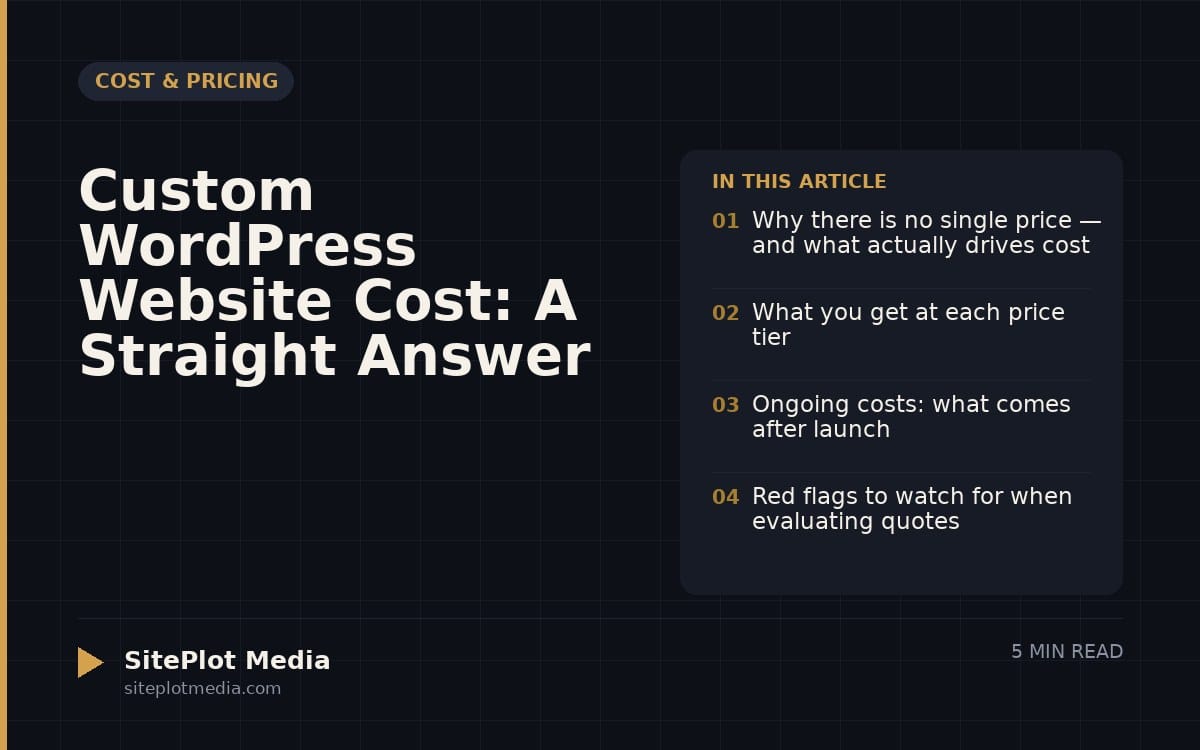
A custom WordPress website typically costs between $3,000 and $25,000 or more depending on the scope of the project, with most small and mid-sized business sites falling in the $4,000–$10,000 range for a professional build. Ongoing costs for hosting, maintenance, and support usually add $200–$600 per month after launch. The wide range exists because “custom WordPress website” covers everything from a five-page brochure site to a complex e-commerce store with custom functionality.
Why there is no single price — and what actually drives cost
When someone quotes you a price for a custom WordPress site, they are really pricing a set of decisions: how many pages, whether the design is built from scratch or adapted from a theme, how much custom functionality is required, and how much content work is included. Change any one of those and the number shifts significantly.
The biggest cost driver is almost always custom functionality. A site that needs a booking system, a member portal, a product configurator, or deep integration with a CRM takes far more development hours than a site that presents information and captures leads through a contact form. The second biggest driver is design. A pixel-perfect custom design built to match your brand requires a skilled designer and a longer approval process — both of which cost real time.
Content is the hidden cost most business owners underestimate. Writing clear, accurate, search-friendly copy for a 15-page site is a substantial project on its own. Many studios offer it as an add-on; others outsource it or skip it entirely and ask you to supply text. Make sure you know which situation you are in before you sign anything.
What you get at each price tier
Understanding what is realistic at each budget level helps you evaluate quotes and avoid surprises.
- Under $1,500: Typically a DIY page builder (Squarespace, Wix, or a WordPress theme you configure yourself) or an offshore freelancer working from a template with minimal customization. Perfectly fine for a brand-new solo business testing an idea, but rarely a good fit for an established company that needs to compete online.
- $1,500–$3,500: A freelancer or small agency using a premium theme with moderate customization. You will get a functional, reasonably attractive site, but the design will likely look familiar because it shares a template with thousands of other sites. Support after launch is often minimal or billed hourly.
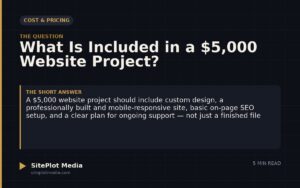
- $4,000–$10,000: The range where most serious small and mid-sized business projects live. At this level you should expect a discovery process, a custom or heavily customized design, proper on-page SEO setup, a staging environment for testing, and some form of post-launch support. This is also where e-commerce projects begin, though a feature-rich WooCommerce store can push toward the upper end or beyond.
- $10,000–$25,000+: Complex builds — large e-commerce catalogs, custom web applications, membership sites, multi-location businesses with unique needs, or projects that require significant third-party integrations. At this level you are paying for senior development talent and a structured project management process.
These ranges assume a U.S.-based studio or experienced freelancer. Offshore rates can be lower, but communication overhead, time zone gaps, and revision cycles often erode the savings.
This is the kind of thing we handle day to day — you can see how our build process works or browse recent work.
Ongoing costs: what comes after launch
The build price is a one-time cost. What you pay every month afterward is a separate conversation, and it is one many vendors bury in fine print.
At minimum, every WordPress site needs managed hosting (typically $30–$100/month for quality hosting), an SSL certificate (often included with hosting), and regular updates to WordPress core, your theme, and your plugins. Skipping updates is how sites get hacked — WordPress powers a large share of the web, which makes it a persistent target. Plugin and theme updates also occasionally break things, which is why someone needs to test after every update cycle.
Beyond basic maintenance, you will likely want ongoing SEO work, analytics review, and the ability to make content changes without paying a developer’s hourly rate each time. Some studios bundle these into a monthly retainer; others bill hourly. Know which model you are signing up for. As one data point, Siteplot Media’s model is a $5,000 one-time build fee plus $500 per month after a 90-day included support period — a structure designed so clients always know what they owe and someone is accountable for the site’s health.
Red flags to watch for when evaluating quotes
A low quote is not automatically a bad sign, and a high quote is not automatically a sign of quality. Here is what to look for regardless of price.
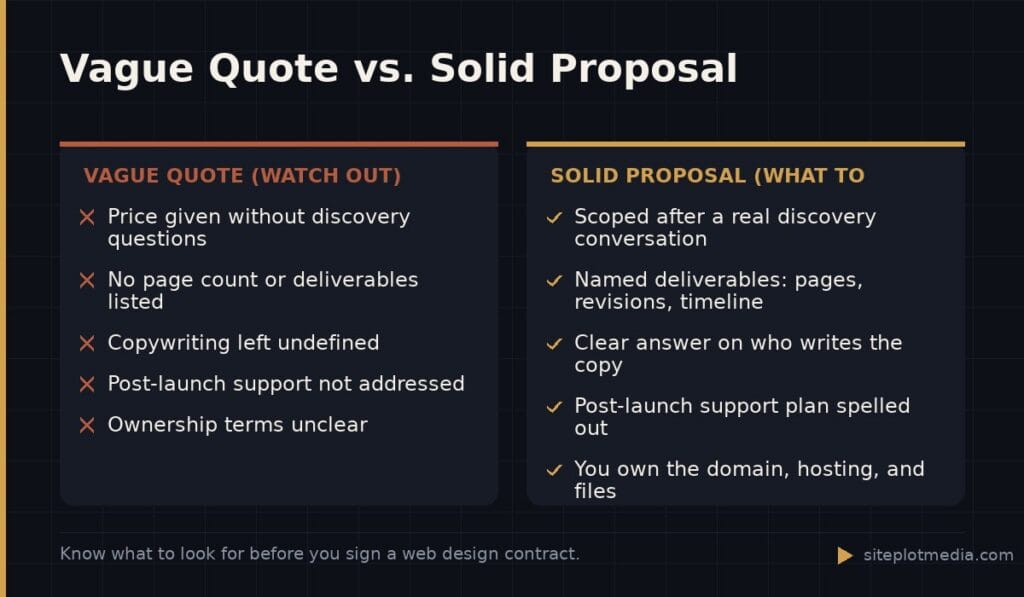
- No discovery process: If a vendor quotes you a price in the first conversation without asking detailed questions about your business, your customers, and your goals, they are pricing a generic product, not your project.
- Vague deliverables: The proposal should name the number of pages, the number of design revisions included, whether copywriting is included, who handles hosting, and what happens if the project runs long. Vague proposals almost always lead to scope creep and extra charges.
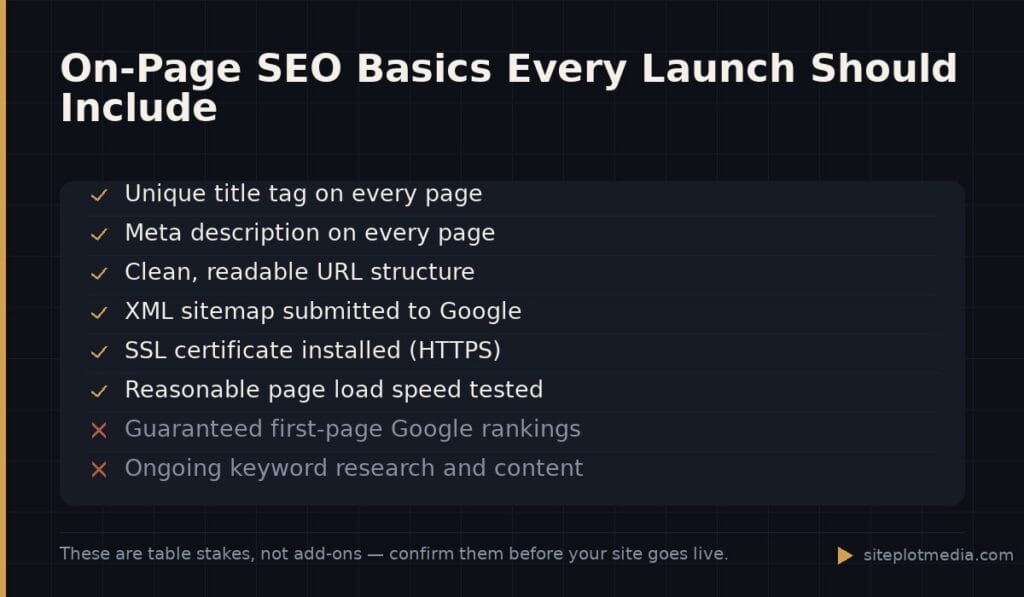
- No mention of SEO basics: A site that launches without proper title tags, meta descriptions, a sitemap, clean URL structure, and reasonable page speed is already starting behind. These are not optional extras; they are table stakes for a site that needs to be found.
- Ownership ambiguity: You should own your domain, your hosting account, and your WordPress installation outright. Some vendors — particularly those offering very low monthly all-in-one plans — retain ownership of your site. Read the contract carefully.
- No post-launch plan: Ask specifically what happens on day 91. If the answer is unclear, budget for the uncertainty.
When a cheaper option is genuinely the right call
Not every business needs a $6,000 website, and it would be dishonest to suggest otherwise. If you are pre-revenue, testing a new service line, or running a local business where most of your customers come from referrals and word of mouth, a well-configured template site can serve you fine in the short term. The goal is a site that accurately represents your business, loads fast, and is easy to update — not necessarily one that was built entirely from scratch.
The calculus changes when your website is a meaningful part of how customers find and evaluate you. If you are competing for organic search traffic, running paid ads that send people to a landing page, or selling directly through your site, the quality of that site has a direct relationship to your revenue. In those cases, treating the website as a cost to minimize is usually a false economy.
A good vendor will tell you which situation you are in. If a studio tries to sell you a $10,000 site when a $4,000 site would genuinely serve your needs, that is a red flag too.
Frequently asked questions
How long does it take to build a custom WordPress website?
Most custom WordPress websites for small and mid-sized businesses take 6 to 12 weeks from signed contract to launch. Timelines stretch when client feedback is delayed, content is not ready, or the scope expands mid-project.
Is WordPress still a good choice for a business website in 2025?
Yes — WordPress remains a strong choice for most business websites because it is flexible, well-supported, and does not lock you into a proprietary platform. The main trade-off is that it requires ongoing maintenance to stay secure, which means you need a plan for who handles updates.
What is the difference between a custom WordPress site and a theme-based site?
A custom WordPress site is designed and built specifically for your brand, while a theme-based site starts from a pre-made template that many other businesses also use. Custom builds offer more design control and can be optimized more precisely, but they cost more and take longer.
Do I need to pay for SEO separately, or is it included in the website build?
On-page SEO foundations — clean URL structure, title tags, meta descriptions, a sitemap, and fast load times — should be included in any professional website build. Ongoing SEO work to improve your rankings over time is a separate service, typically billed monthly.
Can I update a custom WordPress site myself without a developer?
Yes, in most cases — a well-built WordPress site gives you the ability to edit text, swap images, and publish new pages or blog posts without touching code. More complex changes, like adding new features or restructuring the site, will generally still require a developer.