
Squarespace is good enough for many professional services firms, but it depends on what “good enough” means for your business. If your site primarily needs to look polished, communicate your offer, and capture leads, Squarespace can do that job. If you need deep SEO control, custom integrations, or a site that scales with a complex marketing strategy, WordPress will serve you better in the long run.
What Squarespace actually does well
Squarespace is a hosted platform, meaning Squarespace itself handles the servers, security updates, and software maintenance. For a small law firm, consultant, or financial advisor who has no interest in managing a website behind the scenes, that is a genuine advantage. You pay a monthly subscription and the technical housekeeping is handled for you.
The templates are professionally designed out of the box, and the editor is visual and intuitive. If your primary goal is a site that looks trustworthy, shows your services, and includes a contact form or scheduling link, Squarespace can get you there without a developer. For firms that update their own content infrequently, the simplicity holds up well over time.
Squarespace also bundles in hosting, SSL (the security certificate that shows the padlock in a browser), a basic analytics dashboard, and e-commerce for simple transactions. For a solo practitioner or a small team that wants one predictable monthly bill and a site they can maintain themselves, that bundled simplicity is worth something real.
Where Squarespace runs into real limits
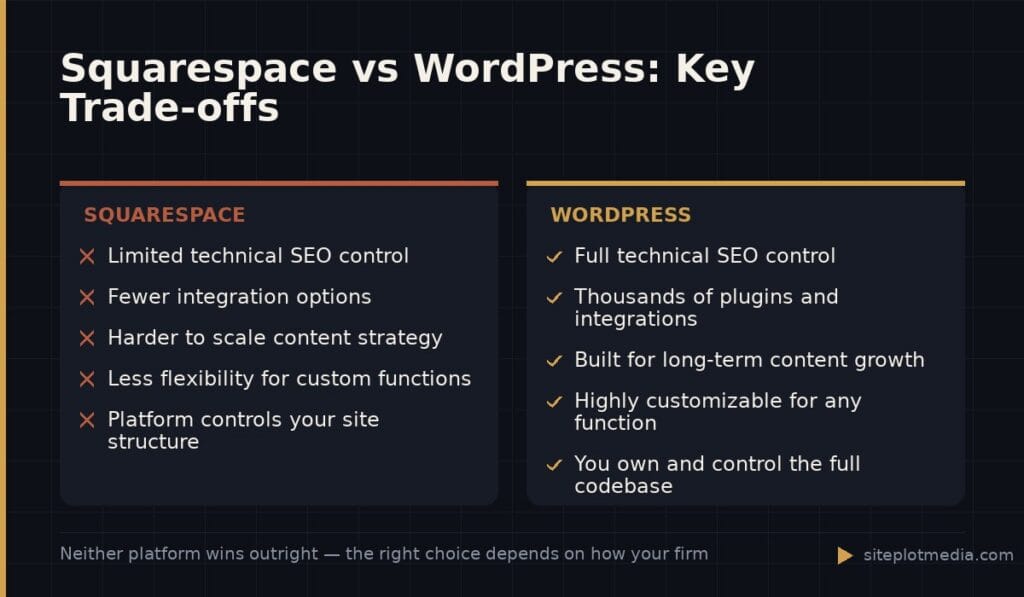
Squarespace’s biggest limitation for professional services firms is control — specifically, control over technical SEO. SEO stands for search engine optimization, the practice of making your site visible in Google and other search engines. Squarespace gives you the basics: page titles, meta descriptions, and image alt text. But it limits your ability to control site structure, URL patterns, schema markup (structured data that helps Google understand what your business does), and page speed tuning in any meaningful way.
Page speed is increasingly important. Squarespace sites tend to load heavier than lean, well-built WordPress or custom sites because the platform loads its own scripts regardless of whether your page needs them. This is not a catastrophic flaw, but it is a real one if you are competing for search traffic in a specific market or practice area.
Integrations are also constrained. Squarespace connects cleanly to a handful of popular tools — Acuity Scheduling, Mailchimp, a few CRMs — but if your firm uses specialized software, you will often hit a wall. WordPress, by contrast, has an ecosystem of thousands of plugins and supports custom API connections. If you ever need your website to talk to your practice management software or marketing automation stack, that gap matters.
This is the kind of thing we handle day to day — you can see how our build process works or browse recent work.
The honest case for WordPress
WordPress powers a large share of the websites on the internet, and that scale is the reason its ecosystem is so large. Nearly any function you can imagine — custom client portals, gated resources, multilingual content, advanced local SEO tools — has a plugin or a developer who has built it before. That flexibility is WordPress’s strongest argument.
The trade-off is maintenance. A WordPress site requires software updates, plugin updates, security monitoring, and periodic performance audits. You can hire someone to manage all of that, but it is an ongoing cost and responsibility that Squarespace simply does not impose. If you let a WordPress site go unmanaged, it can become a security liability or degrade in performance over time.
For firms with competitive SEO goals — say, a personal injury attorney trying to rank in a specific metro area, or a consulting firm producing regular thought-leadership content — WordPress gives you tools that Squarespace does not. Plugins like Yoast or Rank Math let you fine-tune technical SEO in ways that directly affect how your pages rank. A well-built WordPress site with a disciplined content strategy will almost always outperform a comparable Squarespace site in search results over time.
How to actually decide between them
The most useful question is not “which platform is better?” but “what does my website need to do?” Here is a practical way to think through it:
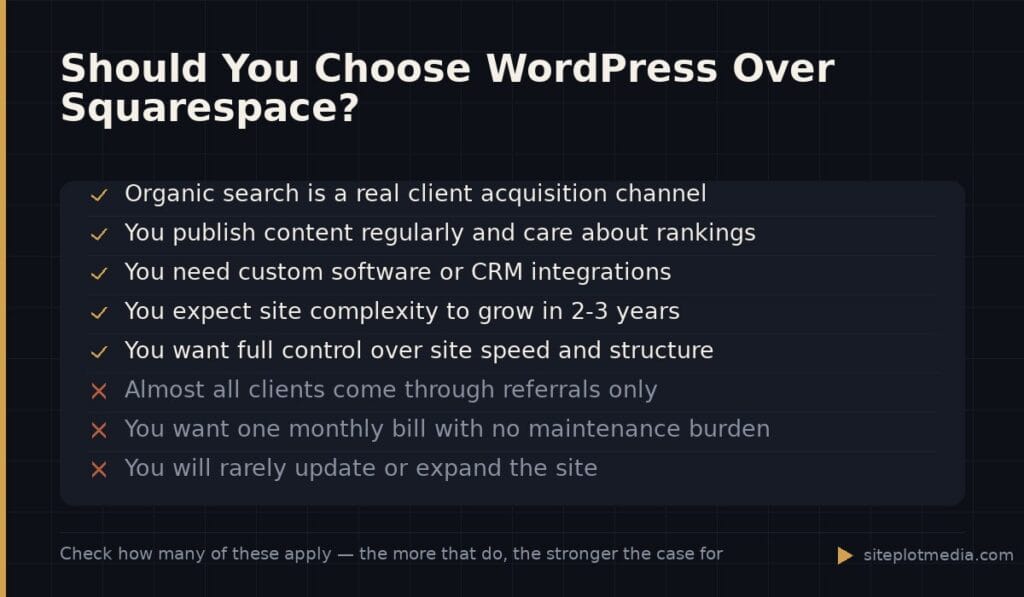
- Go with Squarespace if your site is primarily a digital business card — services, about page, contact form, maybe a blog you update occasionally. If referrals drive most of your business and you want a clean, credible web presence without ongoing maintenance overhead, Squarespace is genuinely fine.
- Go with WordPress if organic search is a real acquisition channel for you, if you need custom integrations, if you publish content regularly and care about how it ranks, or if you expect your site to grow in complexity over the next few years.
- The hybrid question: Some firms start on Squarespace and migrate to WordPress later. That migration is doable but not free — it takes time and money and often requires rebuilding content. If there is any real chance you will need WordPress capabilities in two or three years, it is usually cheaper to start there.
Budget is a real factor. A Squarespace subscription costs roughly $23–$65 per month depending on the plan, and you can build a basic site yourself at no additional cost. A professionally built WordPress site — one that is fast, secure, and optimized — typically runs several thousand dollars upfront plus ongoing maintenance. Siteplot Media’s own WordPress package, for reference, starts at $5,000 for the build and $500 per month for ongoing management after a 90-day included period. Whether that investment makes sense depends entirely on whether your website is a meaningful part of how you find and convert clients.
One thing that trips up professional services firms
The most common mistake we see is choosing a platform based on how the site looks at launch rather than what the business needs the site to do over a three-to-five year horizon. A Squarespace site can look just as polished as a WordPress site in year one. The gap tends to show up in year two and three, when you want to run a content strategy, track conversions properly, or integrate a tool your business has started using.
It is also worth separating “looks professional” from “performs professionally.” A site can be visually impressive and still load slowly, fail to rank for any relevant search terms, or make it hard for visitors to take the next step. Platform choice is one part of that picture — but site structure, content quality, and conversion design matter just as much regardless of which platform you use.
Frequently asked questions
Can a Squarespace site rank on Google?
Yes, Squarespace sites can rank on Google, but they offer less technical SEO control than WordPress. For low-competition searches and local brand queries, Squarespace is usually sufficient; for competitive keyword rankings, WordPress gives you more tools to work with.
Is WordPress harder to maintain than Squarespace?
Yes, WordPress requires more ongoing maintenance than Squarespace. Plugin updates, security monitoring, and performance checks are your responsibility on WordPress, whereas Squarespace handles that infrastructure for you as part of your subscription.
Can I move my Squarespace site to WordPress later?
Yes, migrating from Squarespace to WordPress is possible but involves real cost and effort. Expect to rebuild much of the site's design and reformat content rather than doing a simple automated transfer.
Does platform choice affect how fast my site loads?
Yes, platform choice affects page speed, though the quality of the build matters just as much as the platform itself. A poorly optimized WordPress site can load slower than a clean Squarespace site, and vice versa.
Is Squarespace good enough for a law firm or consulting practice?
Squarespace is good enough for many law firms and consulting practices whose clients come primarily through referrals and who want a credible, low-maintenance web presence. If organic search is a significant part of your client acquisition, WordPress is likely the better long-term investment.