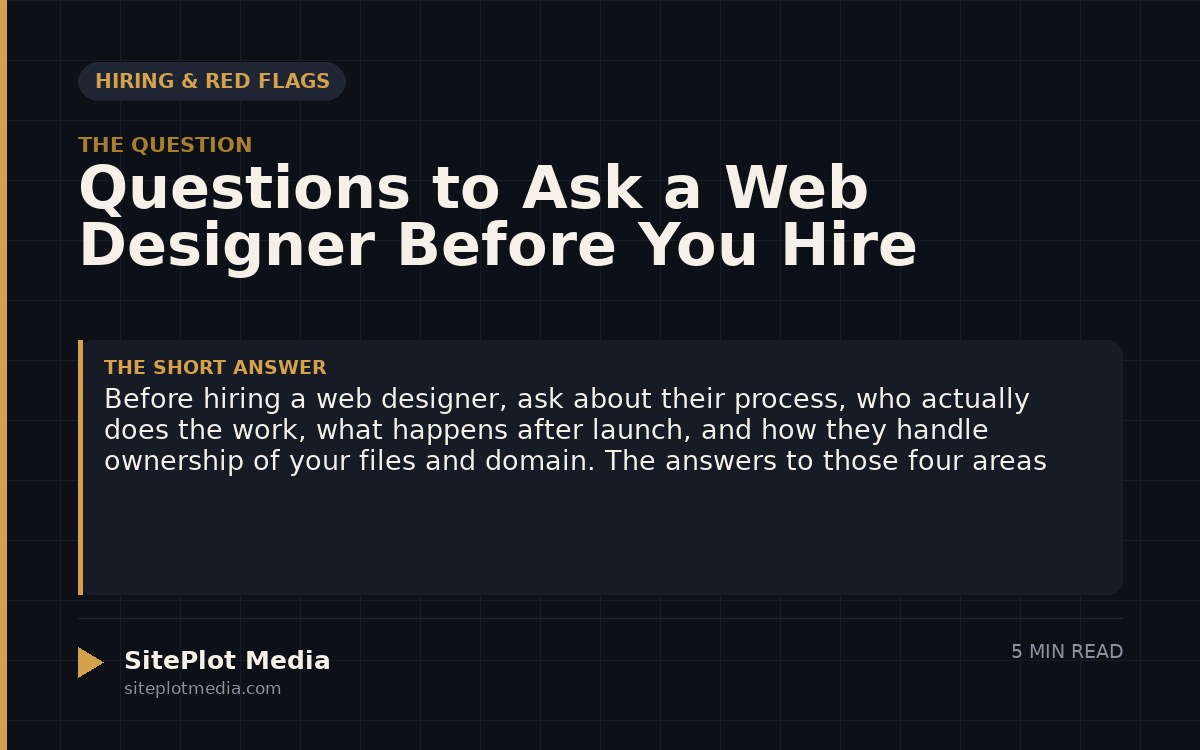
Before hiring a web designer, ask about their process, who actually does the work, what happens after launch, and how they handle ownership of your files and domain. The answers to those four areas will reveal more about fit and risk than a portfolio alone ever will.
Start with process, not portfolio
A good-looking portfolio tells you a designer has taste. It does not tell you whether they will deliver on time, communicate clearly, or build something that actually serves your business goals. Ask how their process works from the first conversation to launch day, and listen for specifics.
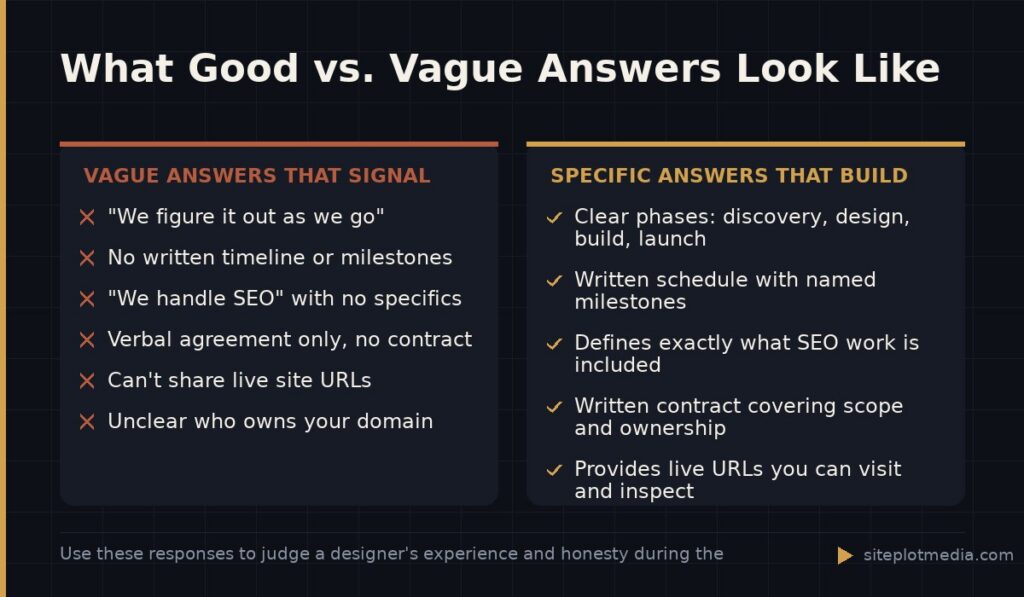
A designer who can walk you through distinct phases — discovery, wireframes or content planning, design, development, testing, launch — is showing you they have done this more than a few times. A vague answer like “we just figure it out as we go” is not a sign of flexibility; it is a sign of a process that tends to miss deadlines and scope.
Also ask how they gather information from you at the start. A good designer will want to understand your customers, your goals, and what success looks like before they open a design tool. If they skip straight to asking for your logo and brand colors, that is a red flag.
Who will actually build your site?
Many web designers subcontract development work, copywriting, or SEO to other people — sometimes overseas, sometimes to other freelancers they have never worked with before. That is not automatically bad, but you deserve to know it upfront.
Ask directly: “Will you personally be doing all the work, or do you use a team or contractors?” Then ask how those people are managed and how quality is reviewed before anything reaches you. A honest answer, whatever it is, is reassuring. Evasion is not.
If you are hiring an agency, ask who your day-to-day contact will be and whether that person changes after the sale. It is common for a senior person to close the deal and then hand the project to a junior team member. Knowing that in advance helps you set expectations and ask the right follow-up questions about that person’s experience.
This is the kind of thing we handle day to day — you can see how our build process works or browse recent work.
Questions about ownership and access you must ask before signing
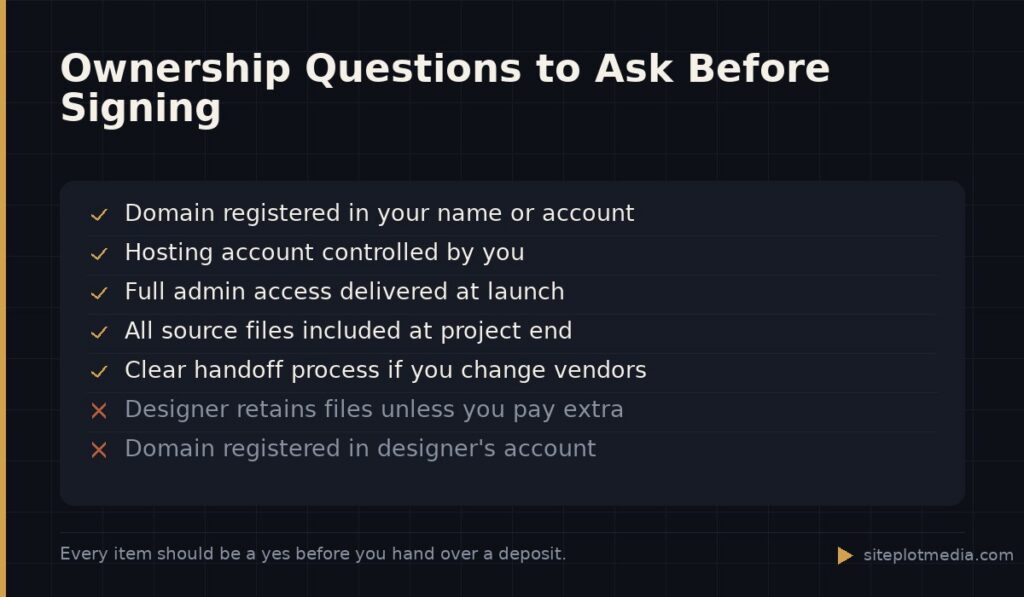
This is the area where the most painful surprises happen. Some designers retain ownership of your website files, your theme, or even your domain name. When the relationship ends — for any reason — you can find yourself locked out of your own site or forced to start over.
Ask these questions before you sign anything:
- Who owns the domain name, and whose account is it registered in?
- Who owns the hosting account?
- Will I receive all source files and have full admin access at launch?
- If I ever want to move to a different developer, what does that handoff look like?
The correct answers are: you own the domain, you own or control the hosting, you get full admin access, and a handoff is straightforward. If a designer cannot give you those answers clearly, the project is not really yours — you are licensing it.
What happens after the site launches?
Launch day is not the finish line. Websites need security updates, plugin or platform maintenance, occasional content changes, and ongoing performance monitoring. Ask every candidate what their post-launch support looks like and what it costs.
Some designers disappear after launch. Others offer a short warranty period for bug fixes. Others offer ongoing monthly maintenance. None of those models is wrong for every situation — a simple brochure site for a local business has different needs than a growing e-commerce store — but you should know what you are getting before you sign.
Also ask what platform they build on and why. WordPress, Webflow, Squarespace, and custom builds all have different maintenance profiles. Ask whether you will be able to make simple content edits yourself, or whether every small change requires a paid request to them. If you have a team that updates content regularly, that matters a lot.
Red flags that are easy to miss during the sales conversation
Some warning signs are obvious — no contract, no references, an unusually low price with no explanation. Others are subtler and worth knowing about.
- They guarantee specific search rankings. No honest designer or SEO can promise a first-page ranking. Google’s algorithm is not something anyone controls. A designer who promises rankings is either misinformed or misleading you.
- They are vague about timeline. “A few months” is not a timeline. Ask for a written schedule with milestones.
- They cannot show you live examples of sites they built. Mockups and screenshots are easier to fake than a URL you can visit and inspect.
- They discourage you from talking to past clients. References should be easy to provide. If they are not, ask why.
- The contract is entirely verbal. Every project, at every price point, should have a written agreement that covers scope, timeline, payment schedule, and ownership.
A good designer will not be offended by any of these questions. They will expect them.
One final question that reveals a lot: how do you price?
Pricing in web design ranges enormously — from a few hundred dollars for a template setup to tens of thousands for a custom-built platform. Neither end is automatically right or wrong for your situation. What matters is whether the pricing model aligns with what you actually need.
Ask whether the quote is fixed or hourly, what is included, and what costs extra. Common extras include copywriting, photography, SEO setup, e-commerce functionality, and ongoing edits. Getting a clear scope and a written quote protects both of you.
For context on what a full-service engagement can look like: Siteplot Media’s standard package is a $5,000 one-time build with a 90-day included support period, followed by $500 per month. That model bundles ongoing maintenance and support into a predictable cost, which works well for businesses that want one accountable partner rather than managing multiple vendors. Whether that fits your situation depends on your scope, your goals, and how much of the ongoing relationship you want handled for you.
Frequently asked questions
How do I know if a web designer is legitimate?
Ask for live URLs of sites they have built, a written contract, and at least one past client reference you can contact directly. A legitimate designer will provide all three without hesitation.
Should I ask a web designer about SEO?
Yes — ask specifically whether SEO is included and what that covers, because the term means very different things to different people. At minimum, a designer should build your site with clean structure, fast load times, and proper page titles; anything beyond that is usually a separate service.
What is a reasonable timeline to expect for a small business website?
A straightforward five-to-ten page site typically takes six to twelve weeks from signed contract to launch, assuming you provide content and feedback on schedule. Delays on the client side are the most common reason projects run long.
Is it okay to hire a freelancer instead of an agency?
Yes — a skilled freelancer can be an excellent choice for many small business websites, often at a lower cost than an agency. The key is confirming that one person can genuinely handle design, development, and any other services you need, rather than quietly subcontracting work they are not qualified to do.
What should a web design contract include?
A web design contract should spell out the project scope, payment schedule, timeline with milestones, who owns the finished files, and what happens if either party needs to end the engagement early. If a designer resists putting any of those items in writing, that is a reason to pause.