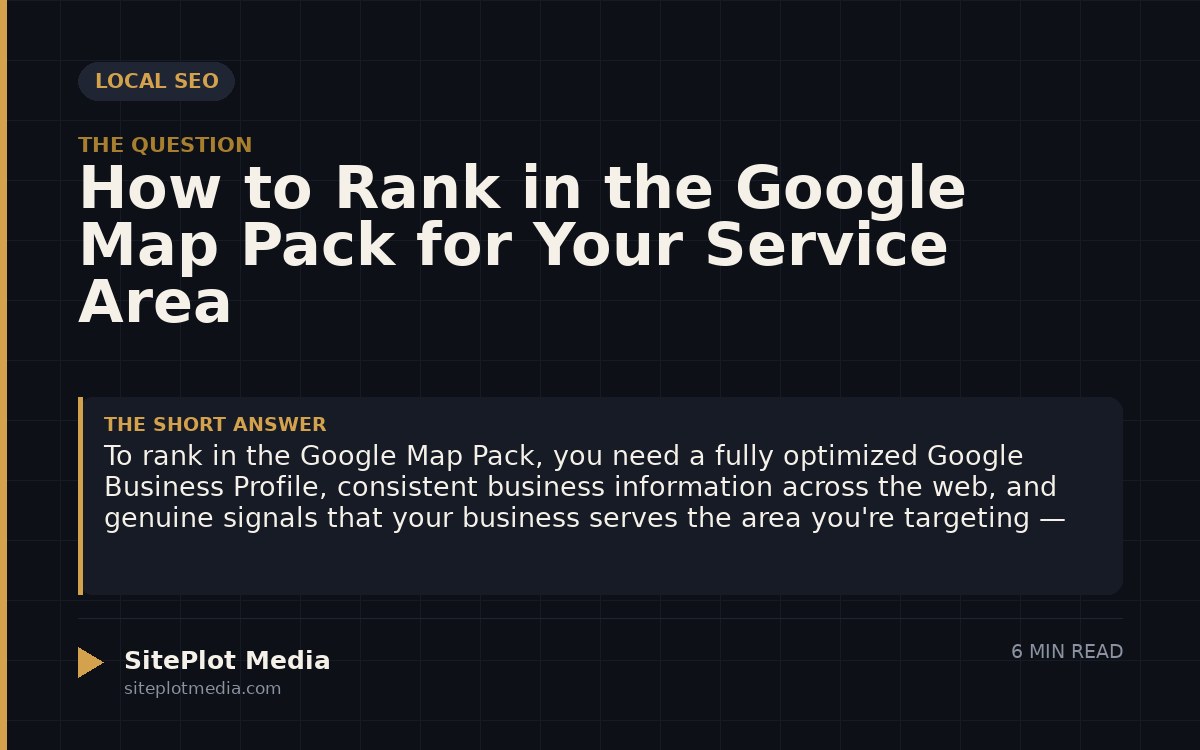
To rank in the Google Map Pack, you need a fully optimized Google Business Profile, consistent business information across the web, and genuine signals that your business serves the area you’re targeting — primarily through local reviews, relevant website content, and citations from reputable directories. No single tactic guarantees a top-three position, because Google weighs relevance, distance, and prominence together, and your competition level matters as much as your own effort. That said, most small businesses have significant gaps in the basics, which means fixing the fundamentals usually produces meaningful improvement.
What the Map Pack actually is and why it matters
The Google Map Pack — sometimes called the Local Pack — is the block of three business listings that appears near the top of a Google search results page when someone searches for a local service. It shows a map, three business names, their star ratings, and a few key details. It sits above most organic results, which means it gets a large share of clicks before anyone scrolls further.
For service-area businesses — plumbers, landscapers, marketing agencies, home inspectors, and the like — the Map Pack is often the single most valuable piece of real estate on Google. If you’re not in it, many potential customers never see you, even if you have a perfectly good website. That asymmetry is why local SEO conversations almost always start here.
Start with your Google Business Profile — it's the foundation
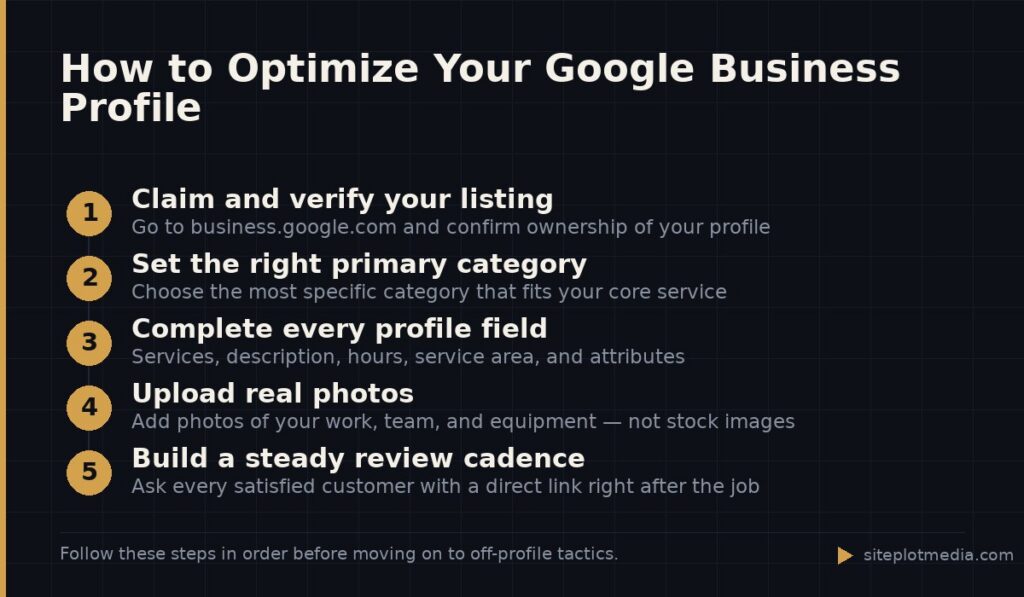
Your Google Business Profile (GBP) is the free listing that feeds the Map Pack. If you haven’t claimed yours, do that first at business.google.com. If you have claimed it but set it up years ago and haven’t touched it since, treat it as incomplete. Google rewards profiles that are thorough, accurate, and actively maintained.
The fields that matter most are:
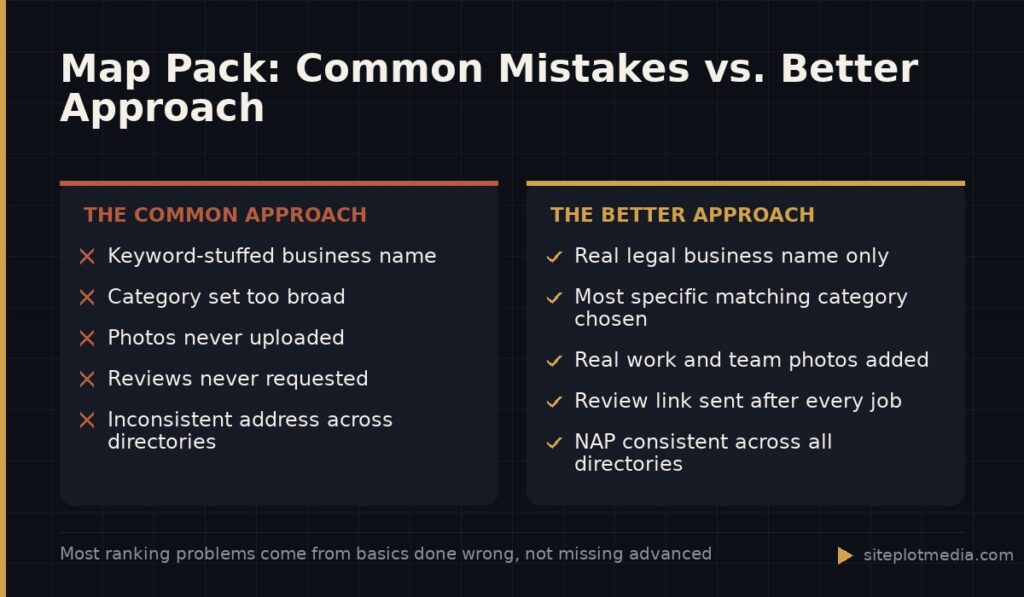
- Business name: Use your real business name. Keyword-stuffing your name (“Smith Plumbing — Best Athens Plumber”) violates Google’s guidelines and can get your listing suspended.
- Primary category: This is the most important category field. Choose the one that most precisely describes your core service, not the broadest option.
- Service area: If you go to customers rather than having them come to you, set your service area rather than a storefront address. You can list multiple cities or zip codes.
- Business description: Write 2-3 sentences that describe what you do, who you serve, and what makes you a credible choice. Skip the marketing fluff.
- Photos: Upload real photos of your work, your team, and your equipment. Listings with photos get more engagement, and engagement is a signal Google notices.
- Products and services: Fill these out with actual service names and short descriptions. This helps Google understand your relevance to specific searches.
Post updates to your profile regularly — even once or twice a month. It signals to Google that your business is active, not abandoned.
This is the kind of thing we handle day to day — you can see how our build process works or browse recent work.
Reviews are the most underestimated ranking factor
Google uses reviews as a measure of prominence — how well-known and trusted your business is. A business with 80 reviews averaging 4.6 stars will almost always outrank an identical competitor with 12 reviews, all else being equal. The quantity, recency, and quality of your reviews all matter.
The most effective way to get more reviews is also the simplest: ask. After every completed job, send a follow-up text or email with a direct link to your Google review page. Most customers won’t volunteer a review unprompted, but many will leave one if you make it easy. Aim for a steady trickle rather than a sudden burst — a dozen reviews in one week after months of silence looks unnatural.
When you receive a review — positive or negative — respond to it. For negative reviews, respond calmly and professionally. How you handle criticism is itself a trust signal to both Google and future customers reading your profile. Never respond defensively, and never ask Google to remove a review just because it’s unflattering.
Citations and consistency: the unglamorous work that still matters
A citation is any mention of your business name, address, and phone number on another website. Directories like Yelp, the Better Business Bureau, Apple Maps, and industry-specific sites all count. Google cross-references these to confirm that your business is real and that your contact information is consistent. Inconsistencies — an old address, a slightly different phone number, a misspelled business name — create ambiguity that works against you.
You don’t need to be listed on hundreds of directories. Focus on the major general directories first, then any directories that are specific to your industry or region. A local chamber of commerce listing from Athens, Georgia carries real weight for businesses here because it’s a credible local source. The same logic applies wherever you’re based.
Tools like BrightLocal or Whitespark can audit your existing citations and find inconsistencies. Many SEO agencies handle citation cleanup as part of a broader local SEO engagement — it’s not glamorous work, but it removes friction from Google’s ability to trust your listing.
Your website still matters, even for Map Pack rankings
Google’s Map Pack rankings aren’t entirely divorced from your website. Google looks at your site to understand what you do, where you operate, and whether you’re a credible business. A website that’s thin on content or never mentions your service areas sends a weak signal.
At a minimum, make sure your website has:
- Your business name, address, and phone number (or service area) somewhere consistent, ideally in the footer
- A dedicated page for each major service you offer
- Content that naturally mentions the cities and regions you serve — not keyword-stuffed lists, but genuine context
- A contact page that matches the information on your Google Business Profile exactly
If you serve multiple cities, consider creating individual location or service-area pages for each. Done well, these pages help Google understand your geographic relevance. Done lazily — identical text with only the city name swapped — they’re ignored or penalized. The difference is whether the page actually says something useful to a person in that city.
Realistic timelines and when to get help
Local SEO is not a switch you flip. After making changes to your Google Business Profile, it typically takes several weeks before you see movement. Building review volume takes months. Citation cleanup is a one-time project, but its effects accumulate gradually. If your market is competitive — say, home services in a mid-sized metro — you may be waiting three to six months before you see meaningful improvement in Map Pack position.
Many business owners handle the basics themselves: claiming the profile, adding photos, asking for reviews, and ensuring their website has service-area pages. That’s a reasonable starting point, and for businesses in lower-competition markets, it may be enough. If you’re in a competitive niche, if your listing has been suspended, or if you’ve made changes and nothing has moved after several months, working with a local SEO specialist is worth considering.
Siteplot Media offers a local SEO engagement — $5,000 one-time for the foundational build, with a 90-day included period followed by $500 per month for ongoing management — but whether that’s the right fit depends entirely on your market, your goals, and what you’ve already done. If you’re a low-competition business that just needs the basics set up, a full ongoing retainer may be more than you need. We’ll tell you that honestly if it’s true.
Frequently asked questions
How long does it take to rank in the Google Map Pack?
Most businesses see meaningful improvement within three to six months of making consistent, well-executed changes — though lower-competition markets can move faster. Timeline depends on how competitive your category is, how complete your starting point is, and how actively you're building reviews and signals over time.
Do I need a physical address to appear in the Map Pack?
No — service-area businesses that go to their customers can rank in the Map Pack without listing a storefront address. You set a service area on your Google Business Profile instead, specifying the cities or regions you cover.
Can I rank in the Map Pack for a city where I don't have an office?
Yes, but it's harder the farther you are from the city. Google factors in proximity, so businesses physically located in or near the searched city have a natural advantage; you can offset this with strong reviews, relevant website content, and citations that confirm your presence in that area.
Will adding keywords to my business name on Google help me rank?
Keyword-stuffing your business name violates Google's guidelines and can result in your listing being suspended or edited by a competitor. Use your real, legal business name and rely on your category, services, and content to signal relevance.
How many reviews do I need to rank in the Map Pack?
There's no universal threshold — it depends entirely on what your competitors have. In a small market you might rank with ten solid reviews; in a competitive metro you may need fifty or more to be competitive. Focus on consistently earning reviews rather than hitting a specific number.