Whether you own your website after paying for it depends entirely on what your contract says — and many business owners are surprised to discover they own very little. Ownership of a website involves several separate assets: the domain name, the hosting account, the design, and the underlying code. Without clear written agreements transferring each of these to you, your developer or agency may retain control over parts of your site even after you’ve paid in full.
Website ownership is not one thing — it's four
When most business owners say “my website,” they picture the whole thing as a single object. In reality, a website is a bundle of distinct assets, and you can own some while your developer or agency owns others. This distinction is where most ownership disputes start.
The four assets that matter are:
- Domain name — the web address (like yourbusiness.com). It lives in a registrar account, and whoever controls that account controls the domain.
- Hosting account — the server where your website files actually live. If the account is in your developer’s name, they can take the site offline or hold it hostage.
- Design and content — the visual look, copywriting, images, and branding created for your site.
- Code and software — the underlying files, theme, plugins, and any custom-built functionality.
A thorough contract should address each one. If yours doesn’t, ask now — before there’s a problem.
The most common ways developers retain control
The honest truth is that some agencies structure their business so that you become dependent on them, whether intentionally or just out of habit. Knowing the common patterns helps you spot them before you sign anything.
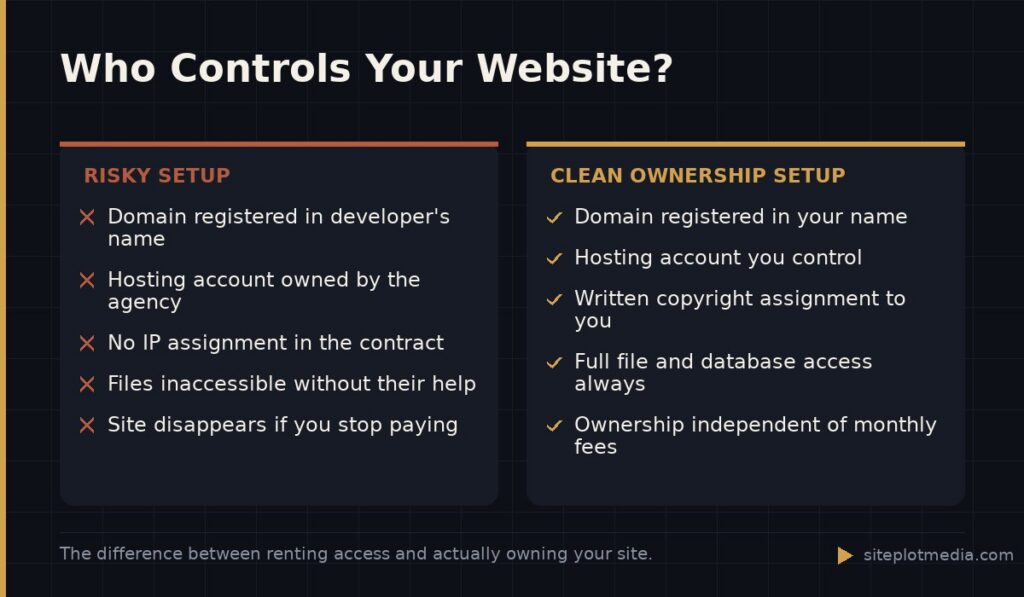
The most frequent red flag is a developer who registers your domain and sets up hosting in their own account rather than yours. If you later want to leave, they control the keys. Some will hand everything over gracefully; others will drag their feet or hold files until outstanding invoices are paid — even disputed ones.
A second pattern involves proprietary website builders. Some agencies build sites on platforms they license and control. When you stop paying the monthly fee, the site can simply disappear. This is different from mainstream platforms like Squarespace or Shopify, where you have your own account — it’s a gray zone where the agency is the actual account holder and you’re a tenant.
Finally, watch for contracts that say the agency retains copyright to the design and code until certain conditions are met, or indefinitely. Under U.S. copyright law, the creator owns the work unless there is a written agreement assigning it to you. Paying for the work is not, by itself, that agreement.
This is the kind of thing we handle day to day — you can see how our build process works or browse recent work.
What a clean ownership arrangement actually looks like
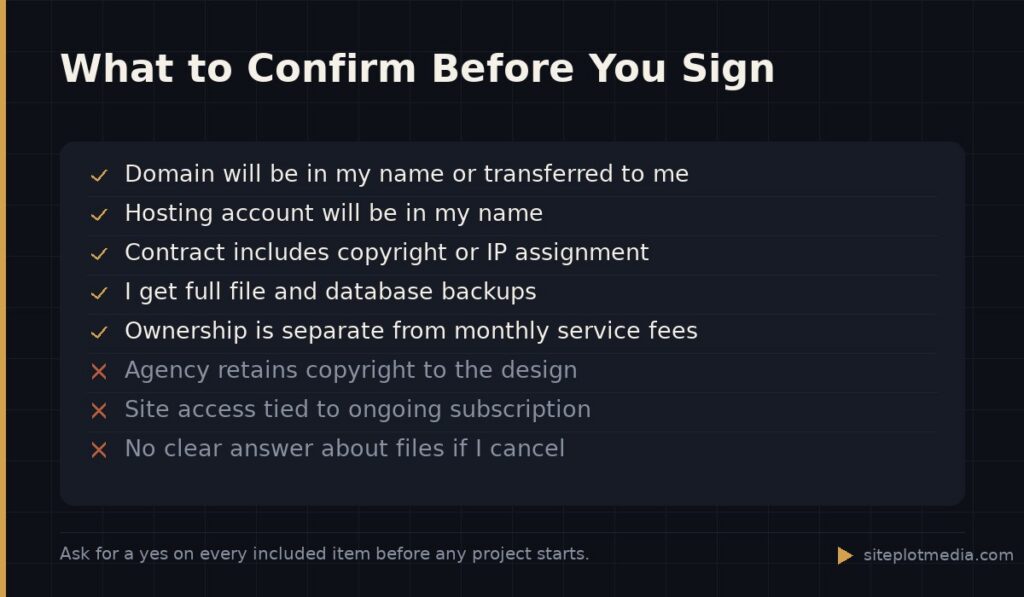
A developer or agency with nothing to hide will set things up so that you are the owner of record on every account from day one. That means you create the domain registrar account (or they transfer the domain to your existing one), and you own or control the hosting environment. The agency may manage these on your behalf, but the accounts are yours.
On the intellectual property side, the contract should include a clear work-for-hire clause or an assignment of rights that transfers ownership of the design and code to you upon final payment. The agency may reasonably retain a portfolio right to show the work publicly, but you should own the deliverables.
You should also receive, or have on-demand access to, a full backup of your site files and database. If a developer is reluctant to hand over files or login credentials when you have a legitimate right to them, that tells you something important about how the relationship will go.
Red flags to look for before you hire anyone
The time to protect your ownership is before the project starts, not after something goes wrong. Here are the specific things to look for when reviewing a proposal or contract:
- No mention of who owns the domain or hosting after the project ends
- The contract is silent on copyright or intellectual property
- The agency insists on keeping accounts in their name “for convenience”
- There is a long-term lock-in with steep exit penalties
- You cannot get a straight answer about what happens to your files if you cancel
- The proposal doesn’t distinguish between the build fee and ongoing access fees
None of these automatically means the developer is dishonest. Some are habits left over from an earlier era of web development. But they are worth raising directly, and a professional agency should have clear, comfortable answers for all of them.
Subscription and maintenance agreements — a separate layer to understand
Ongoing maintenance or hosting agreements are legitimate and often valuable. The question is what you’re actually paying for and what happens if you stop. A fair arrangement charges you for ongoing services — hosting, security monitoring, updates, support — while your ownership of the underlying site remains intact regardless of whether you continue the service.
An unfair arrangement bundles your ownership with your subscription. Stop paying, and you lose access to files, the domain, or the ability to move the site to another provider. Always ask: “If I cancel my monthly plan, what do I walk away with?” The answer should be: everything.
For context on what a transparent arrangement can look like — Siteplot Media’s model is a one-time $5,000 build fee that transfers full ownership to the client, followed by an optional $500/month maintenance plan that begins after a 90-day included period. The site is yours either way. That kind of clarity is what you should expect from any reputable provider, regardless of their pricing structure.
What to do if you're not sure who owns your current site
If you already have a site and you’re not certain what you own, start by looking up your domain at a registrar lookup tool (search for “WHOIS lookup”). The registrant contact listed there is the legal owner. If it’s your developer’s name or company rather than yours, that’s worth addressing promptly.
Next, try logging into your hosting account independently of your developer. If you don’t have credentials, ask for them in writing. The response will tell you a lot. A professional agency will provide access immediately or walk you through a transfer. Resistance or vague delays are a warning sign.
If the relationship is already contentious, consult an attorney before making any moves. Website ownership disputes can intersect with contract law, copyright law, and domain law simultaneously — getting advice first can prevent you from accidentally making things worse.
Frequently asked questions
Do I own my website if I paid someone to build it?
Not automatically — ownership depends on what your contract says. Under U.S. copyright law, the person who creates a work owns it unless there is a written agreement assigning those rights to you, so paying for the work alone is not enough.
What happens to my website if I stop paying my web developer?
It depends on what your agreement covers. If your monthly payment is for ongoing hosting or maintenance and your files are yours, you should be able to move the site elsewhere. If your payment is bundled with access to the site itself, you may lose it — which is why you should ask this question before signing anything.
Who owns the domain name for my website?
Whoever controls the registrar account owns the domain. Run a WHOIS lookup on your domain to see who is listed as the registrant — if it's your developer rather than you, ask for a transfer immediately.
Can a web developer take my website down if I don't pay them?
If your hosting account is in the developer's name, they can technically take the site offline, especially for nonpayment of invoices. This is one of the main reasons your hosting account should be in your own name from the start.
What should a website contract say about ownership?
It should explicitly state that you own the domain, hosting environment, design, and code upon final payment, and include a work-for-hire clause or written assignment of copyright. Any ongoing fees should be clearly separated from your ownership rights.