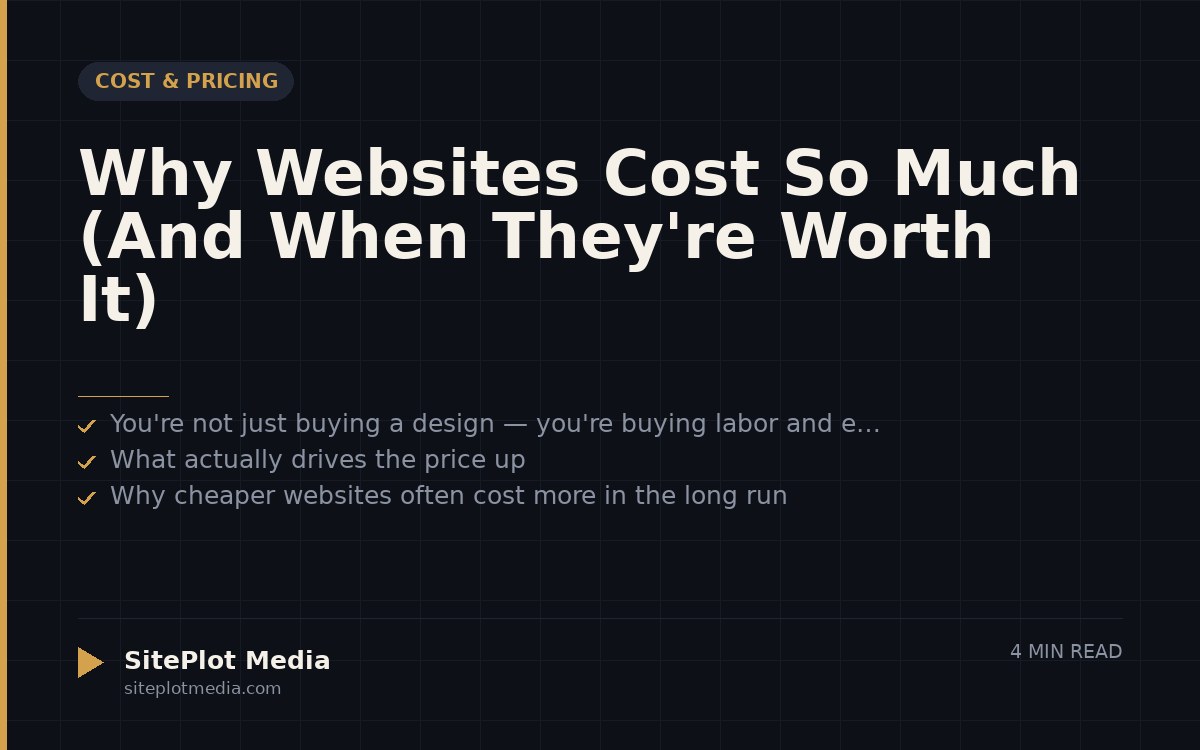
Some agencies charge $25,000 or more for a website because that price reflects strategy, custom design, systems integration, and weeks of skilled labor — not just a pretty layout. The honest answer is that price alone tells you very little; what matters is whether the deliverables match your business goals. A $25,000 site can be a bargain for a complex e-commerce business, and it can be a waste for a local service company that needs something clean, fast, and well-optimized.
You're not just buying a design — you're buying labor and expertise
When an agency quotes $25,000 for a website, most of that money pays for people and time. A mid-sized project typically involves a project manager, a strategist, a designer, one or more developers, a copywriter, and someone handling quality assurance. Even at modest hourly rates, 300 to 500 hours of professional work adds up fast.
Beyond headcount, you’re paying for judgment. A good agency asks hard questions before touching a design tool: Who is this site trying to convert? What does the sales process look like? What happens when a lead submits a form? Those answers shape every decision that follows, and getting them right takes real time. An agency that skips this phase and goes straight to mockups is often the one you’ll be rebuilding from in two years.
What actually drives the price up
Not all expensive websites are expensive for the same reasons. Here are the legitimate cost drivers that separate a $5,000 project from a $25,000 one:
- Custom design: Starting from scratch rather than adapting a template means more design hours and more revision cycles.
- Complex functionality: Membership portals, booking systems, custom quoting tools, and multi-step application flows all require custom development work that cannot be solved with an off-the-shelf plugin.
- Integrations: Connecting your site to a CRM, an ERP, a payment processor, or a proprietary database requires a developer who understands APIs — and testing that can take weeks.
- Content production: Professional copywriting, photography, and video add significant cost but also significant value. A site with weak content underperforms no matter how well it’s built.
- Ongoing strategy: Some agencies bundle SEO, conversion rate optimization, and analytics work into a retainer that inflates the annual total, even if the build itself is modest.
None of these are padding. They’re real scope. The question is whether your business needs that scope right now.
This is the kind of thing we handle day to day — you can see how our build process works or browse recent work.
Why cheaper websites often cost more in the long run
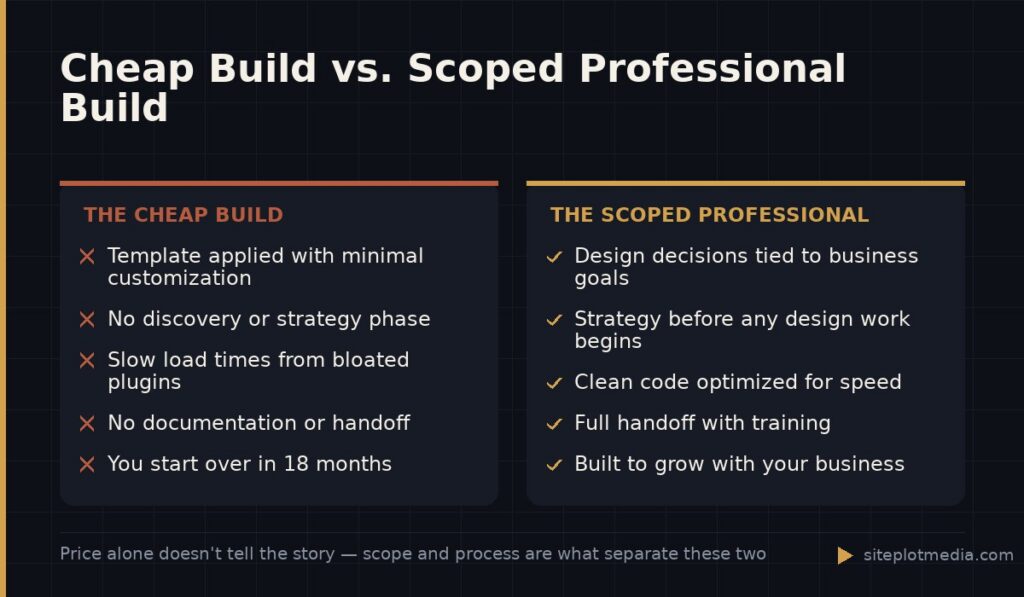
A $500 website from a freelance marketplace is almost never a bargain. The risk isn’t just quality — it’s what happens next. Sites built on bloated page-builder stacks load slowly, which hurts both user experience and search visibility. Sites built without a clear content structure become painful to update. Sites with no documentation leave you dependent on whoever built them.
There’s also the compounding cost of starting over. Businesses that buy cheap, realize the site isn’t working, and then commission a proper build have effectively paid twice. That’s worth keeping in mind when evaluating quotes that feel far apart.
That said, a professionally built site doesn’t have to cost $25,000 to be genuinely good. Scope discipline — knowing exactly what you need and what you don’t — is the variable that separates a well-priced project from an over-engineered one.
How to evaluate a quote honestly
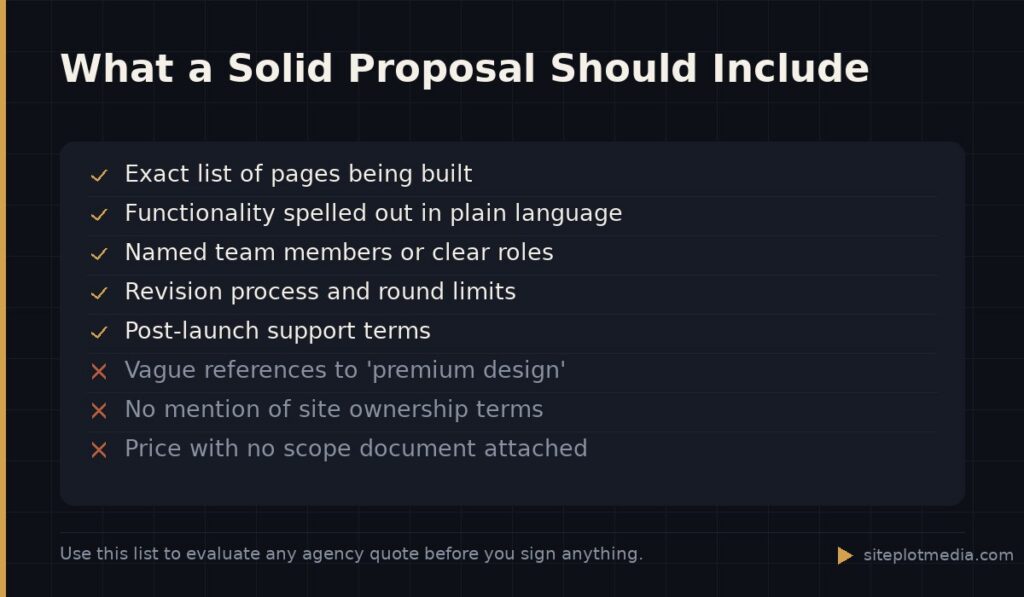
When you receive a proposal, don’t start by comparing the total to another total. Start by comparing the scope documents. A thorough proposal should tell you exactly what pages are being built, what functionality is included, who is doing the work, what the revision process looks like, and what happens after launch. If a proposal doesn’t answer those questions, the price is meaningless.
A few questions worth asking any agency before signing:
- Will I own the site outright, or is it locked to your platform?
- Who actually builds it — your team, or a subcontractor overseas?
- What does the handoff look like, and will I be able to make basic edits myself?
- What’s included in ongoing support, and what costs extra?
An agency that gets defensive about these questions is telling you something important. A confident team with nothing to hide will walk you through the answers without hesitation.
When a $25,000 website makes sense — and when it doesn't
A high-budget build makes sense when the website is a primary revenue channel, when the functionality is genuinely complex, or when the brand is operating at a scale where design quality is a direct trust signal. E-commerce businesses, SaaS companies, large professional service firms, and organizations running national campaigns often have real justification for that level of investment.
For most small and mid-sized service businesses — a law firm, a contractor, a local healthcare practice, a regional B2B company — the honest answer is that you probably don’t need $25,000 worth of website. What you need is a fast, well-structured site built on clean code, optimized for search, and designed to convert the specific visitors you’re actually trying to reach. That is achievable at a fraction of that price if the agency is focused on what matters rather than on billable hours.
For context, Siteplot Media’s standard build is a $5,000 one-time project that includes a 90-day support period, followed by $500 per month — a structure designed specifically for businesses that want professional work without enterprise-level overhead. That’s not the right fit for every situation, but it’s the kind of scope transparency you should expect from any studio you’re considering.
Frequently asked questions
Is a $25,000 website worth it for a small business?
For most small businesses, a $25,000 website is more than necessary. Unless your site has complex custom functionality or serves as a primary revenue engine, you can get a professional, high-performing site for significantly less — provided the agency is focused on the right outcomes rather than maximizing scope.
Why do some web designers charge so little while others charge so much?
Price differences usually reflect differences in process, labor quality, and scope — not arbitrary markup. A low quote often means templated design, minimal strategy, and limited post-launch support, while a high quote typically reflects custom work, more experienced people, and a longer engagement.
What should a website cost for a small business?
A professionally built website for a small business typically ranges from $3,000 to $15,000 depending on scope, with ongoing maintenance and support costs on top of that. The right number depends on how complex the site needs to be and how central it is to your revenue.
Why do websites cost so much even when they look simple?
Simple-looking websites are often the hardest to execute well because restraint requires more decision-making, not less. Behind a clean design is usually a structured content hierarchy, optimized page speed, careful mobile behavior, and accessibility considerations — none of which are free.
Can I get a good website for under $5,000?
Yes, but the conditions matter. A sub-$5,000 site can be excellent if the scope is well-defined, the agency uses efficient tooling, and you're not paying for features you don't need. Be cautious of very low quotes that don't include strategy, copywriting, or post-launch support — those gaps tend to surface quickly.