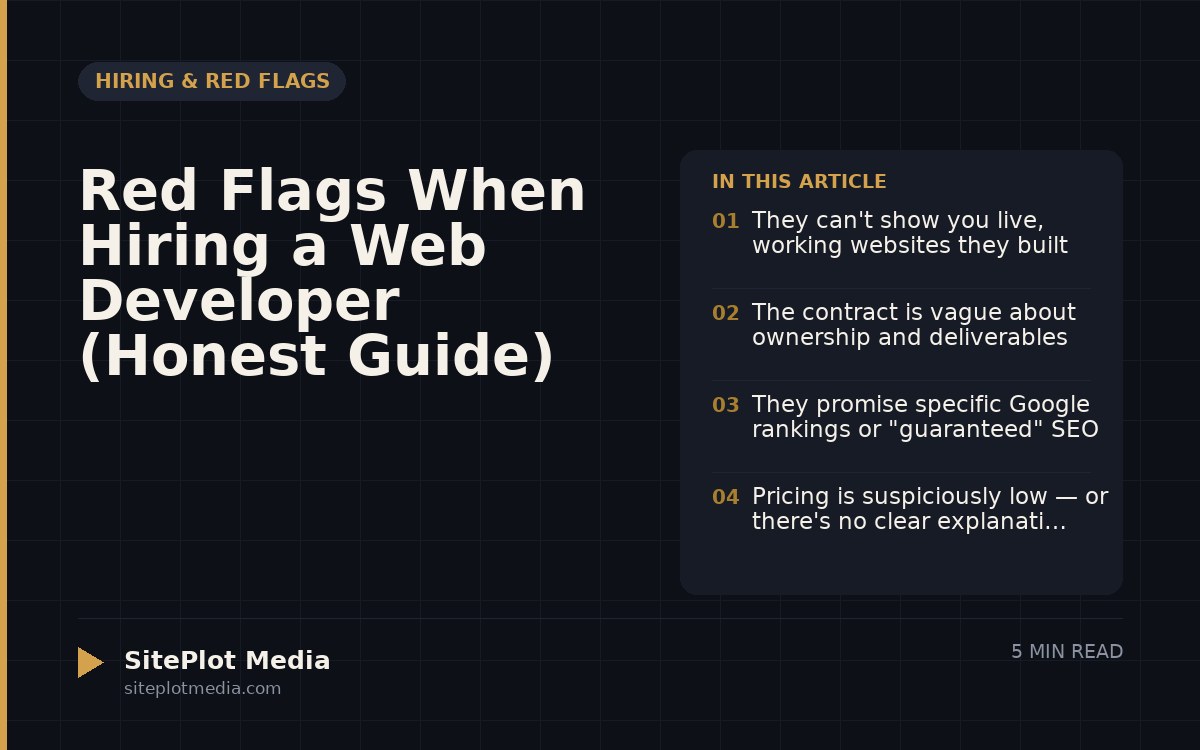
The biggest red flags when hiring a web developer include vague contracts, no clear ownership of your files and domain, pressure to decide quickly, and a portfolio full of excuses instead of live URLs. Any developer worth hiring should be able to explain what they’re building, who will own it when they’re done, and what happens if you ever need to leave.
They can't show you live, working websites they built
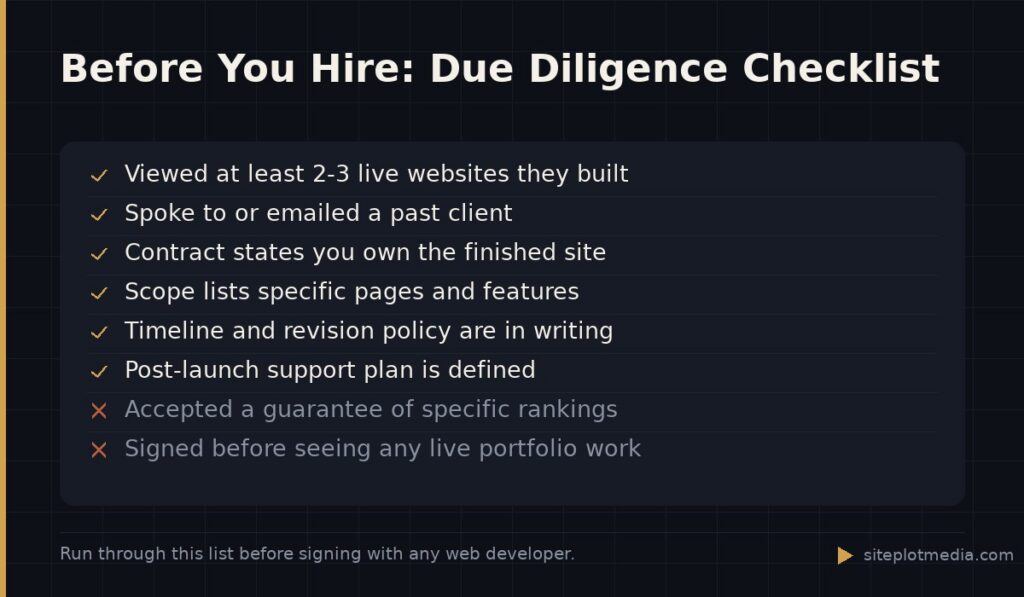
A portfolio is table stakes. If a developer shows you mockups, screenshots, or sites that conveniently “went offline,” that’s a problem. Real work lives on the internet. You should be able to click through to actual websites, poke around, and verify that they load quickly on a phone.
When you look at those sites, notice whether they feel finished. Are images sized correctly? Do links work? Does the site look like someone actually uses it? You don’t need to be a developer to spot a sloppy build — you just need to be a customer looking at it honestly.
It’s also fair to ask the developer to connect you with one or two past clients for a quick conversation. Most legitimate developers won’t hesitate. The ones who do are telling you something.
The contract is vague about ownership and deliverables
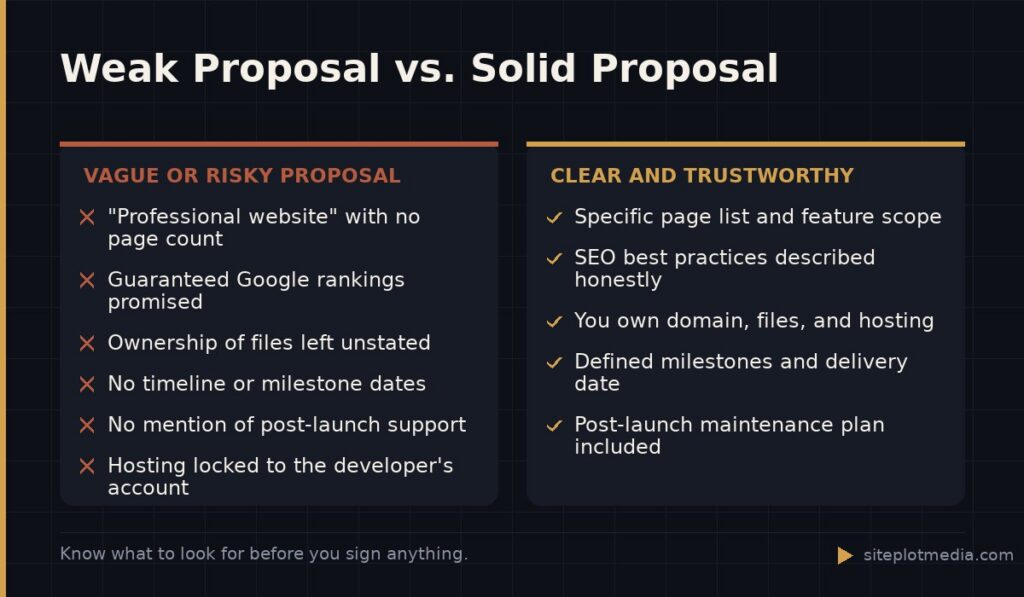
This is where many small business owners get hurt. A contract should spell out, in plain language, exactly what you’re getting: how many pages, what functionality, which platform, and by what date. If the proposal just says “a professional website,” that phrase can mean almost anything.
More importantly, the contract must state that you own the finished product — the design files, the code, the domain name, and the hosting account. Some developers retain ownership of the theme or template they used, which is sometimes fine (many use licensed themes), but you should know that going in rather than discovering it when you try to change vendors.
Watch out for contracts that lock your site to the developer’s own hosting without any exit clause. If you can’t take your site and leave, you’re renting, not buying.
This is the kind of thing we handle day to day — you can see how our build process works or browse recent work.
They promise specific Google rankings or "guaranteed" SEO results
No one can guarantee a ranking on Google. Search engines are independent systems, and any developer who promises you page one placement for specific keywords is either misinformed or being dishonest. This is one of the most common sales tactics used by low-quality shops, and it works because business owners understandably want results.
A good developer can build a site that follows SEO best practices — fast load times, clean code, proper heading structure, accessible content — and that gives you a strong foundation. But rankings depend on your content, your competition, your backlinks, and factors that shift over time. The honest answer is that good technical SEO improves your odds; it doesn’t guarantee an outcome.
If SEO is important to your business (and for most local service businesses, it is), look for someone who can explain the difference between what they control and what they don’t. That kind of honesty is actually the better sign.
Pricing is suspiciously low — or there's no clear explanation of what drives cost
A very cheap website isn’t always a bad deal, and an expensive one isn’t always worth it. Context matters. A simple five-page informational site for a local service business has genuinely different needs than an e-commerce store with inventory management. If a developer can’t explain why their price is what it is, that’s a gap worth probing.
The specific warning sign isn’t a low number — it’s a low number with no explanation of trade-offs. What’s not included? Who handles maintenance? What platform are they using, and will you be able to update it yourself? Sometimes the cheaper option is genuinely fine for your situation. But you should understand what you’re trading away.
On the other end, high prices can also mask poor practices. A $15,000 proposal from a firm that still builds on outdated platforms or hands you a site you can’t maintain isn’t a better deal than a transparent mid-range option. Evaluate the specifics, not just the number.
Communication is slow or unclear before you've even hired them
How a developer communicates during the sales process is a preview of how they’ll communicate during the project. If emails take four days to get a response, if answers are evasive, or if you feel like you’re being handled rather than helped, those patterns typically get worse once they have your deposit.
You should feel like you understand what’s happening at each stage. A good developer will set a clear timeline, explain what they need from you and when, and tell you in advance how revisions work. If any of that feels murky in the early conversations, ask directly. A vague or defensive response to a straightforward question is itself a signal.
There's no plan for what happens after the site launches
A website isn’t a one-time transaction — it’s a system that needs maintenance. Software gets updated, plugins develop security vulnerabilities, hosting environments change. A developer who hands you a site with no conversation about ongoing care is leaving you to figure out a technical discipline most business owners didn’t sign up to manage.
Ask specifically: Who handles updates? What happens if something breaks? Is there a maintenance plan, and what does it cost? Some business owners are comfortable managing their own WordPress dashboard; others want someone on call. Neither is wrong, but you need to know before you sign, not after the developer has moved on to the next project.
For reference, Siteplot Media includes a 90-day period after launch where we handle fixes and updates, and ongoing monthly support is available after that — we mention this not to sell it, but because it illustrates the kind of question you should be asking any developer you’re considering.
Frequently asked questions
What should a web developer contract include?
A web developer contract should clearly state the scope of work, timeline, payment schedule, revision policy, and — critically — who owns the finished website, domain, and any design files. Without explicit ownership language, you may have limited rights to your own site.
Is it a red flag if a web developer uses a template or page builder?
Not necessarily — many excellent production websites are built on templates or page builders, and the tool matters less than how it's implemented. The red flag is when a developer charges custom-build prices while using a template and doesn't disclose it, or when the chosen tool creates a site so bloated with extra code that it loads slowly and hurts your search visibility.
How do I know if a web developer actually built the sites in their portfolio?
Ask them to walk you through one of the projects — what the client needed, what decisions they made, and what they'd do differently. Someone who built the site will be able to answer those questions naturally; someone padding a portfolio with work they didn't do will struggle with specifics.
Should I be worried if a web developer works alone rather than at an agency?
A solo developer is not a red flag on its own — many freelancers do excellent work and are genuinely more accountable than a large agency where your project gets handed to a junior employee. The real question is whether they have a clear process, references, and a plan for continuity if something goes wrong.
What happens if my web developer disappears after the project?
If you own your domain, hosting account, and site files outright, a developer going silent is inconvenient but not catastrophic — another developer can pick up where they left off. If any of those accounts are in the developer's name, recovering access can be a serious legal and technical problem, which is exactly why ownership terms belong in the contract before work begins.