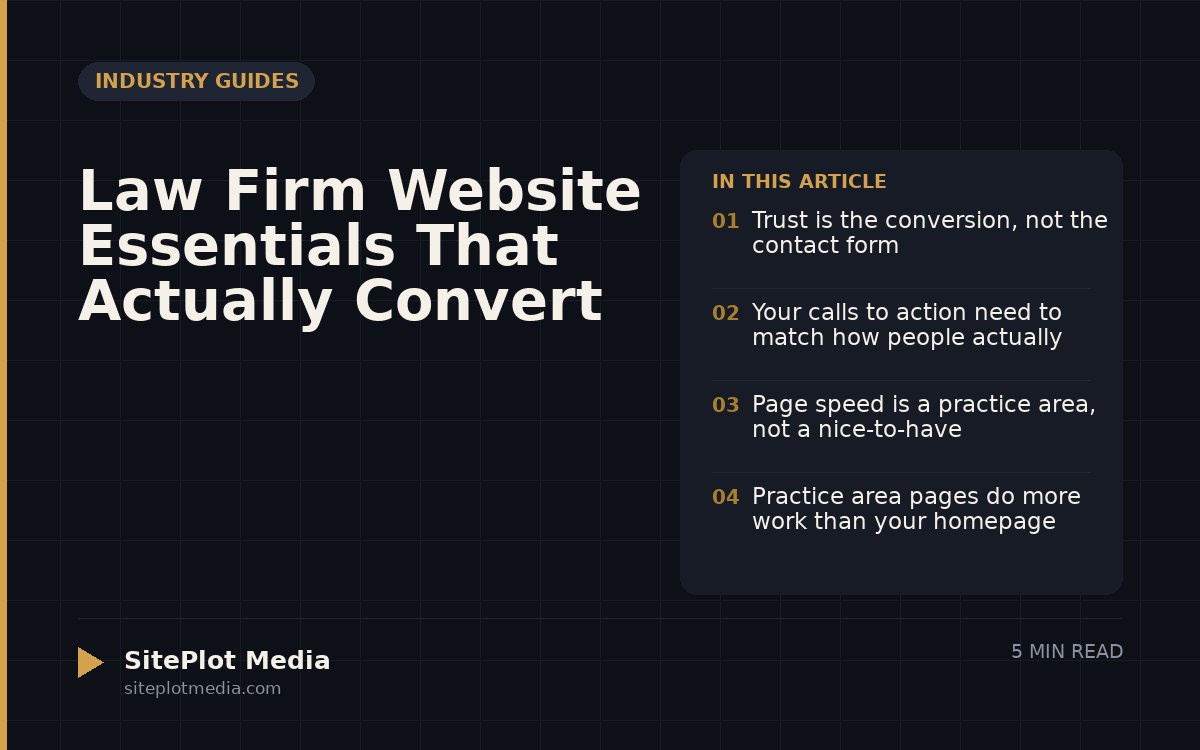
A law firm website converts when it does three things quickly: establishes trust, makes the next step obvious, and loads fast enough that visitors don’t leave before they read a word. Most law firm sites fail on at least one of these, and the fix is usually structural, not cosmetic.
Trust is the conversion, not the contact form
People hiring a lawyer are often scared, embarrassed, or facing one of the worst days of their lives. They are not shopping for the cheapest option — they are looking for someone they can trust with something that matters. Your website’s first job is to answer the unspoken question: “Is this firm safe to contact?”
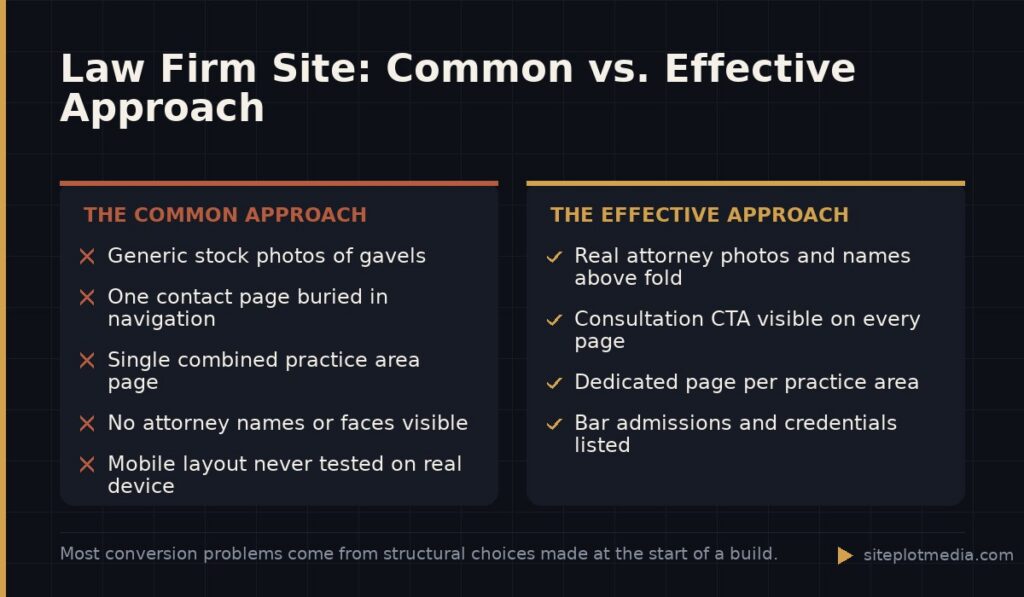
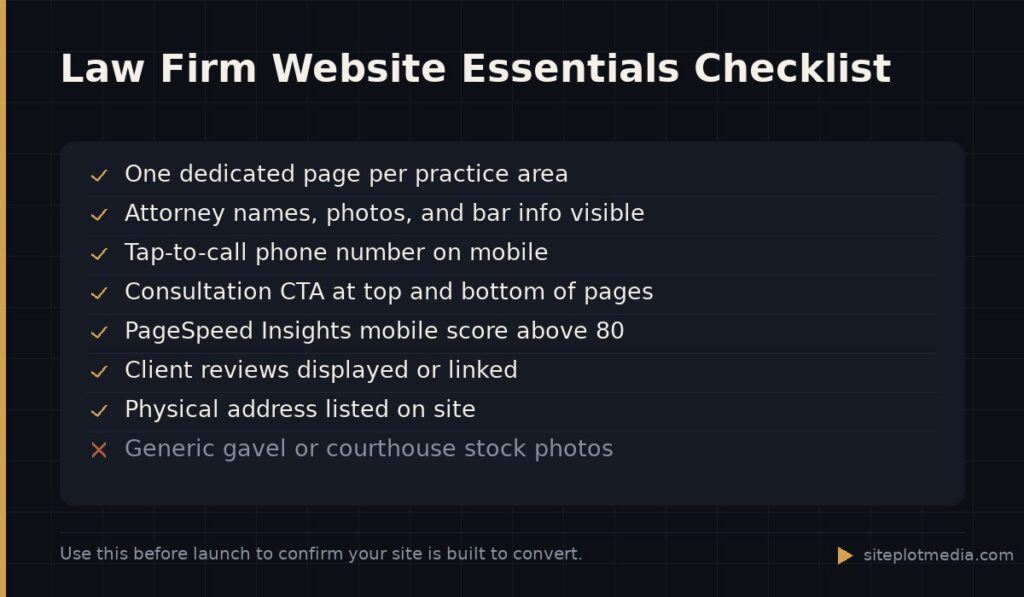
Trust signals are the specific, verifiable details that answer that question before anyone fills out a form. These include bar admissions and licensing information, years in practice, the actual names and faces of attorneys, and a physical address. Generic stock photos of a gavel or a handshake do the opposite — they signal that no real person is behind the page.
Genuine client reviews, displayed with full names where clients have consented, outperform any marketing copy you can write. If you have Google reviews, link to them or embed them. If you don’t, building a process to collect them is more valuable than redesigning your homepage.
Your calls to action need to match how people actually hire lawyers
Most people are not ready to retain an attorney the first time they visit your website. They are researching. A single “Hire Us” button ignores this reality. Effective calls to action meet visitors at different stages of their decision.
The highest-converting action on most law firm sites is a free consultation request — it’s low-commitment for the visitor and high-value for the firm. But the form or booking link needs to be easy to find on every page, not buried in a footer. A sticky header with a phone number and a “Schedule a Free Consultation” button handles this cleanly on both desktop and mobile.
Secondary actions matter too. A downloadable guide, a newsletter, or even a detailed FAQ page keeps someone on your site and in your orbit if they’re not ready to call. Giving people something useful before asking for anything builds the trust mentioned above.
This is the kind of thing we handle day to day — you can see how our build process works or browse recent work.
Page speed is a practice area, not a nice-to-have
A slow website loses clients before they read your name. This is not an exaggeration — when a page takes more than a few seconds to load, a large share of visitors leave immediately, and that number climbs sharply with each additional second of delay. Legal is a high-intent category, meaning someone searching for a DUI attorney or an estate planning lawyer is ready to act. If your site stalls, they hit the back button and call your competitor.
Speed problems on law firm sites usually come from one of three places: images that were never compressed, a page builder that adds significant code weight even to simple designs, or a web host that is too slow for your traffic level. All three are fixable. Compressing images costs nothing. Choosing a leaner theme or build method and a faster host are decisions usually made at build time, which is why they’re worth getting right from the start.
You can check your site for free at Google’s PageSpeed Insights. A score above 80 on mobile is a reasonable target. Below 50 on mobile is a liability.
Practice area pages do more work than your homepage
Most visitors arrive through a search query, not your homepage. Someone searching “wrongful termination lawyer” will land on whatever page on your site best matches that phrase — and if that page doesn’t exist, they’ll land on a competitor’s instead. Practice area pages are where most of your search traffic enters and where most of your conversion happens.
Each practice area deserves its own dedicated page with real information about how you handle that type of case, what a client can expect from the process, and how to get started. A page that is three sentences long does not build trust and does not rank well. A page that walks someone through what happens after they call you does both.
- Name the specific practice area clearly in the page title and heading
- Explain who you help and what outcomes you pursue — be specific
- Address the most common questions clients ask before hiring
- Include a clear call to action at the top and bottom of the page
- Link to related practice areas where the work genuinely overlaps
Mobile experience is where most law firm sites quietly fail
More than half of legal searches happen on a phone. Many law firm websites look fine on a desktop and fall apart on a small screen — text that is too small to read, phone numbers that aren’t tap-to-call, forms that require a user to pinch and zoom. Each of these frictions costs you a potential client.
Mobile-friendliness is not just about layout resizing. It includes whether your font size is readable without zooming, whether buttons are large enough to tap with a thumb, and whether your contact information is immediately visible without scrolling. Test your site on a real phone, not just a browser simulator. What you see is what your clients see.
Google also uses the mobile version of your site as the primary version it indexes and ranks. A site that performs poorly on mobile is at a structural disadvantage in search results, independent of how good your content is.
What a law firm website build actually costs — and what to look for
Law firm website projects vary significantly in price depending on scope, the number of practice areas, whether the firm needs bilingual content, and what integrations are involved (scheduling tools, case management software, live chat). A basic but well-built site with five to ten pages can be done responsibly for a few thousand dollars. A larger firm with multiple attorneys, many practice areas, and location-specific pages will reasonably spend more.
What matters more than the number is what you’re getting for it: a site built on clean, fast code with a clear content strategy, not a template with your logo dropped in. Siteplot Media’s law firm builds start at $5,000 one-time with ongoing support at $500/month after the included 90-day period — but depending on your firm’s situation, a simpler setup or a different provider might serve you just as well. The honest answer is that a well-scoped modest build beats an expensive one that nobody maintains.
Ask any vendor these questions before signing: How is page speed addressed? Who writes the practice area content? What happens when something breaks after launch? What does ongoing support include? The answers tell you more than the portfolio.
Frequently asked questions
How many pages does a law firm website need?
A functional law firm website needs at least one page per practice area, an About page with attorney bios, a Contact page, and a homepage — so a minimum of five to eight pages for a focused practice. Firms with multiple attorneys or multiple practice areas will typically need more to rank for the searches that matter to them.
Do law firms need a blog to rank in search results?
A blog helps but is not required to rank for core practice area searches. Well-written practice area pages often do more for search visibility than a blog with thin, inconsistently published posts. If you're going to blog, publish less frequently and write in genuine depth — a handful of thorough articles outperforms dozens of short ones.
Should a law firm use a website template or get a custom build?
A good template used well beats a poorly executed custom build, so the choice matters less than the execution. What to avoid is a bloated page builder template that loads slowly and looks identical to dozens of other law firm sites — both of those problems hurt conversion and search performance.
What is the most important thing to fix on a law firm website that isn't converting?
Start with your mobile page speed and your practice area pages — these two factors cause most conversion failures on law firm sites. If your pages load slowly on a phone or if your practice area content is thin, fixing either one typically produces measurable improvement before anything else is changed.
Can a law firm rank locally without paying for ads?
Yes — a well-optimized Google Business Profile combined with strong practice area pages and genuine client reviews can produce consistent local search visibility without paid advertising. Paid ads can accelerate results but are not a substitute for the foundational work, and many firms do well on organic search alone.