
An accounting firm website should be organized around the services you offer, the clients you serve, and the trust signals that make a stranger comfortable handing you their finances. Start with a clear homepage that states who you help and how, build individual pages for each core service, and make it easy for a visitor to contact you or schedule a call from any page on the site.
Why site structure matters more than design for accounting firms
Most accounting firm websites look professional but fail at the one job a website actually has: turning a curious visitor into a booked appointment. Design gets people to stay for a few seconds. Structure determines whether they find what they need and take action.
Search engines also read your site’s structure to decide what you’re about and which searches you deserve to show up for. A site with one generic “Services” page is harder to rank than a site with separate, detailed pages for tax preparation, bookkeeping, payroll, and business advisory services. Each page can target its own search terms and answer a specific client’s question.
The good news: a well-structured accounting website doesn’t have to be large or complicated. Five to ten pages built with clear intent will outperform a bloated site built without a plan.
The core pages every accounting firm website needs
Think of your site as a short stack of pages that each do one job. Here’s what that stack should include:
- Homepage: States clearly who you serve, what you do, and what the next step is. This is not a brochure — it’s a handshake and a direction sign.
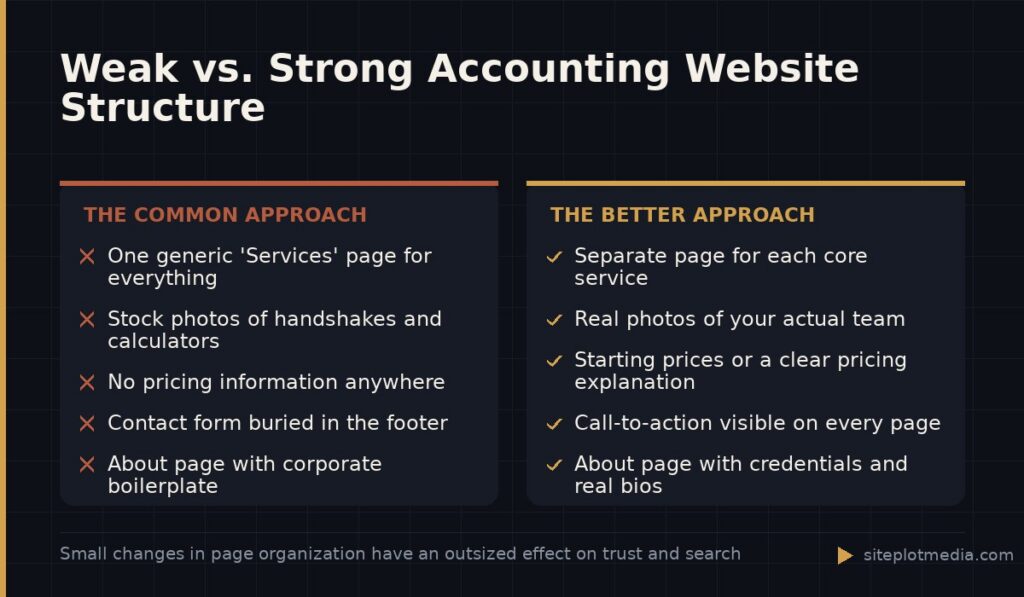
- Individual service pages: One page per service, not a long list on a single page. Tax preparation, bookkeeping, CFO advisory, payroll — each deserves its own URL and its own explanation.
- About page: Credentials, history, and the people behind the firm. Accounting is a trust business. Clients want to know who will actually be touching their numbers.
- Industries or clients served: If you specialize in small businesses, nonprofits, real estate investors, or medical practices, say so explicitly. Specialists win over generalists when a prospect feels understood.
- Contact page: A phone number, an address if you have one, a simple form, and ideally a link to schedule a call. Remove every barrier between the visitor and a conversation.
- Blog or resources (optional but valuable): A place to publish answers to questions your clients actually ask — tax deadlines, estimated payments, what records to keep. This is where long-term search visibility gets built.
Notice what’s not on this list: a splash page, a heavy slider, a generic “Welcome to our firm” paragraph, or a PDF download no one reads. Cut anything that doesn’t directly serve the visitor or move them toward contact.
This is the kind of thing we handle day to day — you can see how our build process works or browse recent work.
How to structure individual service pages so they actually rank
Each service page should answer three questions a prospective client is silently asking: What exactly is this service? Who is it for? What do I do next? Most accounting firm service pages answer only the first, weakly, and then stop.
A strong service page opens by naming the problem the service solves, not just the service itself. Instead of “We offer tax preparation services,” try something like “Business tax season doesn’t have to be a scramble. We handle your federal and state returns so you’re not guessing at deductions or missing deadlines.” That framing speaks to the reader’s actual situation.
After the problem and the solution, include: what’s included in the service, who it’s best for, what the process looks like (even a simple three-step overview helps), and a clear call to action. If you serve a specific geography, mention it naturally — not as a keyword stuffed at the bottom, but as genuine context for who can work with you.
Trust signals that accounting websites can't afford to skip
You’re asking someone to trust you with their financial life. Your website has to do real work to earn that trust before they ever speak to you. Generic stock photos and vague language actively work against you here.
Concrete trust signals include:
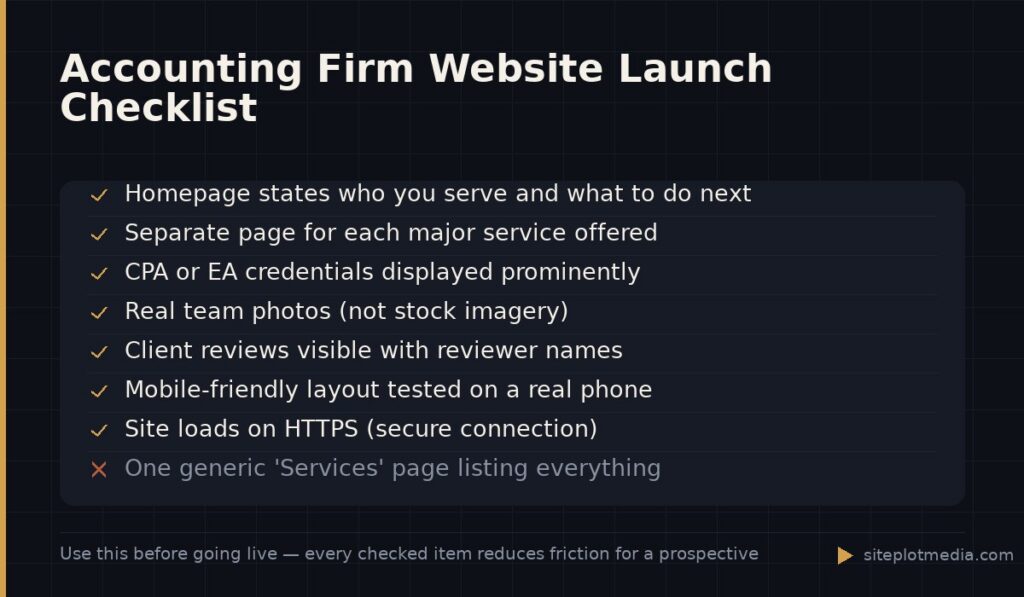
- CPA credentials, EA designations, or professional memberships displayed prominently — not buried in a footer
- Real photos of your team, not stock imagery of people in suits shaking hands
- Client reviews pulled from Google or another verifiable platform, with the reviewer’s name visible
- A clear explanation of your onboarding process so the prospect knows what happens after they contact you
- Transparent pricing ranges, or at minimum an honest explanation of how your pricing works — even “starting at” figures reduce anxiety
One thing many firm owners overlook: your About page is often the second-most-visited page on a professional services site. Treat it seriously. A short bio with credentials and a genuine sentence about why you do this work converts better than a paragraph of corporate boilerplate.
Technical decisions that affect how your site performs
You don’t need a custom-coded website to run an effective accounting firm online. But a few technical choices will determine whether your site loads fast, ranks well, and actually works on a phone — which is where a growing share of initial searches happen.
Page speed matters. A slow site loses visitors and is penalized in search rankings. This means avoiding page builders that load excessive code for features you’re not using, compressing your images before uploading them, and choosing a web host that isn’t shared on an overcrowded server. These aren’t glamorous decisions, but they have a direct effect on whether your site gets found and whether visitors stay.
Your site also needs to be secure (HTTPS, not HTTP), have a working contact form that actually delivers messages to your inbox, and display cleanly on mobile screens without requiring the visitor to pinch and zoom. These are table stakes in 2024, not extras.
If you’re evaluating whether to build a new site or revamp an existing one, it’s worth having someone audit the current site’s speed, mobile experience, and basic search visibility before assuming you need to start over. Sometimes the structure is fine and the problems are fixable without a full rebuild. If you do need a new build, costs range from a few thousand dollars for a template-based site to significantly more for custom work — the right answer depends on your firm’s size, services, and growth goals.
Ongoing content strategy: where long-term visibility comes from
A well-structured site gets you a foundation. Content built on top of that foundation is what compounds over time. For accounting firms, this is particularly tractable because your clients ask the same questions over and over — and those questions are typed into Google every day.
Think about the questions you answer on intake calls or in client emails: When are quarterly estimated taxes due? What’s the difference between an S-corp and an LLC for taxes? What records should I keep as a sole proprietor? Each of those is a blog post that can bring in a qualified visitor who is already thinking about accounting help.
You don’t need to publish constantly. Two or three well-written, genuinely useful posts per month — written for a real person, not for a search engine — is enough to build meaningful visibility over six to twelve months. The compounding nature of search traffic means a post written today may be your best lead source two years from now. That’s a very different dynamic than paid advertising, where traffic stops the moment you stop spending.
Frequently asked questions
How many pages does an accounting firm website need?
Most accounting firms can operate effectively with five to ten core pages. You need a homepage, one page per major service, an about page, and a contact page at minimum — additional pages for specific industries or a blog can help with search visibility over time.
Should an accounting firm list prices on its website?
Displaying at least a starting price or a general pricing structure reduces friction and pre-qualifies visitors, which typically leads to better-fit inquiries. You don't have to publish exact fees, but giving prospects a ballpark figure saves time for everyone.
What should an accounting firm put on its homepage?
Your homepage should immediately communicate who you serve, what services you offer, and what a visitor should do next — usually a call-to-action to book a consultation or get in touch. Credentials, a brief firm overview, and a few trust signals like reviews or logos belong here too.
Does an accounting firm website need a blog?
A blog isn't strictly required, but it's one of the most cost-effective ways to build long-term search visibility for an accounting firm. Publishing honest answers to questions your clients already ask — tax deadlines, entity types, recordkeeping — attracts qualified visitors without ongoing ad spend.
How long does it take to build an accounting firm website?
A focused build with clear content and decision-making typically takes six to twelve weeks from kickoff to launch. Delays almost always come from the content side — gathering bios, writing service descriptions, and collecting photos — not the development side, so having that material ready early shortens the timeline significantly.