

You avoid website project scope creep by defining exactly what is included in your project in writing before any work begins, then agreeing on a clear change-order process for anything that falls outside that definition. Scope creep happens when new requests get added to a project without adjusting the timeline or budget to match, and it is almost always the result of a vague initial agreement rather than bad intentions on either side.
What scope creep actually is — and why it happens
Scope creep is the gradual expansion of a project beyond what was originally agreed. It rarely arrives as one big dramatic request. Instead, it sneaks in as a string of small, reasonable-sounding additions: “Can we add a blog?” “What about a members-only area?” “My partner wants to see a different homepage layout.” Individually, each request feels minor. Collectively, they can double the amount of work a developer needs to do.
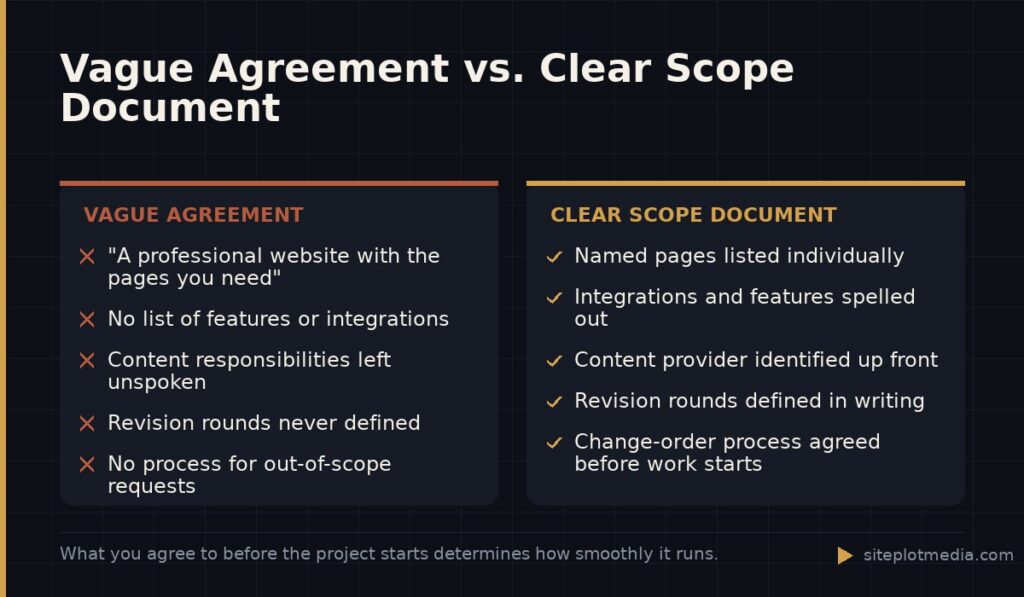
The underlying cause is almost always ambiguity in the original agreement. When a contract says “a professional website with the pages you need,” every stakeholder fills in that blank differently. The developer pictures five pages. The business owner pictures twelve. Neither is lying — they just never aligned. The fix has to happen before the project starts, not after the first invoice dispute.
Start with a scope document, not just a proposal
A proposal tells you what something will cost. A scope document tells you exactly what you are buying. These are not the same thing, and confusing them is where most project problems begin. Before signing anything, ask your developer or agency for a written list of deliverables that specifies pages, features, rounds of revisions, content responsibilities, and integrations.
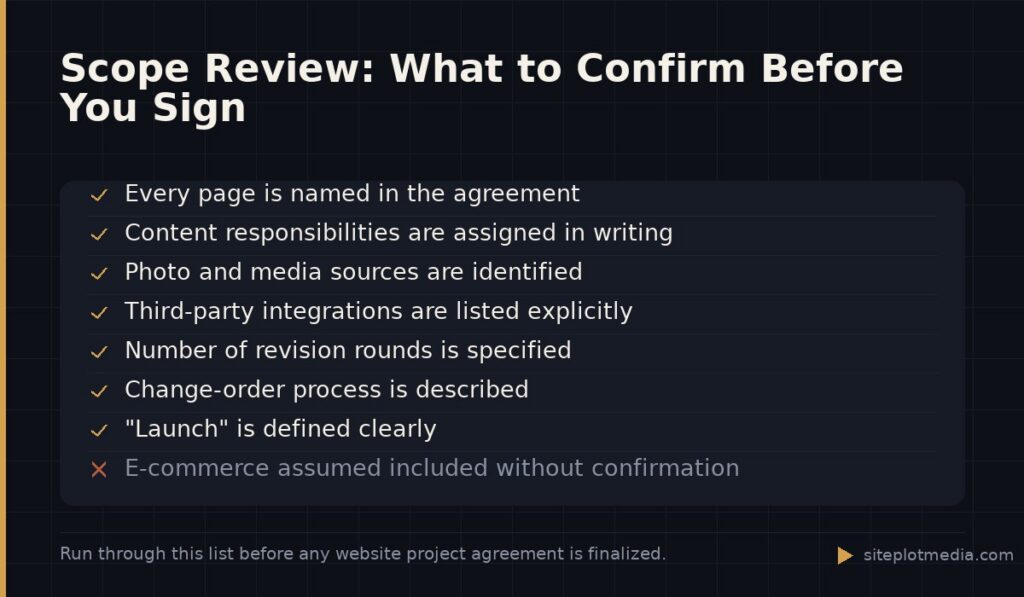
A good scope document answers these questions explicitly:
- How many pages will be built, and what is the name of each one?
- Who is responsible for writing the copy — you or the developer?
- Who is providing photos and other media?
- What third-party tools will be integrated (booking systems, payment processors, email platforms)?
- How many rounds of design revisions are included?
- What does “launch” mean — is it moving the site live, or does it include post-launch fixes?
If your developer cannot or will not answer these questions in writing before the project starts, that is a meaningful signal about how the project will go.
This is the kind of thing we handle day to day — you can see how our build process works or browse recent work.
Build a change-order process into your agreement from day one
Even a detailed scope document will not prevent new ideas from surfacing. That is normal — running a business means you learn things mid-project. The goal is not to eliminate change requests but to handle them honestly. A change order is a simple written acknowledgment that both parties agree a new request falls outside the original scope, along with a cost and timeline adjustment to match.
Ask your developer how they handle out-of-scope requests before you sign. A healthy answer sounds like: “We document it, give you a written estimate for the additional work, and you approve it before we proceed.” A warning-sign answer sounds like: “Don’t worry, we’ll figure it out.” Informality feels friendly at the start and becomes the source of conflict at the end.
On your side of the table, designate a single point of contact for the project — ideally one person who can make decisions. When six people on your team can send feedback directly to the developer, the scope can expand in six different directions at once, and nobody intended it to happen.
The most common requests that blow up a website project
Knowing the usual suspects makes them easier to catch before they become problems. These are the additions that most reliably turn a straightforward website project into something larger and more expensive:
- E-commerce features added after the project starts — selling products online requires a fundamentally different site architecture than a brochure site. Adding it mid-project is often more expensive than building it in from the beginning.
- Content management system training — if you want to edit the site yourself after launch, that training time needs to be scoped and priced up front.
- SEO beyond technical basics — on-page SEO setup, keyword research, and content strategy are significant bodies of work. Clarify whether any of this is included or whether it will be a separate engagement.
- Multilingual or multi-location variations — a second language or a second region means near-duplicate work across the entire site.
- Custom functionality — anything that requires a developer to write code specific to your business (custom calculators, quote tools, filtered directories) is almost never included in a standard website package.
None of these things are unreasonable to want. The point is to price and schedule them honestly before the project begins rather than treat them as obvious inclusions.
How to stay organized on your end of the project
Clients cause scope creep just as often as developers do — usually without realizing it. The most common client-side pattern is collecting feedback from multiple people and forwarding it piecemeal over several weeks rather than consolidating it into one round of organized notes. That fragmented feedback process is expensive because it forces the developer to revisit finished work repeatedly.
A few habits that keep your side of the project clean:
- Collect all internal feedback before sending any of it to your developer. One consolidated note is far more efficient than ten separate emails.
- Be specific. “The header feels off” is hard to act on. “The header font is too large on mobile and I’d like it reduced” is actionable.
- Separate “must have before launch” from “nice to have someday.” Write the second list down and save it for a future phase rather than letting it bleed into the current project.
- Respect the revision rounds in your contract. If you have two rounds of revisions and you use them both on minor edits, you will not have one available when you need it for something significant.
At Siteplot Media, our project agreements include a defined list of pages, a content intake process, and two rounds of design revisions — all spelled out before any work begins. Our one-time build is $5,000 with ongoing support at $500 per month after a 90-day included period, and because the scope is documented from the start, clients rarely face surprises.
When to push back — and when to just say yes to the change
Not every addition to a website project is worth fighting over. If a request is genuinely small — a fifth navigation link, swapping one image for another — and your developer absorbs it without complaint, let it go and say thank you. Good working relationships involve mutual flexibility, and treating every small accommodation as a scope violation will make the project unpleasant for everyone.
The requests worth pushing back on are the ones that change the structure, functionality, or content volume of the project in a meaningful way. If the developer comes to you with a change-order estimate and you believe the new work is actually something that should have been included originally, that is a legitimate conversation to have. Ask them to explain specifically why they consider it out of scope. A professional will be able to point to language in the agreement. If they cannot, the work may genuinely have been implied in the original price.
The broader principle is this: scope creep is a process failure, not a character flaw. It happens to experienced developers and well-intentioned clients alike. The businesses that avoid it are the ones who invest twenty minutes of careful conversation up front rather than a week of difficult emails three months later.
Frequently asked questions
What is scope creep in a website project?
Scope creep is when a website project grows beyond what was originally agreed, usually through small additions that accumulate over time without corresponding increases in budget or timeline. It is almost always caused by an agreement that was too vague at the start.
How do I know if a request is out of scope?
A request is out of scope if it is not described anywhere in your signed agreement or scope document. If the contract is silent on the topic, it is worth a direct conversation with your developer before assuming it is included.
Should I put a cap on revision rounds in my contract?
Yes — specifying revision rounds in writing protects both you and your developer and keeps the project on schedule. Two rounds is a common standard for design, though the right number depends on project complexity.
What happens if I need something added mid-project?
Request a written change order that describes the new work, the additional cost, and any timeline adjustment before the work begins. A reputable developer will provide this without hesitation.
Is scope creep always the developer's fault?
No — clients contribute to scope creep just as often, usually by adding requests gradually or sending fragmented feedback over many rounds rather than consolidating it. Clear communication from both sides is what prevents it.