A custom WordPress theme is worth it when site performance, brand precision, or long-term maintenance costs genuinely matter to your business — but Elementor is a perfectly reasonable choice for many small businesses that need to launch quickly on a limited budget. The right answer depends on your traffic volume, how distinctive your brand needs to look, and how much technical debt you can afford to carry over time.
What you're actually choosing between
Elementor is a visual page builder — a plugin that lets you drag and drop content blocks inside WordPress without writing code. It’s genuinely powerful, widely supported, and the reason many small business owners can build a decent-looking site without hiring a developer. When people say “Elementor site,” they usually mean a site built on a third-party or free theme with Elementor doing the heavy design lifting.
A custom WordPress theme, by contrast, is code written specifically for your site — your colors, your layouts, your content structure — without a visual builder sitting in between your design decisions and the browser. A developer writes or generates that code from scratch (or from a minimal starter), and nothing is loaded that your site doesn’t actually use.
Neither is inherently superior. They solve different problems at different price points, and the mistake most business owners make is assuming one is always the professional choice.
Where Elementor genuinely works well
If you’re a local service business, an early-stage startup, or a solo professional who needs a clean, credible website live within a few weeks and under a few thousand dollars, Elementor is a solid tool. The ecosystem is mature, there are thousands of trained freelancers who know it, and a well-configured Elementor site can absolutely rank in search and convert visitors.
Elementor also makes content updates easier for non-technical owners. If you want to change a headline, swap a photo, or add a new section without calling a developer, the visual editor makes that realistic. That independence has real business value.
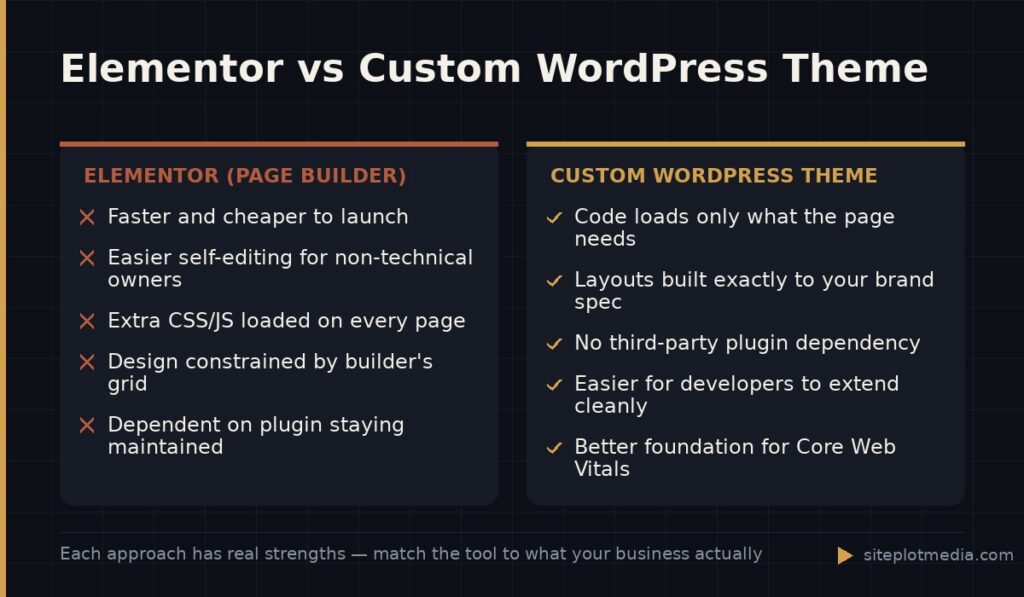
- Good fit for brochure sites, landing pages, and local service businesses
- Faster and cheaper to launch than a fully custom build
- Large pool of freelancers and agencies comfortable working in it
- Built-in template library helps non-designers create usable layouts
This is the kind of thing we handle day to day — you can see how our build process works or browse recent work.
Where Elementor creates real problems
The core trade-off with Elementor is page weight. The builder loads a meaningful amount of CSS and JavaScript regardless of which features a given page actually uses. On a fast connection, a visitor may never notice. But page speed matters to Google’s Core Web Vitals scoring, and on mobile connections or in competitive markets where every fraction of a second counts, that overhead becomes a liability.
The second issue is design lock-in. Elementor’s drag-and-drop grid is flexible but still opinionated — certain layouts are easy, others fight you. If your brand has a genuinely distinctive visual identity, you may find yourself compromising on design to fit what the builder makes convenient. Over time, those compromises accumulate.
There’s also a dependency risk worth naming honestly: your site’s appearance is tied to Elementor remaining actively developed, compatible with your theme, and compatible with future versions of WordPress. Major Elementor updates have broken sites before. A custom theme has no such dependency.
- Extra CSS/JS weight can hurt Core Web Vitals scores on slower connections
- Distinctive or complex layouts are harder to execute cleanly
- Plugin conflicts and version updates introduce ongoing maintenance risk
- Duplicate or bloated markup can make technical SEO cleanup harder later
What a custom theme actually costs — and what you get
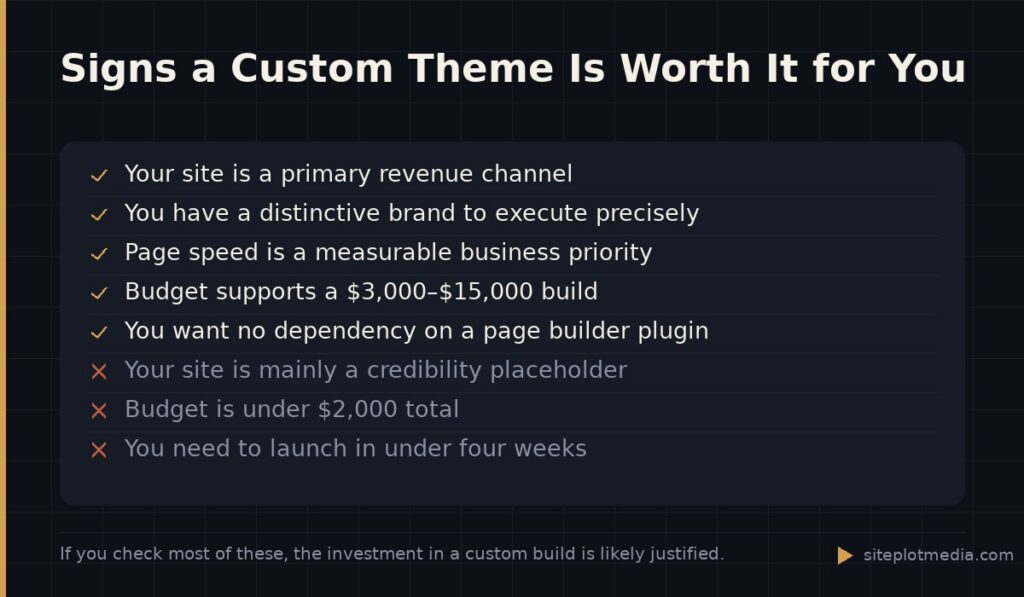
A professionally built custom WordPress theme typically costs between $3,000 and $15,000 depending on complexity, the number of page templates, and whether custom functionality is involved. At Siteplot Media, our standard engagement starts at $5,000 one-time, which includes a 90-day support period before ongoing maintenance at $500 per month — but scope drives cost everywhere, so treat any range as a starting point for a real conversation.
What you’re paying for isn’t just a prettier site. You’re paying for code that only loads what your pages actually need, layouts built exactly to spec, a theme with no third-party plugin dependencies, and a codebase a developer can extend without fighting the builder’s assumptions. For businesses where the website is a primary sales channel, that investment often pays for itself in performance and conversion improvements over 12 to 24 months.
That said, if your site is primarily an online business card and your budget is under $3,000, a well-configured Elementor site is the honest recommendation. Don’t buy more than your business actually needs.
Performance and SEO: the honest picture
Custom themes have a performance advantage, but it’s not automatic and it’s not magic. A carelessly built custom theme can still be slow. The advantage is that a custom build gives a skilled developer the tools to optimize precisely — minimal render-blocking resources, clean semantic HTML, no unused CSS — in ways that are structurally harder to achieve inside a visual builder.
For SEO specifically, page speed is one signal among many. A well-structured Elementor site with good content, solid internal linking, and proper technical setup will outrank a fast custom theme with thin content. Speed matters most at the margins — in competitive niches, for e-commerce sites where load time directly affects conversion, or for businesses already doing everything else well and looking for an edge.
If a developer or agency is promising you rankings based on switching from Elementor to a custom theme, that’s a red flag. Site architecture supports SEO; it doesn’t guarantee it.
How to decide which is right for your business
Ask yourself these questions honestly before making a decision:
- Is your website a primary revenue channel, or mainly a credibility placeholder?
- Do you have strong brand guidelines that a template would compromise?
- Is your budget closer to $1,500 or $8,000?
- Do you care about page speed enough to test and measure it?
- How often do you need to update content, and do you want to do it yourself?
If you answered “primary revenue channel, strong brand, meaningful budget, yes on speed” — a custom theme is likely worth the investment. If you answered “credibility placeholder, flexible on brand, limited budget, updates maybe once a quarter” — start with Elementor and revisit the question in 18 months when your business has grown into the conversation.
The best website is the one your business will actually maintain and improve over time. A custom theme you can’t afford to update is worse than an Elementor site you can.
Frequently asked questions
Does a custom WordPress theme rank better in Google than an Elementor site?
Not automatically — a custom theme can load faster and produce cleaner code, which supports SEO, but content quality, backlinks, and overall site authority matter far more than which tool built the site. Speed becomes a meaningful differentiator mainly in competitive niches or for businesses already optimizing everything else.
Can I switch from Elementor to a custom theme later without losing my content?
Your text and images stored in WordPress posts and pages will survive a theme switch, but your layouts will not — Elementor stores design structure in its own format, so switching themes means rebuilding page layouts from scratch. Plan for that rebuild cost before committing to an Elementor site you expect to outgrow.
Is Elementor bad for page speed?
Elementor adds meaningful CSS and JavaScript overhead that a custom theme would not include, which can slow page load times — especially on mobile. A well-optimized Elementor setup with caching and a lightweight theme can perform adequately, but it requires deliberate effort and still has a structural disadvantage versus a lean custom build.
How long does it take to build a custom WordPress theme compared to an Elementor site?
A custom WordPress theme typically takes six to twelve weeks for a professional build, while a polished Elementor site can launch in two to four weeks. If speed to launch is a priority, Elementor has a genuine advantage.
Is Elementor still a good choice in 2025?
Yes, Elementor remains a legitimate and widely used tool for small business websites in 2025, provided you choose a reputable developer, use a lightweight base theme, and have realistic expectations about performance ceilings. It is not the right tool for every situation, but it is far from obsolete.