
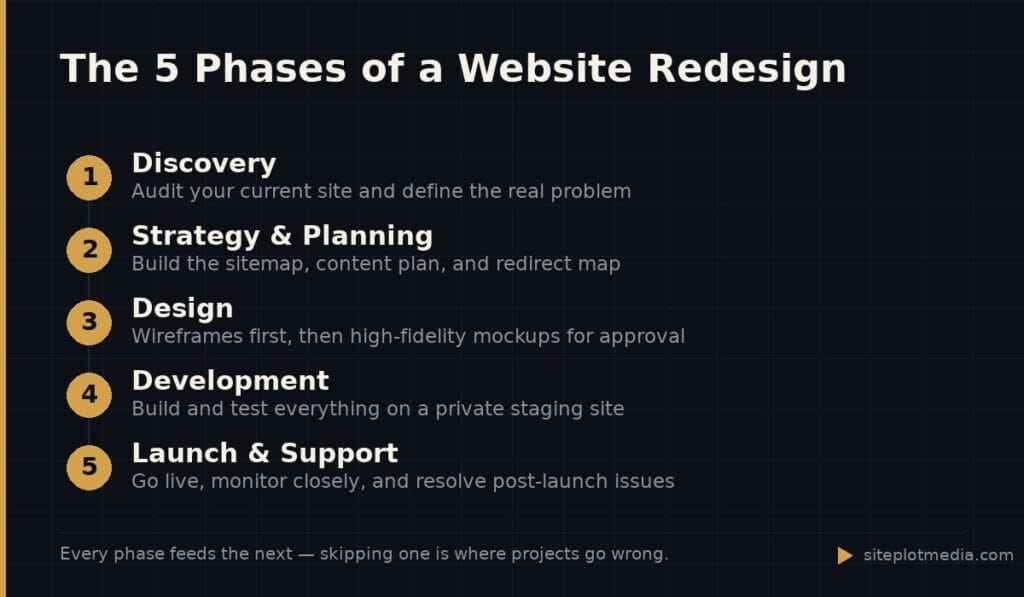
A website redesign typically moves through five phases: discovery, strategy and planning, design, development, and launch with post-launch support. Each phase builds on the last, and skipping one is usually what causes projects to run over budget or miss the mark. Knowing what to expect at each stage helps you stay involved without getting lost in the technical details.
Phase 1: Discovery — Understanding your business before touching a pixel
Before any design work starts, a good agency needs to understand what you actually do, who your customers are, and why your current site is falling short. This usually involves a kickoff call or questionnaire covering your goals, your competitors, your top-performing pages, and any hard constraints like brand guidelines or a platform you are locked into.
Discovery also includes a technical audit of your existing site. This means reviewing how fast your pages load, whether your content is indexed by search engines, how visitors currently move through your site, and where they drop off. You are not expected to interpret all of this yourself — the purpose is to give the agency a baseline so they are solving the right problems.
Expect this phase to take one to two weeks and to require real input from you. The agencies that skip discovery or treat it as a formality are the ones most likely to hand you a site that looks nice but does not move the needle for your business.
Phase 2: Strategy and planning — Deciding what to build before building it
With discovery complete, the agency translates what they learned into a plan. This typically includes a sitemap (a simple outline of every page and how they connect), a content plan, and decisions about platform, hosting, and any third-party tools like a booking system or e-commerce cart.
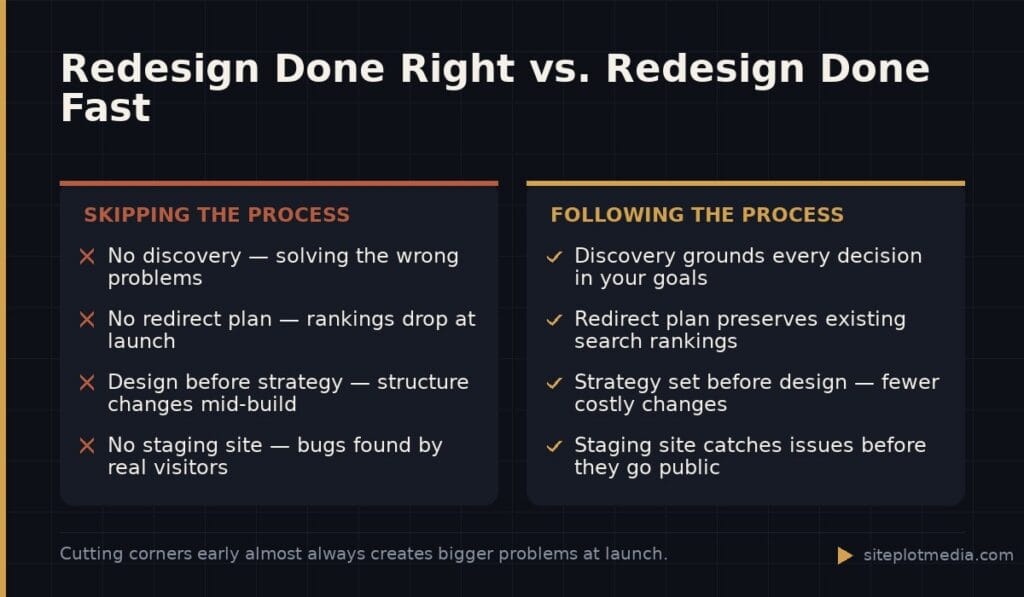
This is also where SEO strategy enters the picture in a meaningful way. A responsible agency will map target keywords to specific pages, flag any URLs that are currently ranking and should be preserved, and set up a redirect plan so you do not lose search visibility when the new site goes live. Redirects are one of the most commonly botched parts of a redesign — a page that ranks today can vanish from search results overnight if its old URL is not properly forwarded to the new one.
Strategy is where you should push back and ask questions. If the agency proposes something that does not match how your customers actually find or use your site, say so. It is much cheaper to change a plan than to change a built website.
This is the kind of thing we handle day to day — you can see how our build process works or browse recent work.
Phase 3: Design — What you will review and approve
Design does not mean the agency disappears and returns with a finished website. Most agencies start with wireframes — low-detail layouts that show where content will sit on a page without worrying about colors or photography. This step forces both sides to agree on structure before investing time in visual polish.
After wireframes are approved, the agency moves into high-fidelity mockups, which look close to the finished product. You will typically review a homepage and one or two interior page templates. Feedback rounds are normal; most contracts include two to three rounds of revisions. What slows projects down is vague feedback like “make it pop” — the more specific you can be about what is and is not working, the faster this phase moves.
One thing worth knowing: what you approve in design software and what appears in a browser can look slightly different across devices. A good agency will flag these differences and resolve them in development rather than treat them as bugs after launch.
Phase 4: Development — Building the real thing
Development is where approved designs are turned into a working website. The agency builds pages on a staging environment — a private, password-protected version of the site that you can view and click through but that is not yet visible to the public or search engines.
This phase includes writing or migrating content, setting up forms and integrations, configuring your CMS (content management system) so you can edit pages yourself later, and running performance checks. Page speed deserves attention here. Heavy page-builder tools can add significant load time if they are not configured carefully, which affects both user experience and search rankings. A competent developer optimizes images, trims unnecessary code, and tests on real mobile devices, not just a browser emulator.
Development is also when the redirect plan from Phase 2 gets implemented, analytics tracking is confirmed, and the site is tested across browsers. Before anything goes live, you should receive a staging link and time to click through the site yourself and flag anything that does not work as expected.
Phase 5: Launch and what happens after
Launch day involves pointing your domain to the new site’s server, which typically takes a few hours to propagate across the internet. A good agency will monitor the site closely in the first 24 to 48 hours, watching for broken links, missing redirects, or anything that did not transfer cleanly from staging.
Post-launch support is where many vendors go quiet, and it is worth asking about this explicitly before you sign a contract. In the weeks after launch, small issues tend to surface — a form that stops working after a plugin update, a page that looks wrong on a specific phone model, or a new piece of content you need help adding. Whether support is included and for how long varies widely by vendor. Some charge hourly after launch; others include a defined support period. At Siteplot Media, for example, the first 90 days of support are included in the project before ongoing care begins.
SEO results after a redesign take time. Search engines need to recrawl and re-evaluate your new pages, which can take weeks to months depending on how often your site was previously crawled. A well-executed redesign should not hurt your existing rankings and may improve them over time — but any agency that promises specific ranking outcomes after launch is overpromising.
How long does a website redesign actually take?
For a small to mid-sized business site — typically five to twenty pages — a realistic timeline is eight to fourteen weeks from signed contract to launch. Larger sites with custom functionality, e-commerce, or multiple stakeholder approval rounds often run longer.
The most common causes of delay are not technical. They are slow content delivery from the client, extended feedback rounds, and scope changes mid-project. If you want your redesign to land on time, the single most useful thing you can do is have your copy, photography, and logo files ready before development begins.
- Weeks 1–2: Discovery and technical audit
- Weeks 2–4: Strategy, sitemap, and content planning
- Weeks 4–7: Design and client review rounds
- Weeks 7–12: Development on staging
- Weeks 12–14: Final review, testing, and launch
Frequently asked questions
How much does a website redesign cost for a small business?
A small business website redesign typically ranges from $3,000 to $15,000 or more depending on the number of pages, custom functionality, and how much content work is included. Simpler brochure sites sit toward the lower end; sites with e-commerce, booking systems, or significant SEO buildout cost more.
Will a website redesign hurt my Google rankings?
A properly executed redesign with a complete redirect plan should not hurt your existing rankings and may improve them over time. The risk comes when old URLs are not redirected to their new equivalents, causing search engines to treat the new pages as brand new with no history.
Do I need to provide content for my website redesign?
Yes — you will need to provide or approve the words, images, and other content that goes on your site. Some agencies offer copywriting as an add-on service, but even then you will need to review and fact-check anything written about your business.
Can I keep my existing website live while the new one is being built?
Yes, and you should — the new site is built on a private staging environment until it is ready to launch, so your current site stays live and functional the entire time. The switchover typically happens in a matter of hours on launch day.
What is a staging site and why does it matter?
A staging site is a private, password-protected copy of your new website where the agency builds and tests everything before it goes public. It matters because it lets both you and the agency catch problems — broken links, display issues, missing content — without any of it affecting real visitors or search engines.