
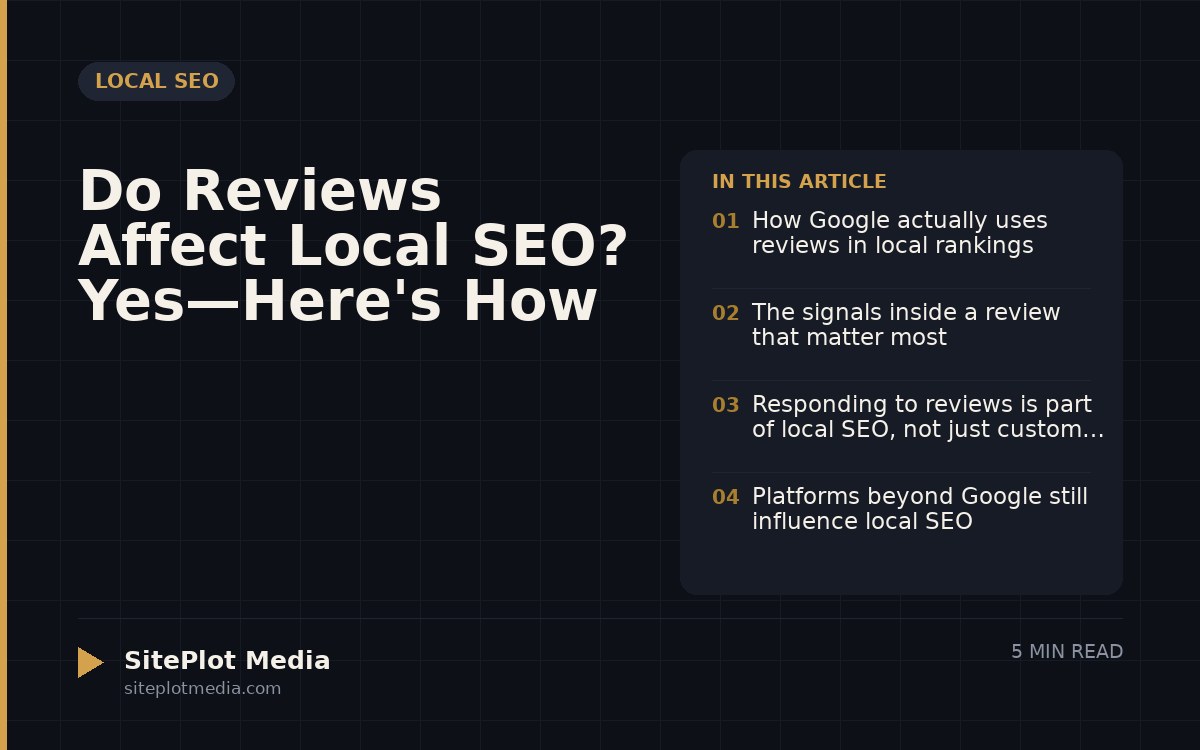
Yes, customer reviews directly affect local SEO. Google uses review signals—including the quantity of reviews, the overall rating, the recency of reviews, and the words customers use in them—as ranking factors in local search results. A business with a steady stream of genuine, detailed reviews will consistently outperform a similar business with few or outdated ones, all else being equal.
How Google actually uses reviews in local rankings
Google’s local search algorithm—the system that decides which businesses appear in the map pack and nearby results—weighs several categories of signals. Review signals are one of those categories, sitting alongside factors like proximity, website relevance, and how complete your Google Business Profile is.
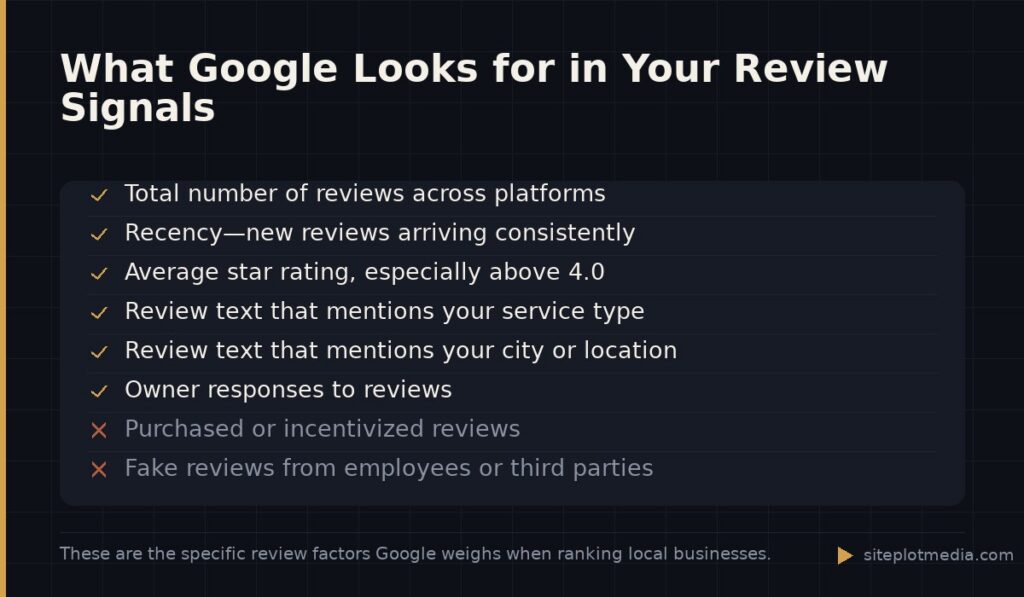
Within review signals, Google pays attention to a few specific things: the total number of reviews you have, your average star rating, how recently reviews were left, and whether reviewers use words that describe what you do and where you do it. A plumber in Athens, Georgia whose customers write "best emergency plumber in Athens" is giving Google useful confirmation of both the service and the location.
It is worth being honest about what this means in practice: reviews alone will not launch a poorly optimized business to the top of results. But they are a real, confirmed ranking input—and one of the few you can actively influence through good customer service and a simple follow-up process.
The signals inside a review that matter most
Not all reviews carry the same weight. A one-word review that says "Great!" is better than nothing, but a review that mentions your service category, your location, and a specific experience gives Google richer information to work with. You cannot put words in customers’ mouths, but you can make it easy for them to leave a review right after a job is done, when the details are still fresh.
Recency matters more than many business owners expect. A business with 200 reviews, most of them three years old, can lose ground to a competitor with 60 reviews if that competitor is earning new ones every week. Google interprets a steady flow of reviews as a sign that the business is still active and still serving customers.
- Total review count across Google and other platforms
- Average star rating (especially below 4.0, where click-through rates drop noticeably)
- Review recency—how recently the most recent reviews were left
- Review text that includes service keywords and location mentions
- Your response rate and the quality of your responses to reviews
This is the kind of thing we handle day to day — you can see how our build process works or browse recent work.
Responding to reviews is part of local SEO, not just customer service
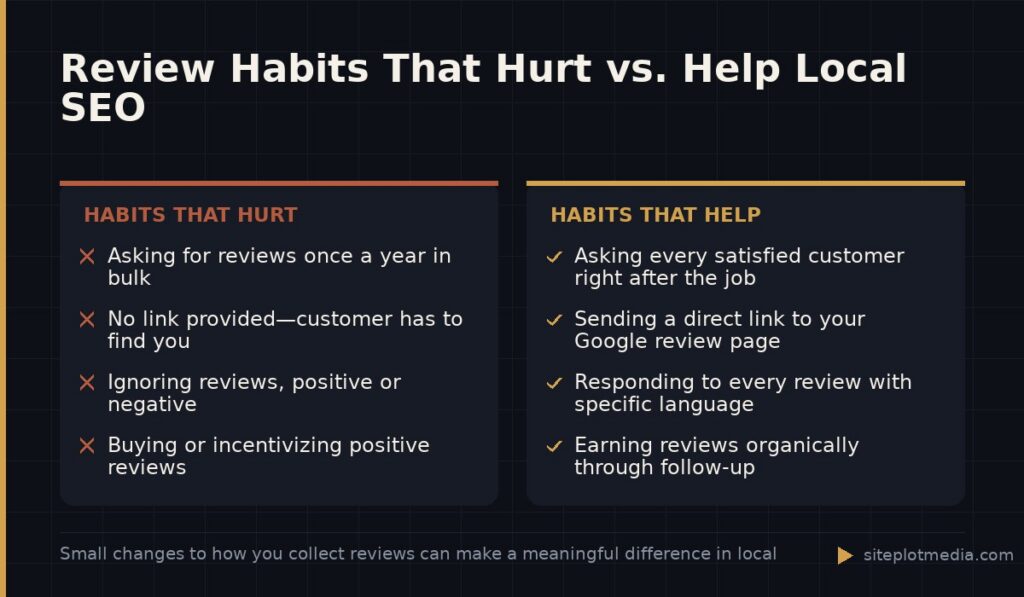
When you respond to a review, Google indexes that response. That means the keywords you naturally use in your reply—your business category, the neighborhood or city you serve, the specific service the customer mentioned—can reinforce your relevance signals. Responding is not a magic ranking lever, but it contributes, and it also signals to potential customers that a real person is behind the business.
Responding to negative reviews matters just as much. A polite, specific response to a complaint shows both Google and prospective customers that you take quality seriously. Businesses that ignore negative reviews or respond defensively tend to see those reviews influence purchasing decisions far more than they would have otherwise. The goal is not to win the argument—it is to show the next reader that you are professional.
Platforms beyond Google still influence local SEO
Google reviews carry the most direct weight in Google’s local results, but reviews on Yelp, Facebook, industry-specific directories, and the Better Business Bureau all contribute to your broader local authority. Google’s algorithm can read structured data from many of these platforms, and third-party review sites often rank on their own in local searches—meaning a strong Yelp profile can appear on page one even if your own website does not.
For service-area businesses in specific industries, niche platforms matter a great deal. A contractor should care about Houzz and Angi. A medical practice should pay attention to Healthgrades and Zocdoc. An attorney should monitor Avvo. Concentrating all your energy on Google while ignoring the platform where your specific customers actually look for providers is a common and costly mistake.
What to avoid: shortcuts that backfire
Buying reviews is against Google’s terms of service and creates real risk. Google has become increasingly good at detecting patterns that look artificial—a sudden spike of five-star reviews from accounts with no history, reviews that all use similar phrasing, or reviews that geolocate to a place far from where your customers actually are. Penalties range from review removal to suspension of your Google Business Profile entirely.
Incentivizing reviews is a gray area worth understanding. You can ask customers to leave a review. You can make it easy with a direct link. What you cannot do is offer a discount, a gift, or any other reward in exchange for a positive review—that violates both Google’s policies and FTC guidelines. The distinction matters: asking is fine, compensating is not.
- Do not buy reviews from any service
- Do not create fake reviews yourself or ask employees to do so
- Do not offer incentives specifically for positive reviews
- Do not mass-email your entire list asking for reviews after years of silence—earn them steadily
Building a review strategy that actually works
The most effective review strategy is boring in the best way: ask every satisfied customer, make it easy, and do it consistently. A single text message or email with a direct link to your Google review page, sent within a day or two of completing a job, converts far better than a generic "please leave us a review" note buried in an invoice footer. Timing and friction reduction are everything.
For businesses working with a local SEO partner, review generation should be part of the ongoing work—not an afterthought. At Siteplot Media, our local SEO engagements include setting up and optimizing the review request process as part of the foundation work, alongside Google Business Profile optimization, citation building, and on-page signals. If you are evaluating whether professional help makes sense for your situation, consider whether you have the bandwidth to maintain these signals consistently month over month—because consistency is what the algorithm actually rewards.
If you are a small business with a tight budget, the honest answer is that you can build a solid review presence yourself with nothing more than a spreadsheet and a follow-up message template. The investment of time pays off whether or not you hire anyone. Start there.
Frequently asked questions
Do reviews affect local SEO rankings directly?
Yes, reviews are a confirmed local search ranking factor. Google uses the quantity, recency, rating, and keyword content of reviews when deciding which businesses to show in local results.
How many Google reviews do I need to rank locally?
There is no magic number that guarantees a ranking. What matters more than a specific count is earning reviews consistently over time and maintaining a rating above 4.0, where most customers still consider a business trustworthy.
Do negative reviews hurt my local SEO?
A few negative reviews do not necessarily hurt your rankings, and a mix of ratings can actually appear more authentic than a perfect score. However, a very low average rating does appear to reduce click-through rates, which can indirectly affect performance.
Do reviews on Yelp or Facebook help Google rankings?
Reviews on third-party platforms contribute to your overall local authority and often rank on their own in local searches, even if their direct impact on Google's map pack is smaller than Google reviews themselves.
Is it okay to ask customers to leave a review?
Yes, asking customers to leave a review is completely acceptable under Google's policies. What is not allowed is offering compensation—discounts, gifts, or other incentives—in exchange for a positive review.