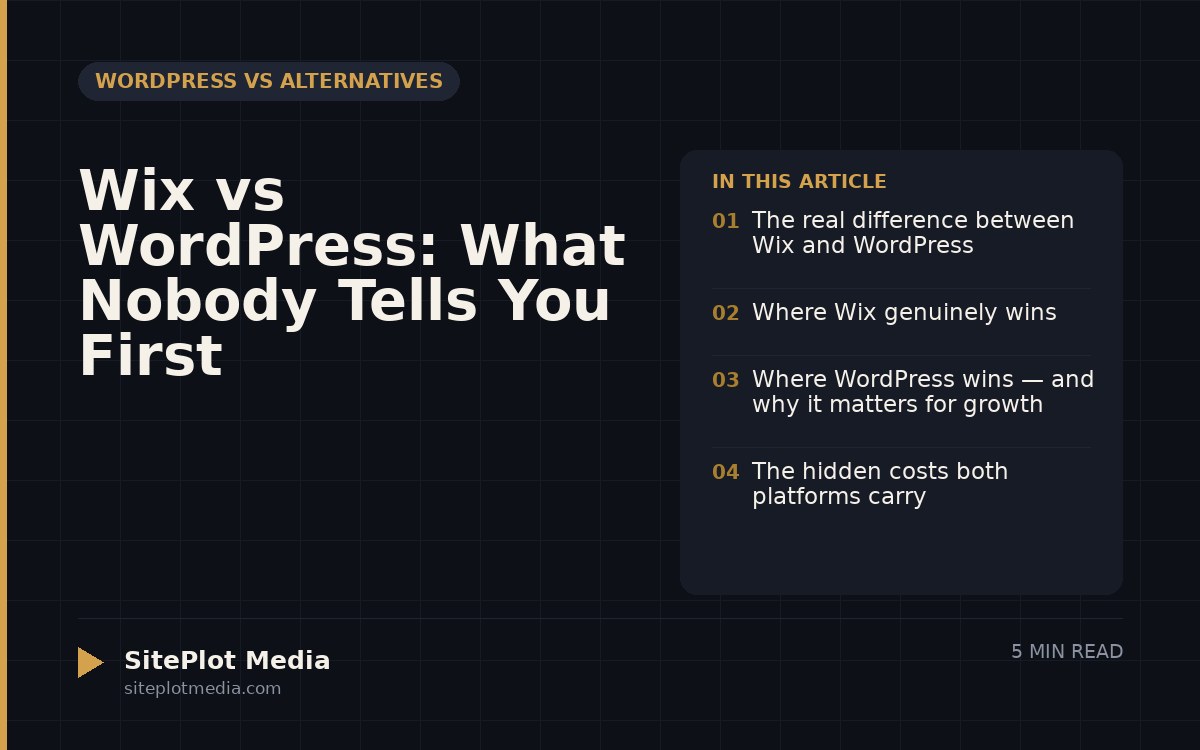
For most small businesses that need a simple, presentable website and have no plans to scale it heavily, Wix is genuinely fine — but WordPress gives you more control, more SEO flexibility, and no platform lock-in as your business grows. The choice that hurts people is not picking the wrong one upfront; it is picking Wix for a business that will outgrow it and then paying to rebuild everything two years later.
The real difference between Wix and WordPress
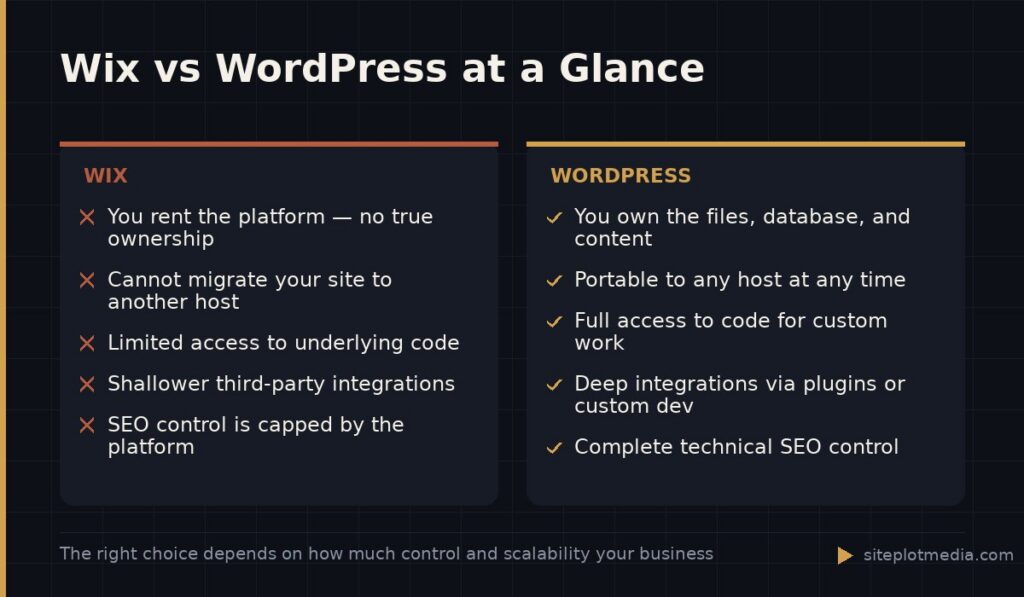
Wix is a hosted, all-in-one platform. You pay Wix a monthly fee and they handle the servers, security, and software updates. Everything happens inside their system, and you cannot take your site and move it to a different host. WordPress (specifically WordPress.org, the self-hosted version) is open-source software you install on a server you control. The files, the database, and the content all belong to you.
That distinction sounds technical, but it has practical consequences. With Wix, the ceiling on what you can customize or extend is set by Wix. With WordPress, the ceiling is essentially your budget and your developer’s skill. Neither answer is wrong — it depends entirely on what your business actually needs from a website.
Where Wix genuinely wins
Wix is fast to launch, honest about its pricing upfront, and requires almost no technical knowledge to maintain. If you are a local service business — a therapist, a portrait photographer, a single-location restaurant — and your website’s main job is to show hours, services, and a contact form, Wix handles that without drama.
The drag-and-drop editor has improved substantially over the years. Wix also includes hosting, an SSL certificate (the padlock in your browser), and automatic backups in every paid plan. For a solo operator or a very small team that has no interest in managing software, that bundled simplicity has real value.
- No server management or manual updates required
- Predictable monthly cost, all-in
- Straightforward for non-technical users to edit content
- Built-in hosting, SSL, and basic security
This is the kind of thing we handle day to day — you can see how our build process works or browse recent work.
Where WordPress wins — and why it matters for growth
WordPress powers a large portion of the web because it scales in ways Wix simply cannot match. Need a custom booking system integrated with your CRM? A membership portal? An e-commerce store with complex inventory rules? WordPress has a plugin or a custom development path for virtually all of it. Wix has an app market too, but its integrations are shallower and you are always working within Wix’s constraints.
The SEO argument for WordPress is real, though often overstated. WordPress does not rank automatically — no platform does. What it offers is more control over technical SEO: clean URL structures, full access to your site’s code, schema markup, page speed optimization, and the ability to implement changes without asking a platform for permission. For businesses where organic search traffic matters to revenue, that control compounds over time.
Ownership is the underrated advantage. Your WordPress site can be moved to a faster host, handed to a new developer, or restructured without starting from zero. With Wix, if you ever want to leave, you are rebuilding your site, not migrating it.
- Full ownership of files, code, and content
- Portable — move hosts without losing your site
- Deeper SEO and technical control
- Scales to complex functionality through plugins or custom code
- Larger global developer ecosystem
The hidden costs both platforms carry
Wix looks cheap until you price out the plan you actually need. The entry-level plans include Wix branding and limited storage. Business-grade plans with e-commerce, more storage, and no Wix ads run considerably higher per month. Over three to five years, Wix subscription costs are not trivial, and you retain no asset at the end — you are renting.
WordPress has its own cost structure that beginners underestimate. Hosting, a domain, a premium theme or page builder, essential plugins, and professional development time all add up. A well-built WordPress site done by an experienced developer typically starts in the $3,000–$8,000 range depending on scope, plus ongoing hosting and maintenance costs. At Siteplot Media, our standard build starts at $5,000 one-time with a 90-day included support period, then $500 per month — a structure designed so clients know exactly what they own and what ongoing care costs.
The honest summary: Wix has low upfront cost but no exit ramp and a recurring fee forever. WordPress has higher upfront cost but you own the asset and control the ongoing expense.
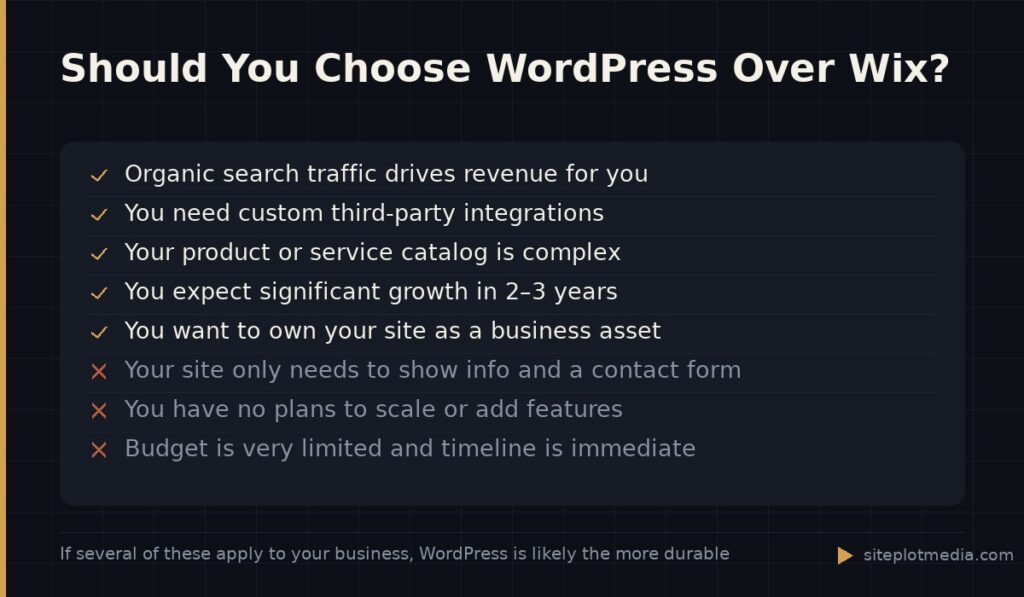
Red flags that mean you should not choose Wix
There are specific situations where choosing Wix will cost you more in the long run than starting with WordPress. Watch for these:
- You expect significant organic search traffic to drive revenue
- You need custom integrations with third-party software (CRMs, ERPs, booking systems)
- Your product catalog is large or complex
- You anticipate needing a developer to build custom features
- Your business model may require the site to scale significantly in the next two to three years
Wix has closed some of its historical SEO gaps, but it still limits access to your site’s underlying code in ways that matter for advanced optimization. If SEO is a growth channel for your business, those limits will eventually frustrate you or your agency.
How to make the right call for your situation
Start by being honest about two things: what your website needs to do right now, and what you expect it to do in two to three years. If the answers are simple and stable — present your business, list your services, let people contact you — Wix is a defensible choice and nobody should talk you out of it.
If your website is meant to generate leads at scale, support e-commerce, rank for competitive keywords, or grow with your business, WordPress is the more durable investment. The rebuild you avoid by choosing correctly now is worth more than the upfront savings.
When in doubt, talk to a developer before you build, not after. A one-hour conversation about your actual business goals costs nothing and can save you from a platform decision you will regret when your site needs to do something it was never built to do.
Frequently asked questions
Is Wix good enough for SEO?
Wix is adequate for basic local SEO but gives you less technical control than WordPress for more competitive or complex SEO strategies. If organic search is a primary growth channel for your business, WordPress's flexibility will serve you better over time.
Can I move my Wix site to WordPress later?
Not in any straightforward way — you cannot export a Wix site and import it into WordPress cleanly. Switching platforms means rebuilding your site, which is why the platform decision matters more than most people realize upfront.
Which is cheaper, Wix or WordPress?
Wix has a lower upfront cost but charges an ongoing subscription with no option to own the asset. WordPress typically costs more to build initially but gives you full ownership, and your ongoing costs — hosting and maintenance — are more controllable over time.
Does WordPress require a developer to manage it?
Not for day-to-day content updates, but you benefit from professional help for setup, security, plugin updates, and anything custom. A well-configured WordPress site with managed hosting can be maintained by a non-technical owner for routine tasks.
Is there a situation where I should just use Wix and not feel bad about it?
Yes — if your site's job is simply to establish an online presence for a local or service business, your budget is limited, and you have no plans to scale, Wix is a reasonable and honest choice. Not every business needs a custom WordPress build, and a good advisor will tell you that.