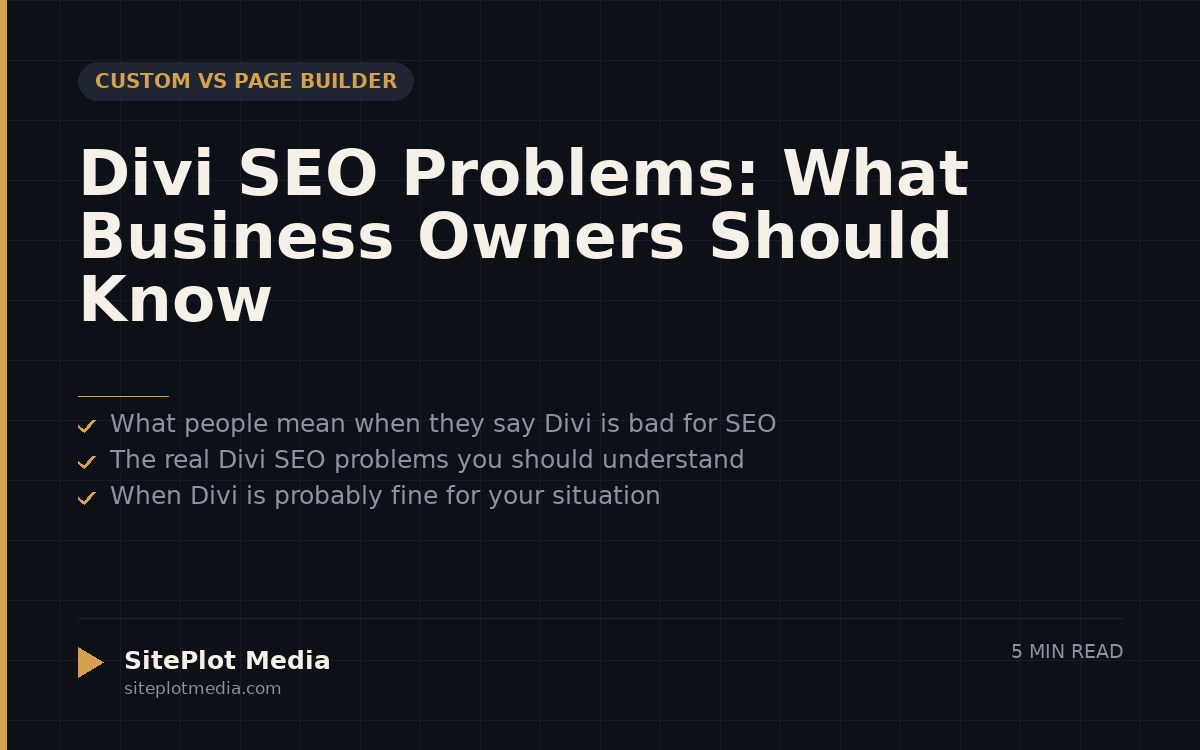
Divi is not inherently bad for SEO, but it comes with real technical drawbacks — extra page weight, bloated code, and shortcode dependency — that can quietly drag down your search rankings if no one on your team is managing them. For a small business owner who needs a fast, well-optimized site, those problems are worth taking seriously before you build.
What people mean when they say Divi is bad for SEO
When developers or marketers say Divi has SEO problems, they are usually talking about three things: slow page load times, bloated HTML output, and what happens to your content if you ever want to leave the platform. None of these are automatic dealbreakers, but all three require attention that most small business owners never know to ask for.
It is worth separating two different questions: Can a Divi site rank well? Yes, it can. Does a default Divi install give you a site that is well-optimized out of the box? Mostly no. The gap between those two answers is where most of the confusion lives.
The real Divi SEO problems you should understand
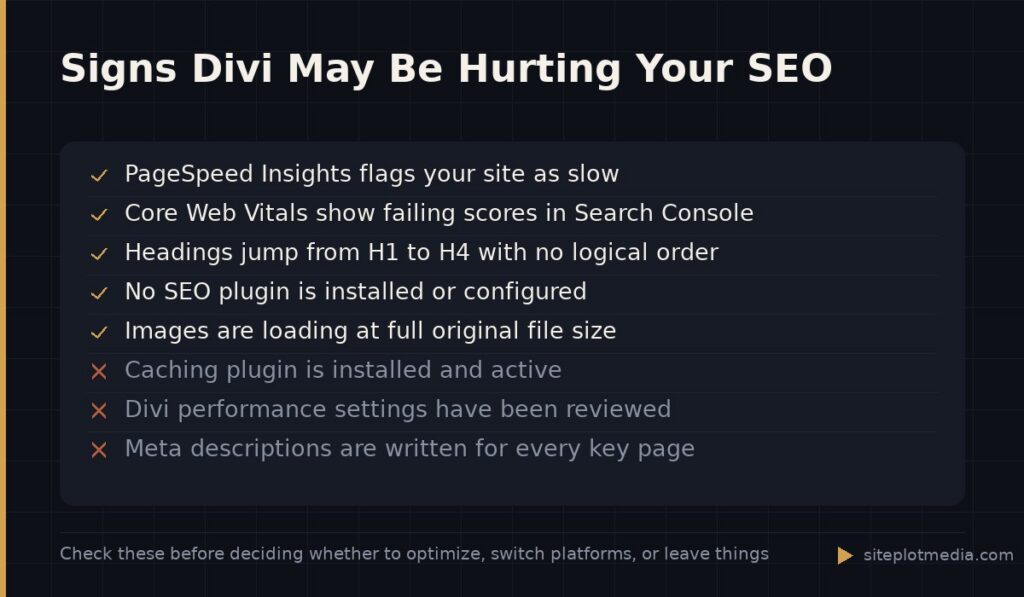
Divi loads a significant amount of CSS and JavaScript on every page, including scripts for builder features that have nothing to do with the page a visitor is actually looking at. Google uses page speed as a ranking signal, and tools like Google PageSpeed Insights or Core Web Vitals will often flag a default Divi site for load time issues. This does not mean the site will rank last — it means it starts with a handicap that a custom-coded or leaner-built site does not have.
The second issue is shortcode lock-in. Divi stores your page layouts using its own formatting codes embedded inside your content. If you ever move away from Divi, those codes do not translate — your pages can appear as walls of broken text. This is not an SEO problem in the traditional sense, but it creates platform dependency that makes future improvements harder and more expensive.
The third issue is heading structure and semantic HTML. Divi’s drag-and-drop interface makes it easy to accidentally create pages where the heading hierarchy is wrong — for example, jumping from an H1 straight to an H4, or using a styled text block when an actual heading tag was needed. Search engines use heading structure to understand what a page is about, so a sloppy structure can undercut otherwise good content.
This is the kind of thing we handle day to day — you can see how our build process works or browse recent work.
When Divi is probably fine for your situation
If you are running a local service business with a small site — a few pages, a contact form, maybe a blog — and your competitor landscape is not intensely competitive, a well-configured Divi site with a good caching plugin, an image optimizer, and careful attention to headings can perform reasonably well. The technical disadvantages of Divi matter more as competition increases and as your content volume grows.
Divi is also a reasonable choice if your team already knows it and would otherwise pay a developer to rebuild the site in something else. Switching platforms has real costs, and those costs need to be weighed against the SEO benefit you would actually gain — which depends on your specific market and keyword targets.
The honest answer here is: Divi’s problems are more likely to hurt you if you are in a competitive market, if site speed is already a bottleneck for your users, or if you are trying to scale to a large volume of content pages. If none of those apply, the urgency is lower.
What a properly optimized Divi site actually requires
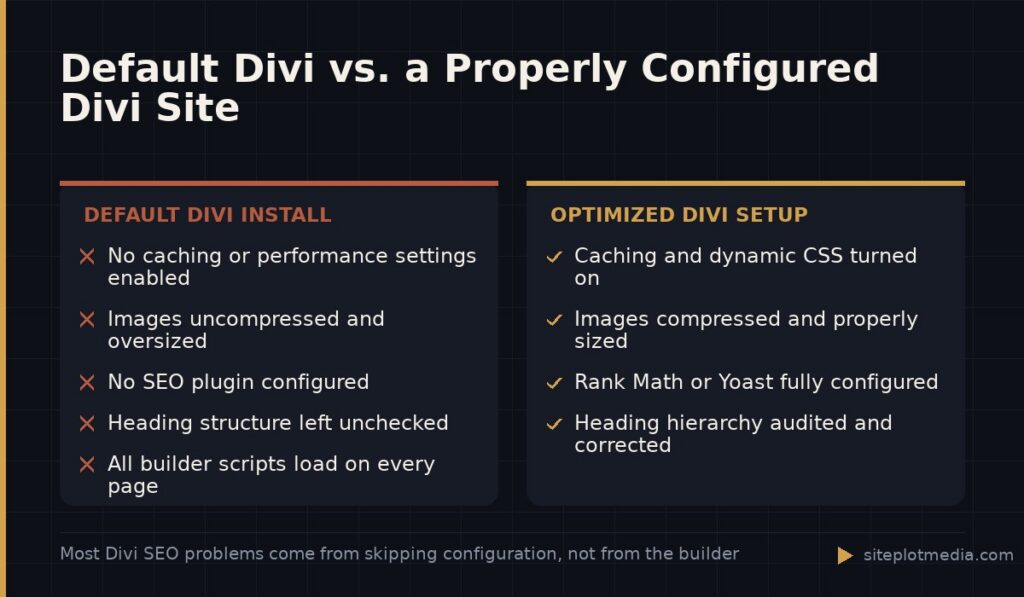
Getting a Divi site to perform well for SEO is not impossible, but it does require deliberate configuration that goes well beyond installing the theme and dragging in some modules. Here is what actually needs to happen:
- Enable Divi’s built-in performance settings, including dynamic CSS and critical CSS generation
- Use a caching plugin (such as WP Rocket or LiteSpeed Cache) configured correctly for the builder’s output
- Compress and properly size every image — Divi does not do this automatically
- Install an SEO plugin like Yoast or Rank Math and configure title tags, meta descriptions, and schema markup for each page
- Audit heading structure manually or with a tool like Screaming Frog to catch hierarchy errors the builder introduces
- Limit third-party scripts and unnecessary Divi modules on pages where they add no value
Most Divi sites that rank poorly are not suffering from some fundamental flaw in the builder — they are simply sites where none of these steps were taken, often because the person who built the site was focused on how it looked rather than how it performed technically.
How custom-built sites compare to Divi on SEO fundamentals
A site built with clean, hand-coded HTML and CSS — or with a minimal WordPress theme and no page builder — will almost always outperform a Divi site on raw technical metrics. There is no builder overhead, no shortcode dependency, and no extra scripts loading in the background. The HTML output is exactly what it needs to be and nothing more.
That technical advantage translates into faster load times, better Core Web Vitals scores, and cleaner markup for search engines to read. Whether that translates into better rankings for your business depends on factors beyond the code — your content quality, your backlink profile, your competitors’ sites, and how well your pages match what searchers actually want.
At Siteplot Media, our custom website builds start at $5,000 one-time with a 90-day included support period followed by $500 per month — not because a custom build is always necessary, but because for clients in competitive markets or with real growth goals, the technical foundation genuinely matters and cheap shortcuts tend to cost more later.
The practical question to ask before making a decision
Before deciding whether to stick with Divi, optimize it, or move to a custom build, ask yourself one question: Is my site currently losing business because of how it performs in search, or is the problem something else? If your site ranks fine and your conversion rate is the issue, a platform switch is probably not the answer. If you are invisible in search for terms your customers clearly use, the platform may be one piece of a larger problem worth investigating.
A technical SEO audit — which any competent web studio can run — will tell you whether your Divi site’s performance is actually hurting you, and by how much. That data gives you something to make a real decision from, rather than relying on broad claims that Divi is good or bad across the board.
Frequently asked questions
Does Divi hurt Google rankings?
Divi can negatively affect Google rankings by slowing down page load times and adding unnecessary code, both of which Google treats as quality signals. Whether it actually hurts your specific rankings depends on how the site is configured and how competitive your market is.
Is Divi slower than other WordPress page builders?
Divi tends to produce heavier page output than minimal or custom-built sites, though it is comparable to other full-featured builders like Elementor. With proper caching, image optimization, and Divi's performance settings enabled, the speed gap can be significantly reduced.
Can I rank on the first page of Google with a Divi website?
Yes, Divi sites can and do rank on the first page of Google. Technical factors like page speed matter, but content quality, relevance, and backlinks are equally important — a well-managed Divi site can outrank a poorly executed custom build.
What SEO plugin should I use with Divi?
Rank Math or Yoast SEO are both solid choices for handling meta titles, descriptions, schema markup, and sitemaps on a Divi site. Divi itself does not handle these elements, so a dedicated SEO plugin is not optional — it is necessary.
Should I rebuild my Divi site to improve SEO?
Not necessarily — rebuild it only if a technical audit shows your current setup is genuinely harming your performance and if the cost of rebuilding is justified by your business goals. Many Divi sites can be meaningfully improved through optimization without a full rebuild.