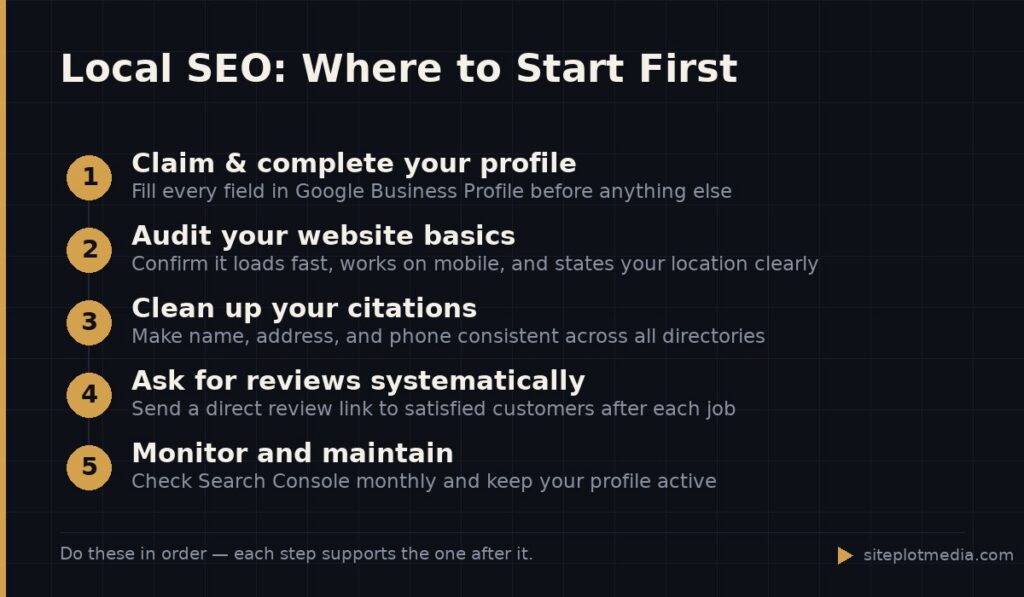
To get your Athens, GA business to show up on Google, start by claiming and fully completing your Google Business Profile — that single step has more impact on local visibility than almost anything else you can do. From there, make sure your website clearly signals what you do and where you do it, earn a handful of honest customer reviews, and build consistent citations (mentions of your business name, address, and phone number) across the web. These three pillars — your Google Business Profile, your website, and your reputation signals — work together, and neglecting any one of them limits what the others can accomplish.
Start with your Google Business Profile — it is your most valuable local asset
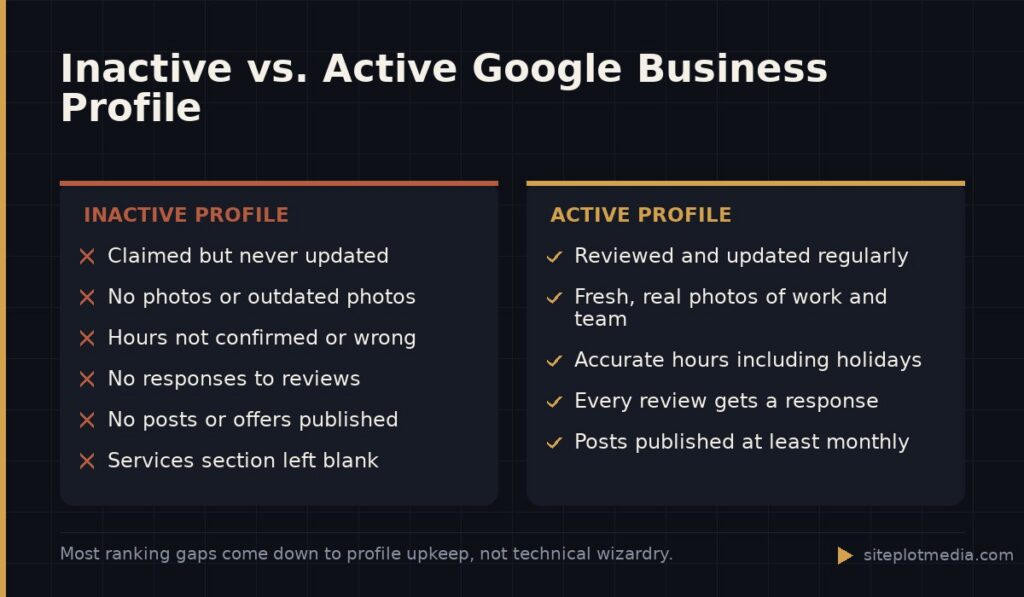
Google Business Profile (sometimes still called Google My Business) is the free listing that powers the map results and the info panel that appears when someone searches for a business by name or category. If you have not claimed yours, do that first at business.google.com. If you claimed it years ago and barely touched it, treat it like a neglected storefront — it needs attention.
A complete profile means filling in every field Google offers: business category, hours, service area or physical address, phone number, website, services or products, and a genuine description of what you do. Upload real photos of your location, your team, and your work. Google rewards completeness because complete profiles give searchers more to go on, and searchers who get good information are more likely to click.
One thing most businesses miss: Google posts. You can publish short updates, offers, or event announcements directly to your profile, similar to a social media post. These are not a magic ranking lever, but they signal to Google that the listing is active and maintained, which matters.
Your website still matters — even in a world of social media and map listings
Some business owners ask whether they even need a website if their Google Business Profile looks great. The honest answer is: for most businesses, yes. Your website is the only piece of digital real estate you fully control. Social platforms change their algorithms; Google can suspend a Business Profile; your website stays yours.
For local search specifically, your website needs to do a few things well. It should clearly state what you do and where you serve customers — not buried in fine print, but in plain language on the homepage and in your page titles. If you serve Athens and surrounding areas like Watkinsville, Bogart, or Commerce, say so somewhere that makes sense contextually, not just in a keyword-stuffed footer.
Page speed and mobile usability are also genuine ranking factors, not just best practices. Google predominantly uses the mobile version of your site to decide how to rank it. A slow, hard-to-navigate site on a phone is a real liability. You do not need a cutting-edge design, but you do need one that loads quickly and works on a small screen.
This is the kind of thing we handle day to day — you can see how our build process works or browse recent work.
Reviews are a trust signal Google takes seriously
Customer reviews on your Google Business Profile influence both how often you appear in local results and how often people choose you over a competitor once they see you. Google uses review quantity, recency, and overall rating as signals of a business’s real-world credibility.
The most effective review strategy is the simplest one: ask satisfied customers to leave a review, and make it easy by sending them a direct link to your review form. You can find that link inside your Google Business Profile dashboard. Do not offer incentives for reviews — Google’s policies prohibit it, and it tends to produce reviews that read as inauthentic anyway.
Respond to every review, positive or negative. A thoughtful response to a critical review often does more for your reputation than ten five-star responses to praise. It shows prospective customers that a real person is paying attention.
Citations and directory listings: boring but genuinely useful
A citation is any online mention of your business’s name, address, and phone number — often called NAP for short. Common citation sources include Yelp, Apple Maps, Bing Places, the Better Business Bureau, your local chamber of commerce, and industry-specific directories.
Citations help Google confirm that your business is real and located where you say it is. The catch is consistency: if your address is listed differently across a dozen directories — suite number sometimes included, sometimes not; phone number with a different area code on one old listing — Google’s confidence in your information drops. Audit your listings using a free tool like Moz Local’s checker or simply search your business name and phone number together to find what’s out there.
You do not need hundreds of citations. A few dozen accurate, consistent listings on reputable directories are more valuable than a massive volume of low-quality or duplicate entries. Quality over quantity applies here.
What local SEO cannot do — and when to be skeptical of promises
No one can guarantee a specific ranking on Google, and you should be cautious of any agency or individual who promises one. Google’s algorithm weighs hundreds of signals, some of which are outside anyone’s control — including how many strong competitors exist in your market and how long your domain has been established.
Local SEO is also not instant. Most businesses begin to see meaningful movement in three to six months, with more substantial results accumulating over a year or more. That timeline can be frustrating, but it reflects how search engines actually work: they build trust in a business incrementally, just as human customers do.
If you are a brand-new business with no website, no reviews, and no citations, paid Google Ads (where you pay per click) can generate visibility while your organic presence builds. Ads and SEO are not competitors — for many small businesses, they work best together in the early months.
When to do it yourself versus hiring help
If your budget is tight and you have time, you can make real progress on local SEO yourself. Claiming your Google Business Profile, adding photos and posts, responding to reviews, and submitting your business to a dozen key directories are all genuinely doable without hiring anyone. Free tools like Google Search Console and Google Analytics give you meaningful feedback at no cost.
The case for hiring professional help grows when your market is competitive, when your website needs technical work you are not equipped to do, or when your time is simply worth more spent running your business. A well-executed local SEO engagement — including a properly built website, optimized profiles, citation cleanup, and ongoing content — typically runs anywhere from a few hundred dollars a month for basic maintenance to several thousand for a comprehensive build-out, depending on scope. Siteplot Media’s local SEO package, for context, is structured as a $5,000 one-time build followed by $500 per month after a 90-day included maintenance period — but that kind of investment makes most sense for businesses in competitive markets or those starting from scratch.
If your current site is decent and you just need profile and citation work, a lighter-touch arrangement might serve you just as well. Be honest with yourself about where the gap is before committing to any service.
Frequently asked questions
How long does it take to show up on Google after I claim my Google Business Profile?
Your listing can appear within a few days of claiming and verifying it, but ranking well in competitive local searches typically takes three to six months of consistent effort. Verification alone is not enough — a complete, active profile ranks significantly better than a bare one.
Do I need a website to rank locally on Google?
You can appear in map results with only a Google Business Profile, but a website strengthens your credibility and gives Google more signals to rank you for specific service searches. For most businesses, having both works better than either alone.
How many Google reviews do I need to rank well?
There is no magic number, and it varies by market and competition. What matters is that your reviews are recent, authentic, and growing over time — a steady trickle of honest reviews outperforms a onetime burst followed by months of silence.
Why does my competitor show up above me even though I have been in business longer?
Time in business is not a direct ranking factor — Google weighs profile completeness, review quantity and recency, website relevance, and citation consistency, among other things. Auditing those specific factors for both your listing and your competitor's usually reveals the gap.
Is Google Ads the same as SEO, and do I need both?
They are different: Google Ads puts you at the top of results immediately but stops the moment you stop paying, while SEO builds organic visibility that compounds over time without a per-click cost. Many small businesses benefit from running both during the early months of a new SEO effort, then scaling back ads as organic rankings improve.