
A medical practice should organize its website content around three priorities: building patient trust, meeting legal and compliance requirements, and being found by the right people searching locally. Start with clear service pages, accurate provider bios, and honest information about what patients can expect — then layer in compliance safeguards like HIPAA-conscious contact forms and appropriate disclaimers.
Why medical website content is different from other industries
Most small businesses can publish content freely and refine it over time. Medical practices face a higher bar because the stakes are different — a patient making a care decision based on your website is not the same as someone choosing a restaurant. This means your content carries both legal weight and an ethical responsibility to be accurate and clear.
Google applies what it calls “YMYL” scrutiny — Your Money or Your Life — to health-related pages. This is not an official ranking algorithm anyone can measure precisely, but it is a documented part of how Google’s quality raters evaluate sites. In practice it means thin, vague, or misleading content on a medical site is penalized more harshly than on a retail site. Strong authorship, accurate information, and genuine credentials matter more here than in almost any other industry.
There is also the trust dimension. Patients research providers before they ever pick up the phone. If your website feels generic, outdated, or evasive, many will quietly move on to the next result. Content is how you earn the appointment before the appointment.
The core pages every medical practice website needs
Before thinking about SEO or content strategy, make sure your foundational pages are solid. These are the pages patients and search engines check first:
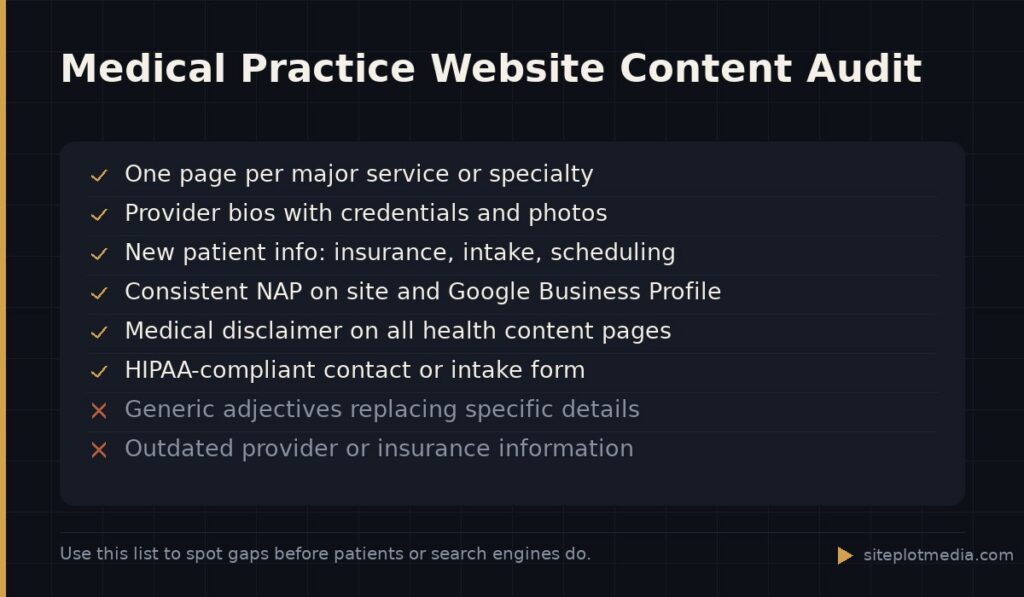
- Service pages: One page per major service or specialty. Describe what the condition or procedure is, who it is for, what the process looks like, and what to expect. Plain language wins here — avoid clinical jargon unless you immediately explain it.
- Provider bios: Full names, credentials, medical school and training, areas of focus, and a natural-sounding paragraph about their approach to care. A photo matters. Patients want to see who they are meeting.
- New patient information: What to bring, what insurance you accept, how to schedule, what the intake process looks like. Removing uncertainty lowers the barrier to booking.
- Contact and location: Your address, phone number, hours, and a map embed. This information should also be consistent with your Google Business Profile — inconsistencies confuse both patients and search engines.
- About the practice: When you were founded, your philosophy of care, the community you serve. This is where you build the emotional case for choosing you.
None of these pages need to be long. They need to be accurate, readable, and complete. A 400-word service page that answers the five questions a patient actually has is far more valuable than a 1,200-word page padded with vague reassurances.
This is the kind of thing we handle day to day — you can see how our build process works or browse recent work.
Compliance basics you cannot skip
HIPAA governs how you handle protected health information, and your website touches that boundary in several places. Standard contact forms that let patients describe their symptoms or ask specific questions about their care can create compliance exposure if that data is not handled through a HIPAA-compliant form service or patient portal. Most general web contact forms are not HIPAA-compliant by default. This is worth confirming with your compliance officer or attorney — not something to assume is covered.
Every page that offers health information should carry a medical disclaimer making clear that the content is for informational purposes only and does not constitute a patient-provider relationship or medical advice. This does not need to be alarming or legalistic in tone, but it does need to be present.
If you collect reviews or display patient testimonials, be careful about what information is included. Even a quote that seems innocuous can reveal protected health details. Stick to general satisfaction statements rather than condition-specific stories unless you have written authorization that meets HIPAA standards.
Accessibility is a separate but related concern. The ADA increasingly applies to websites, and medical practices — which serve people with disabilities — are a natural target for accessibility complaints. Proper image alt text, sufficient color contrast, and keyboard navigation are not optional nice-to-haves; they are reasonable baseline expectations.
How to write content that earns patient trust
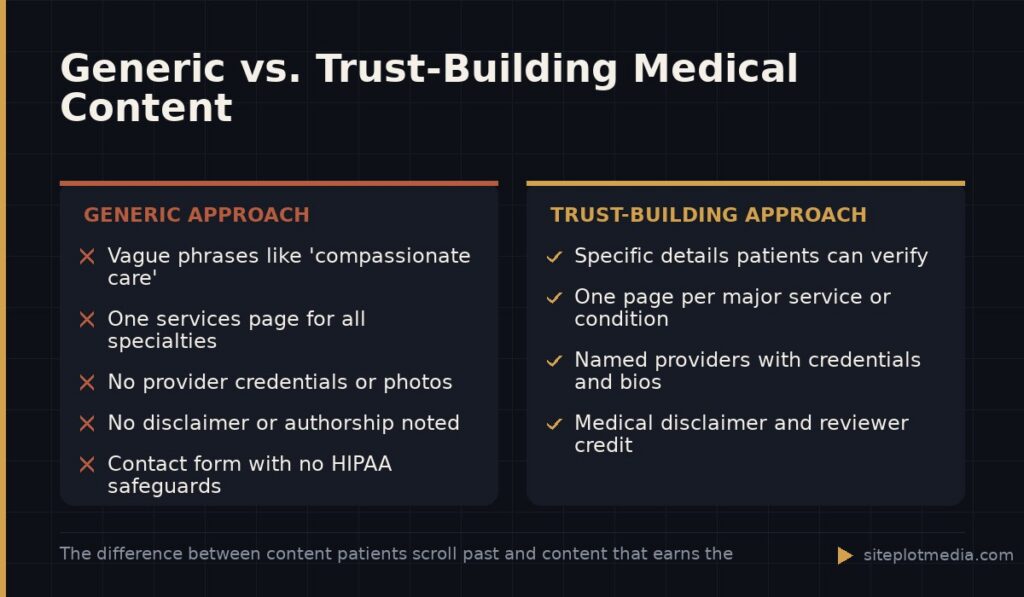
The single biggest mistake medical practices make with their content is writing for search engines instead of people. A page stuffed with phrases like “best cardiologist Athens” repeated eight times does not serve the patient trying to understand whether your practice is the right fit for them. Write first for the person reading, and the search performance tends to follow.
Specificity earns trust. Instead of “We provide compassionate, patient-centered care,” write “Our appointments run 30 minutes so we have time to answer your questions” or “We offer same-week appointments for new patients when our schedule allows.” Concrete details are credible. Adjectives are not.
Credentials and authorship matter significantly on medical content. If a physician on your staff writes or reviews a blog post or FAQ, say so — include their name, title, and the date the content was reviewed. This is what Google’s quality guidelines call demonstrated expertise, and it also happens to be what a careful patient is looking for before they trust your advice.
Avoid overclaiming. Phrases like “We cure” or “guaranteed results” are not just marketing problems — they can create legal liability. Honest language about outcomes, typical patient experiences, and what your practice is best suited to handle actually builds more trust than overblown promises.
Local SEO content for medical practices
Most medical practices serve a defined geographic area, which means local search is where the real opportunity lives. Local SEO for a medical practice is less about tricks and more about consistency: consistent name, address, and phone number across your website, your Google Business Profile, and any directory listings (Healthgrades, Zocdoc, WebMD, etc.).
Your service pages should reference the specific cities, neighborhoods, or counties you serve where that is genuinely true and useful to the reader — not forced in every paragraph. A primary care practice in a mid-sized metro might have a line like “Serving patients in [City] and surrounding communities” on their homepage. That is useful context. A keyword-stuffed paragraph listing 15 zip codes is not.
Condition-specific FAQ content is one of the most underused opportunities for medical practices. Patients search questions like “what to expect after a colonoscopy” or “how long does it take to see a dermatologist.” A short, accurate, well-attributed answer page for questions your practice genuinely fields serves both the patient and your visibility. It does not need to be a 2,000-word article — a clear 300-word answer with a call to schedule is often enough.
Maintaining content over time — and knowing when to get help
Medical content goes stale. Treatment guidelines change, insurance panels change, providers join or leave, hours shift. A website with outdated information does not just hurt your search visibility — it erodes patient trust and can create genuine confusion. Build a review cadence into your practice operations: at minimum, audit your core pages once a year and update anything that has changed.
For practices without in-house marketing staff, the realistic choice is usually between a template-based DIY approach and working with a web partner who understands the healthcare space. The DIY route can work if your practice is simple and your content needs are modest. It tends to break down when you need to add services, handle compliance questions, or compete in a crowded specialty market.
A web partner worth hiring should be able to write or review content for plain-language clarity, flag compliance concerns without replacing your attorney or compliance officer, and build a site structure that holds up as your practice grows. At Siteplot Media, our practice website packages start at $5,000 one-time with a $500/month maintenance plan after the included 90-day period — but the right fit depends entirely on your practice’s size, specialty, and competitive market. If your current site is accurate, loads fast, and patients can find what they need, a rebuild may not be justified at all.
Frequently asked questions
Does a medical practice website need a HIPAA-compliant contact form?
Yes, if your contact form allows patients to submit health information, it should route through a HIPAA-compliant service. Standard web contact forms do not meet this requirement by default, so confirm with your compliance officer what tools your form provider uses to secure and handle submissions.
How often should a medical practice update its website content?
At minimum, review your core pages — services, providers, insurance, and contact information — once per year and immediately after any significant change. Blog or FAQ content benefits from a date-of-review notation so patients and search engines know the information is current.
Should a medical practice have a blog?
A blog is worth having if someone in your practice has the time and expertise to keep it accurate and updated. A small collection of well-written, physician-reviewed FAQ pages is more valuable than a large archive of generic health articles no one maintains.
Can a medical practice use patient testimonials on its website?
Yes, with care — general satisfaction quotes are typically fine, but testimonials that reference a specific condition, treatment, or outcome can create HIPAA exposure unless you have proper written patient authorization. When in doubt, consult your compliance officer before publishing.
What makes a medical practice website rank in local search?
Consistent name, address, and phone number across your website and directory listings is the foundation of local search visibility for medical practices. Beyond that, accurate service pages, a complete and active Google Business Profile, and genuine patient reviews contribute the most.