To show up in AI search results, your business needs clear, well-structured content on a credible website that AI systems can read, understand, and confidently cite. AI tools like ChatGPT, Google’s AI Overviews, and Perplexity pull answers from sources they consider authoritative — which means the fundamentals of good SEO still matter, but a few specific content and technical choices now matter more than before. The good news is that most small businesses can make meaningful progress without starting from scratch.
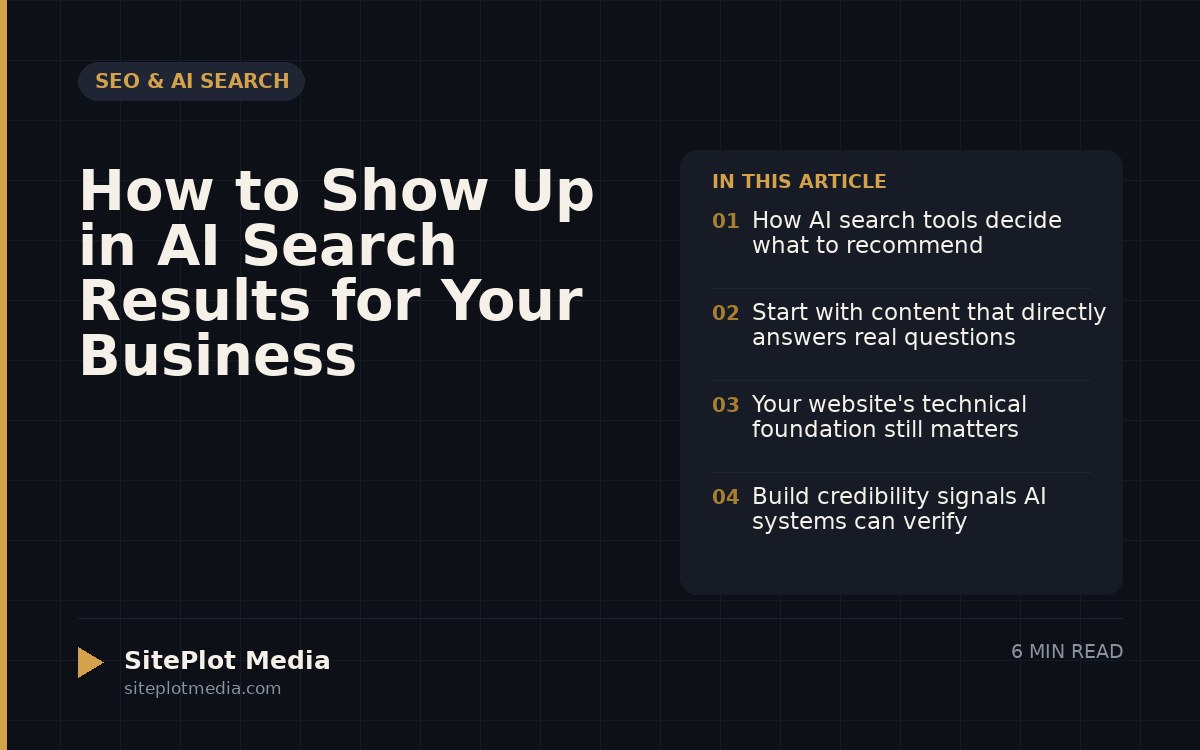
How AI search tools decide what to recommend
ChatGPT, Perplexity, Google’s AI Overviews, and similar tools are not search engines in the traditional sense. They don’t return a list of ten blue links — they synthesize an answer and sometimes cite the sources they drew from. To do that, they rely on content that is clearly written, topically focused, and published on websites that other credible sources already reference or link to.
Think of it this way: an AI assistant is trying to give a confident answer to someone’s question. It will lean on sources that already answer questions clearly, have a reasonable level of authority on the web, and are structured in a way the AI can parse. If your website is thin on content, hard to crawl, or buried in jargon, you are effectively invisible to these systems — not because of any single penalty, but because there is nothing there for the AI to latch onto.
One important thing to understand: there is no direct submission process for most of these tools. You cannot pay ChatGPT to include you. What you can do is make your business the obvious, credible answer to the questions your customers are already asking.
Start with content that directly answers real questions
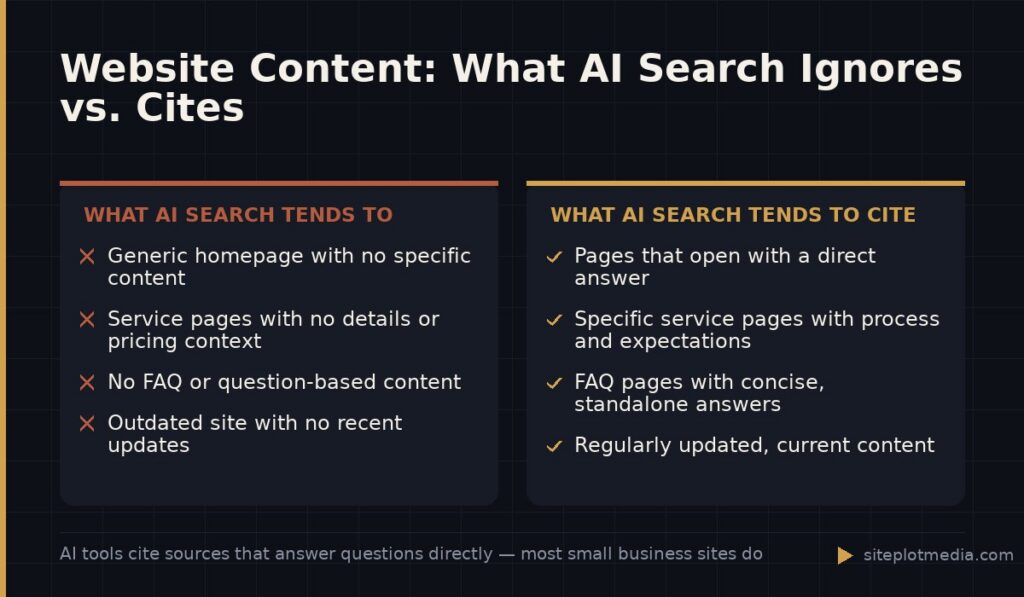
The single highest-leverage change most small businesses can make is publishing content that answers specific questions plainly and completely. AI systems are trained on and rewarded by text that gets to the point. If someone asks “What’s the best landscaping company in [city]?” and your website has a page that clearly explains your services, your service area, your process, and what makes you different, you become a plausible citation. If your site only has a homepage with a hero image and a phone number, you do not.
Focus on the questions your customers actually ask before they hire you. These are things like “How much does [your service] cost?”, “How long does it take?”, “What should I look for when hiring a [your trade]?” Write a page or blog post for each one. Answer the question in the first sentence or two, then explain. This structure is not a trick — it is just good writing, and it happens to be exactly what AI answer engines look for.
A few content types that tend to perform well in AI results:
- FAQ pages with specific, direct answers
- Service pages that explain what you do, who it’s for, and what to expect
- “How to choose” or “What to expect” guides in your industry
- Comparison content (for example, “Hiring an agency vs. doing it yourself”)
This is the kind of thing we handle day to day — you can see how our build process works or browse recent work.
Your website's technical foundation still matters
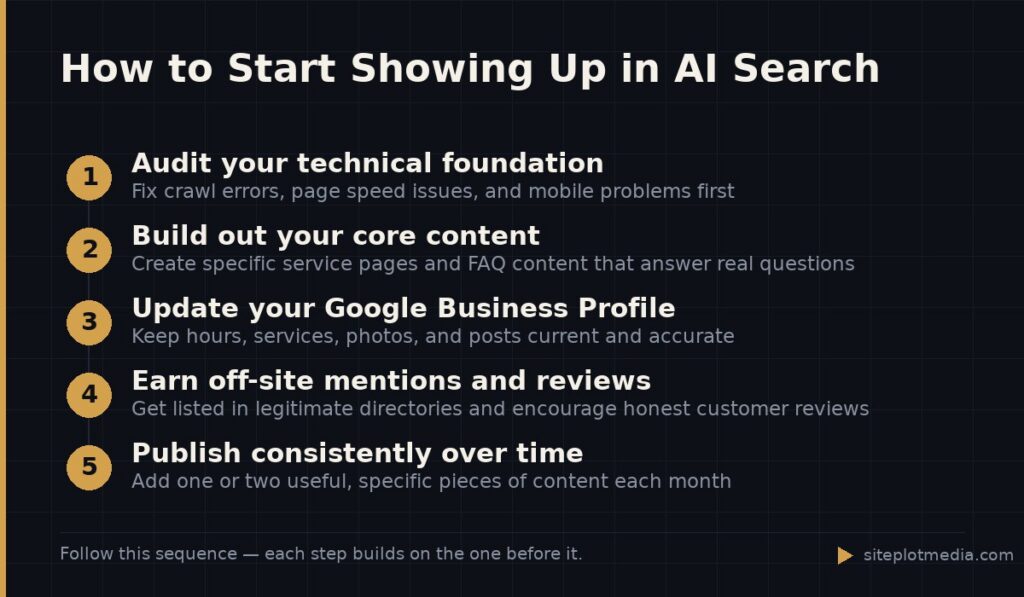
AI systems pull from the web, and the web is indexed by crawlers — primarily Google’s. If your site loads slowly, has broken pages, blocks crawlers in its settings, or is not mobile-friendly, you are likely underrepresented even before the question of content comes up. These are not new problems, but they are worth auditing now because the stakes have increased.
Structured data (sometimes called schema markup) is a layer of code you add to your website that helps search engines — and by extension, AI tools — understand what your content is about. For a local business, this means marking up your business name, address, phone number, hours, and service area in a standardized format. It does not guarantee visibility, but it removes ambiguity about who you are and what you do.
Your Google Business Profile also feeds into Google’s AI Overviews for local queries. Keeping it complete, accurate, and regularly updated with posts and photos is one of the lowest-cost things you can do to stay visible in local AI-assisted search.
Build credibility signals AI systems can verify
AI tools assess credibility partly the same way traditional SEO does: through links, mentions, and references from other respected sources. If local news outlets, industry directories, trade associations, or other businesses in complementary fields link to or mention your business, that is a signal that you are a real, established entity worth citing.
This is worth being honest about: link-building is slow work, and anyone promising you fast results should be questioned carefully. The practical approach for most small businesses is to focus on the assets you can build over time — getting listed in legitimate directories (not link farms), earning a mention in a local publication when you do something newsworthy, and building relationships with partners who might naturally reference you.
Reviews also matter, particularly for local AI search. Google’s AI Overviews for local queries often surface businesses with strong review profiles. Encouraging happy customers to leave honest reviews on Google — and responding to reviews you receive — is both good practice and a credibility signal these systems read.
What a realistic timeline and effort level look like
Showing up consistently in AI search results is not a one-week project. For most small businesses starting from a thin or outdated website, a realistic minimum runway is three to six months before you see meaningful traction — and that assumes you are publishing content regularly, not just doing a single audit and stopping.
That said, you do not need to do everything at once. A reasonable starting sequence looks like this: fix any obvious technical issues on your site first, then build out your core service and FAQ pages, then work on your off-site presence (reviews, directories, occasional press). Each step reinforces the next.
If you have the budget to work with a web and SEO team, look for one that can explain their strategy in plain language and is honest about what they can and cannot control. Siteplot Media, for example, structures its SEO foundation work as a $5,000 one-time build followed by $500/month ongoing support after a 90-day included period — but whether that or any other engagement is right for your business depends entirely on your current situation, your goals, and how competitive your market is. Plenty of businesses are better served by learning these fundamentals themselves and executing gradually.
The one thing most businesses skip that costs them the most
The most common mistake we see is treating a website as a finished product rather than a living document. A site built in 2019 with five pages and no updates since is effectively telling AI systems — and the people behind them — that this business is not actively engaged. AI tools favor sources that are current, specific, and clearly maintained.
Publishing even one or two genuinely useful pieces of content per month — a blog post that answers a common question, an updated service page, a new FAQ — keeps your site active and gives AI systems more material to draw from. This is not about volume for its own sake. One well-written, specific answer to a question your customers actually ask will outperform ten generic posts about “the importance of your industry.”
If you are not sure where to start, open ChatGPT or Perplexity right now and search for the service you provide in your city. Read the answers that come back. Ask yourself: is my business mentioned? Are the sources being cited ones I can learn from or compete with? That five-minute exercise will tell you more about your current AI search visibility than any tool on the market.
Frequently asked questions
Can I pay to get my business listed in ChatGPT answers?
No — there is currently no paid placement option inside ChatGPT's conversational answers. Visibility in AI-generated answers comes from having credible, well-structured content on the web that the AI's underlying systems can find and trust.
Does Google SEO still matter if people are using AI search instead?
Yes, traditional SEO remains foundational because most AI search tools still rely on Google's index to find and evaluate sources. Improving your Google rankings and improving your AI search visibility are largely the same work.
How long does it take to show up in AI search results?
For most small businesses starting from a thin or outdated website, expect three to six months of consistent effort before seeing meaningful results. There is no shortcut that reliably compresses that timeline without risk.
Does my Google Business Profile affect AI search results?
Yes, especially for local searches — Google's AI Overviews draw on Business Profile data for queries with local intent. Keeping your profile complete, accurate, and regularly updated is one of the highest-return low-cost actions you can take.
What kind of content does AI search favor?
AI search tools favor content that answers a specific question directly, is written in plain language, and comes from a site with at least some credibility signals like inbound links or established reviews. Generic or vague content is unlikely to be cited regardless of how much of it you publish.